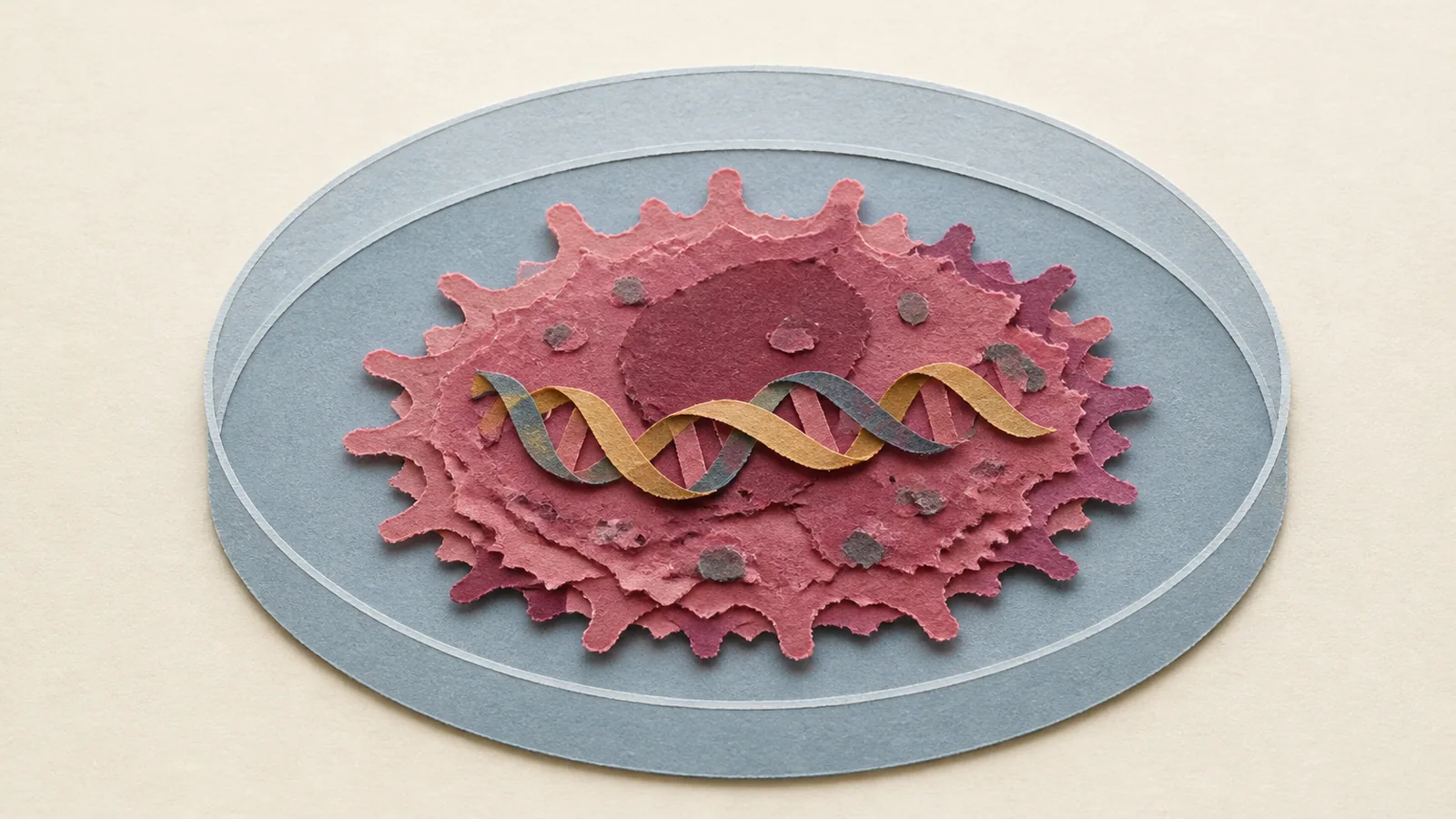
For years I filed lupus under “hormones, probably.” Nine women diagnosed for every man, and I assumed the reason lived somewhere in estrogen: the pregnant body learning to stand down, some hormonal story in that neighborhood. It turns out the lopsidedness may not be a hormone story at all. It may be written into the regulatory DNA of the immune cells themselves, in stretches of code that men and women carry in identical copy, and a team in Sydney just read it off more than a million of them.
Researchers at the Garvan Institute of Medical Research and UNSW Sydney have published a study in The American Journal of Human Genetics that did something nobody had tried at this scale: they read male and female immune systems one cell at a time. Using the OneK1K cohort of 982 healthy people, they sequenced more than 1.25 million peripheral blood mononuclear cells and sorted them into their major immune cell types. Then they went looking for the spots where the same gene gets turned up in one sex and down in the other. They found more than 1,000 of them.
Those switches have a clunky name, eQTLs, expression quantitative trait loci, but the idea underneath is simple and kind of wonderful. Think of each one as a volume knob: a spot in your DNA that decides how loudly a nearby gene gets played. What stopped me cold is where these particular knobs were sitting. Not on the X or the Y, where you would expect every male-female difference to hide. More than 1,000 of them sat on the autosomes, the ordinary chromosomes both sexes carry, letter for letter the same. So why would an identical stretch of DNA get turned up to a different volume depending on sex? That is the question the study chases, and it is a stranger, more foundational thing than “women have more estrogen.” The regulation itself is sexed, right down at the knob.
Follow which genes those knobs turn up in women and a pattern pours out. The female-biased genes cluster in inflammatory pathways, with heavy enrichment in TNF-alpha signaling, the same machinery that drives an immune system to attack. In male cells the busier genes were the quiet, vital ones: ribosomal work, protein synthesis, basic cellular housekeeping. Women in the cohort also carried more B cells and more regulatory T cells, with those inflammation pathways idling higher. Men carried more monocytes, their genetic effort pointed at upkeep rather than assault. Read it as something happening in a body and it turns almost tactile: the female immune system sits at a higher resting volume, ready to pour resources into a fight the second something shows up.
That higher resting volume is a gift and a tax at once. “While this highly reactive immune profile gives females an advantage in fighting viral infections, it comes with a biological trade-off,” co-senior author Dr. Sara Ballouz said of the work. The gift is the aggressive viral defense, in her own words. The tax arrives when that primed, attack-ready system loses the thread and turns on the body it was built to defend. Which is where lupus comes back in.
Systemic lupus erythematosus hits roughly nine women for every man, which works out to about 9 in 10 patients being women, one of the most lopsided sex ratios in medicine, and it has never had a clean genetic account of why. The Sydney team found two of their switches sitting right on lupus-associated genes. One variant turns up FCGR3A in natural killer cells; another turns up ITGB2 in monocytes, and both genes were already tied to SLE. In women, the female-biased setting plays them louder. This is not proof that these knobs cause lupus, and I want to be straight about that. What it is: the first time anyone has shown that the genetic control of known lupus genes is itself set differently by sex. “This is the first time we have shown that these differences occur at the genetic control level,” Ballouz said, not just in a blood count.
| Measure | Value |
|---|---|
| Count | 9 of 10 patients are women |
The default body in medical research has, for most of its history, been male, and the immune system got treated like a unisex appliance you could study in men and prescribe to everyone. This study is a receipt for how wrong that runs. “Our findings show that the immune system needs to be studied with sex in mind,” lead author Dr. Seyhan Yazar said, and her colleague Professor Joseph Powell drew the clinical line: “Treatments need to be tailored not just to the disease, but to how a patient’s immune system operates at a baseline genetic level.” Sit that next to a disease that is overwhelmingly a women’s disease, treated with drugs and doses worked out on a system that idles at a different volume, and the sex-blind approach stops looking like a footnote. It looks like a standing assumption nobody bothered to check.
I want to keep the excitement inside what the evidence can hold. This is a mapping study, an association between genetic switches and gene activity, drawn from blood cells in a single, largely older Australian cohort, and the specific variants will need replicating in other populations before anyone builds a drug around them. So it is not a cure. It is a map, and the map’s whole value is that it marks the ground medicine has been walking past: the places where a woman’s immune system runs on settings no male-default trial ever measured.
So here is what I am taking from it, and it is small and stubborn. The next time a doctor reaches for a standard immunosuppressant dose, or any drug that leans on the immune system, I am going to ask what sex the trial behind it actually enrolled. I would not have known to ask a week ago. I do now, and if an autoimmune diagnosis ever lands on me, I am not treating “this is the standard dose” as the end of the conversation.
Sources
- The American Journal of Human Genetics – Yazar, Ballouz, Powell et al., “The impact of sex on the immune system explored at the single-cell level” (2026)
- bioRxiv – preprint with the sex-specific eQTL, autosomal detail, and SLE variants (FCGR3A in NK cells, ITGB2 in monocytes)
- EurekAlert – Garvan/UNSW release with researcher quotes
- UNSW Newsroom – “Researchers uncover hidden sex differences in the human immune system”
- ScienceDaily – “More than 1,000 genetic switches reveal why female immunity is different”
- ScienceDirect – full-text mirror of the AJHG study