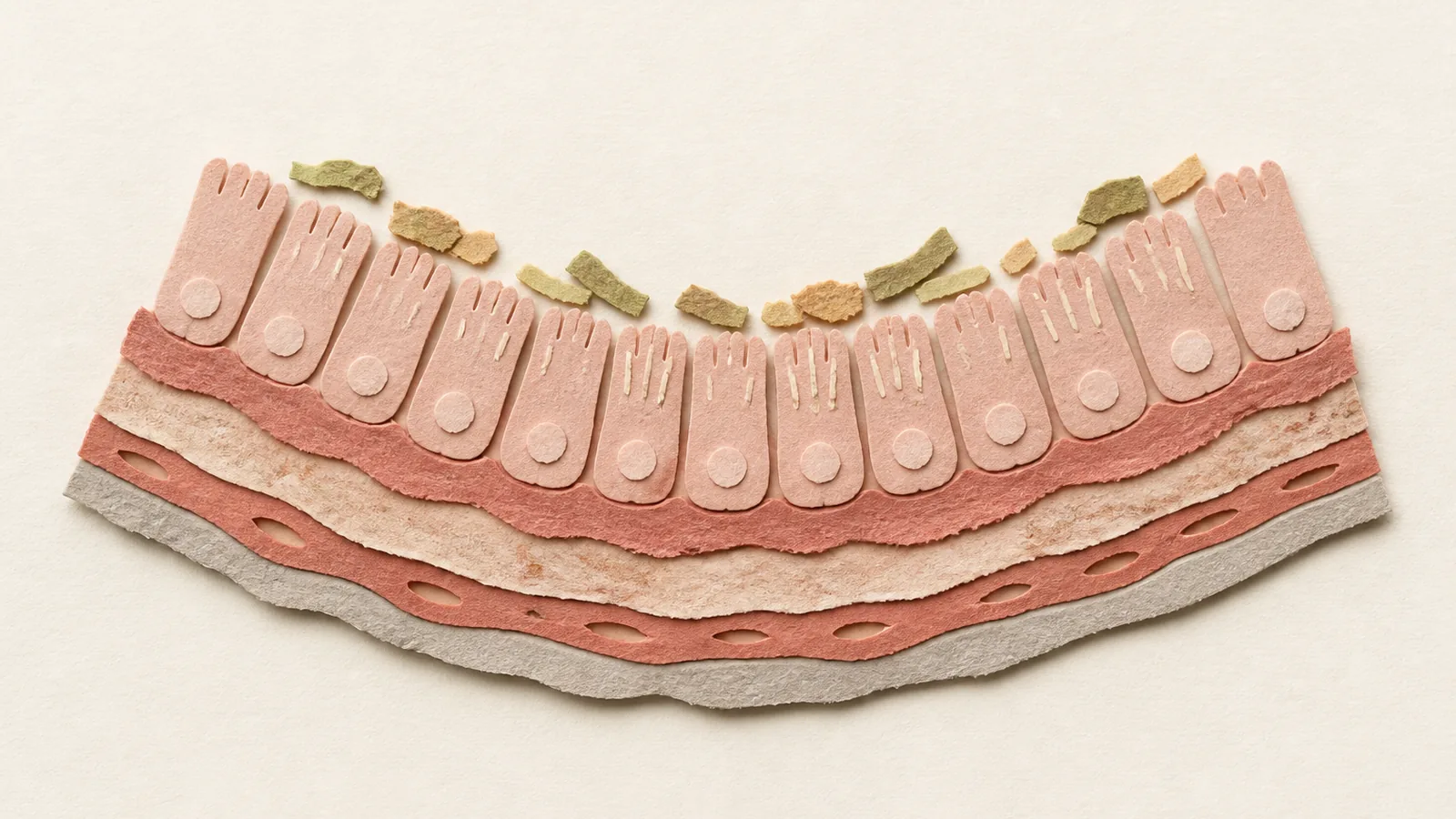
I always filed the lining of my gut under “disposable.” The cells that face the churn of everything you swallow get sloughed off and replaced every few days, a wall that rebuilds itself constantly precisely so it never has to remember anything. So when I read that a single microbial compound could leave a lasting mark on that wall, one that kept working long after the compound itself had washed out, I assumed somebody had over-read their data.
Then I read the data. Germ-free mice. A two-week afterglow. The wall itself doing the remembering.
A team at Northwestern’s Feinberg School of Medicine, led by Tianming Yu with senior author Yingzi Cong, reported in Nature Communications that butyrate, the short-chain fatty acid your gut bacteria make when they ferment dietary fiber, does something stranger than “calm inflammation.” It reprograms the intestinal lining so those cells keep encouraging an anti-inflammatory response after the butyrate is gone. In their mice, the protection lasted at least 2 weeks past the last dose. Fiber’s leftover molecule teaches the wall a habit and then leaves.
Then they ran the experiment that broke my mental model. This is not the microbiome story you have been sold a hundred times, the one where you feed the good bugs, the good bugs make good stuff, and everything downstream depends on keeping that bacterial garden alive. The Northwestern group ran the same protocol in germ-free mice, animals raised with no gut bacteria at all, and the durable effect still showed up. So the lasting part isn’t happening in the bacteria. It’s happening in you. Butyrate acts directly on your own epithelial cells and rewires how they behave.
So how does a wall that replaces itself every few days hold onto anything? That was the question I kept circling, and the answer is the good part. Butyrate lands on the intestinal epithelial cells and switches on an enzyme called Sat1, not briefly but in a way the cells keep carrying, an epigenetic change that outlives the signal that triggered it. Sat1 pumps out a metabolite with an unlovely name, N1-acetylspermidine. That metabolite pours out of the epithelium and nudges nearby CD4+ T-cells into making IL-10, the immune system’s main “stand down” signal. Fiber goes in, bacteria break it down to butyrate, butyrate flips a durable switch in the gut wall, and the wall starts quietly telling the immune cells next door to keep the peace. 2 weeks later, butyrate long cleared, the mice still ran high on IL-10, and when the researchers induced colitis they lost less weight and showed lower inflammatory markers than animals that never got it.
Yu frames the payoff as something that could reshape treatment: understanding how “diet, microbiota-derived metabolites and inflammation shape intestinal epithelial memory could open new directions for restoring intestinal immune tolerance in inflammatory bowel disease.” Intestinal epithelial memory. I love that phrase, because it inverts the assumption I walked in with. The disposable wall keeps a memory. Not the neurons, not the immune system’s dedicated memory cells, the humble lining you never think about.
Now I put my enthusiasm on a leash, because this is about to get run through the supplement grinder. It is a mouse-and-cell study. The whole chain, butyrate to Sat1 to N1-acetylspermidine to IL-10, was mapped in mice and cultured cells, and Yu is explicit that the next job is testing whether the same pathway is even active in human intestinal cells. It has not been tested in a single person.
And the capsule shortcut is not the same experiment. As Yu’s own team notes, a large proportion of butyrate in the gut is rapidly absorbed and metabolized by the epithelial cells themselves, which limits how much free butyrate reaches the immune cells underneath. Your own bacteria making it in place, continuously, from fiber you actually ate is a different proposition than swallowing a bottle. The study is a mechanism, not a product.
What it does earn is a serious look at the boring intervention. Roughly 3 million American adults live with inflammatory bowel disease, and the dominant tools are drugs that suppress inflammation from the top down, immunosuppressants and biologics with real costs and real side effects. A pathway that instead coaxes the gut’s own lining into sustained tolerance, and that starts with something as cheap and unpatentable as fiber, is exactly the kind of lead the drug-first reflex tends to under-fund. Worth noticing that this work leaned on federal NIH grants rather than a pharma sponsor. There is no blockbuster molecule to protect at the end of a fiber-and-butyrate story, which may be exactly why it took this long to chase.
The question I actually care about is the flip side of memory. If butyrate can write a durable pro-tolerance state into the gut wall, what does a long fiber-starved diet write instead, and how long does that stick? Nobody has that answer yet.
Me, I’m not buying the capsules. I’m going to keep feeding the bugs that make the real thing: the beans, the oats, the fiber my gut bacteria actually ferment into butyrate on-site and continuously, instead of a pill my epithelium burns for fuel before it does any of this work. If the pathway holds up in people, the cheapest thing on the plate was doing quiet, lasting work the whole time.
Sources
- Nature Communications – Yu et al., “Butyrate epigenetically licenses sustained epithelial–T cell crosstalk for intestinal immune tolerance” (2026)
- Northwestern Medicine (Feinberg) – “Gut Bacteria Leave Intestinal ‘Memory,’ Protecting Against Inflammation” (2026)
- ScienceDaily – “Scientists discover how gut bacteria ‘train’ the intestine to fight inflammation” (2026)
- MedicalXpress – “Gut bacteria leave intestinal ‘memory,’ protecting against inflammation” (2026)
- CDC MMWR – “Prevalence of Inflammatory Bowel Disease Among Adults Aged ≥18 Years, United States, 2015” (2016)