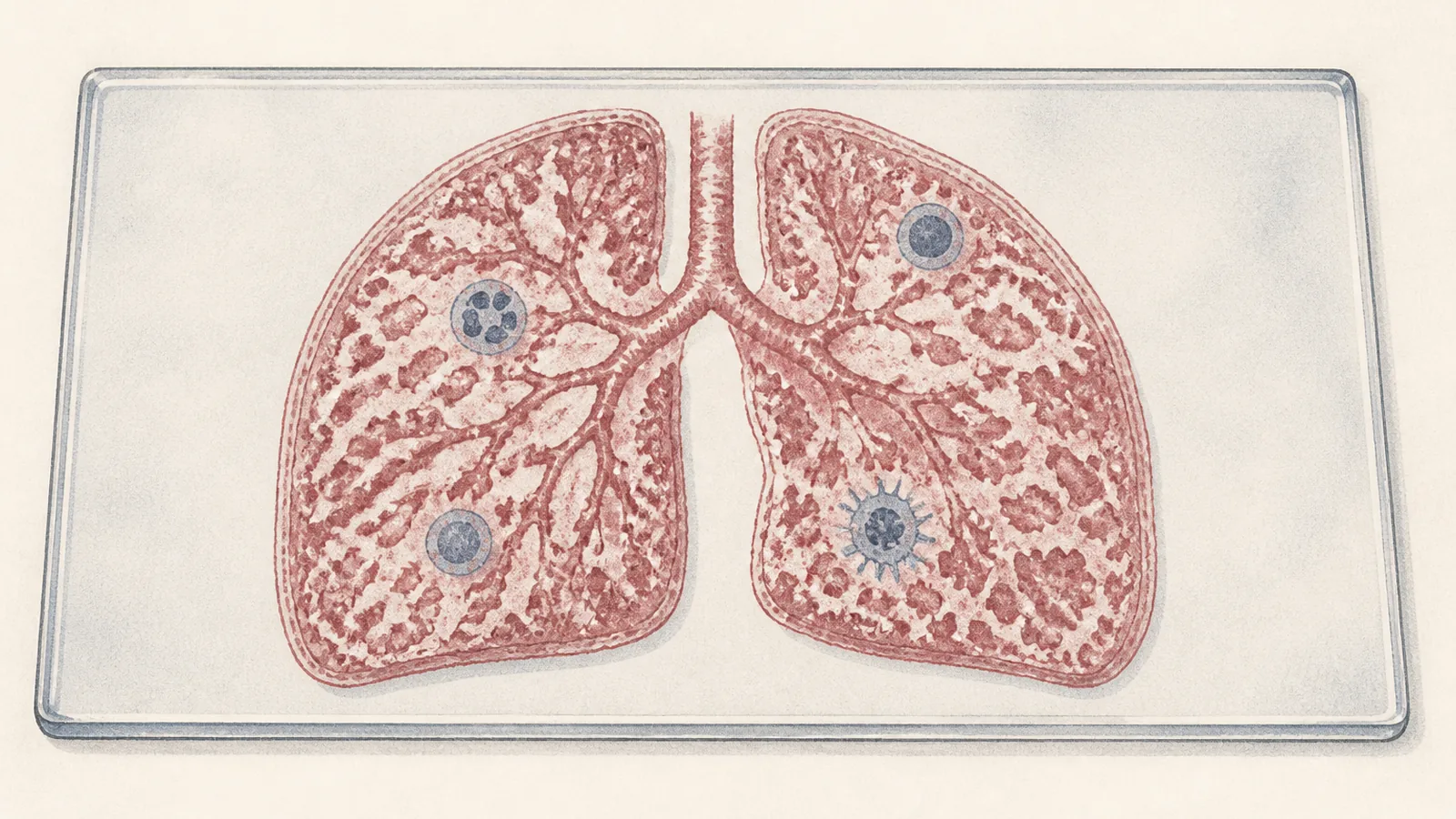
I always figured that if a disease was written into your genes, the way you caught it in the act was to draw a little blood. Pull the tube, look at the cells floating in your arm, watch the risky gene do its thing. So it genuinely rearranged something in my head to learn that for the autoimmune diseases that grind down joints and scar lungs, staring at the blood was staring into the wrong room. The variant was there the whole time. It just wasn’t switched on.
The human lung immune-cell atlas that a team at the La Jolla Institute for Immunology just published went looking in the tissue instead, and found roughly 1,000 genes whose activity is shaped by autoimmune-risk variants only in the immune cells lodged in lung tissue. In an ordinary blood draw, those same regulatory effects are largely missed. The commentary that ran beside it in Nature Immunology wears the whole thesis as its title: where risk resides.
For about twenty years, genome-wide association studies have handed us thousands of DNA risk variants for autoimmune disease, most of them sitting out in the noncoding stretches of the genome that build no protein. A variant would turn up statistically chained to lupus or rheumatoid arthritis, researchers would pull immune cells from blood to watch it work, and the switch would sit there dark. Loud in the statistics, mute in the cell.
Here is what the La Jolla team did differently, and it is almost embarrassing in hindsight: they stopped interrogating blood and went into the tissue. Using healthy scraps of lung removed from 128 patients during cancer surgery, they profiled more than 1.1 million immune cells, then asked, cell type by cell type, which genes each person’s variants were turning up or down. Out came those roughly 1,000 genes whose expression is governed by genetic risk variants only in tissue-resident immune cells. “This is a foundational paper for any researcher asking whether genetics has a role in an autoimmune disease,” says senior author Pandurangan Vijayanand. His colleague Benjamin Schmiedel put the scale plainly: “No study has produced and analyzed a dataset at this scale and resolution before.”
So why would a risk gene stay silent in a blood cell and start shouting in a lung cell carrying the same DNA? This is where I had to stop and reread it twice. A circulating T cell and a lung-resident T cell are not the same cell wearing two badges. When an immune cell leaves the bloodstream and settles into a tissue, the tissue reprograms it: different genes come online, different regulatory switches get wired up and made live. A risk variant is often just a tiny tweak to one of those switches. If the switch only gets powered on once the cell has moved in and put down roots, then a blood draw will never catch the variant in the act, because in blood the switch was never plugged in. The genetics were there all along. We were reading them in a cell that had the relevant circuitry unplugged.
The atlas is more than a headcount of genes. Some of the risk genes lit up across several autoimmune diseases at once, both the body-wide kind like lupus and the organ-restricted kind, which hints at shared wiring beneath conditions we file away in separate clinics. And 1,700 genes showed sex-based differences in expression, a hefty number for a family of diseases that fall disproportionately on women and that medicine has spent decades under-explaining.
What convinced me this isn’t a one-organ fluke is that the gut told the same story on its own. A separate 2026 effort out of the Wellcome Sanger Institute, nicknamed IBDverse, mapped 2.2 million single cells from the intestines and blood of more than 400 people, 125 of them with Crohn’s disease. When the team resolved the genetics down to individual cell types instead of bulk tissue, they could finally pin a likely causal gene to more than half of the known inflammatory-bowel-disease risk regions: the dendritic cells with their damped Notch signaling, the epithelial cells with their scrambled Wnt genes. Look at the whole organ, or worse at the blood, and that signal washes out. Zoom to the cell that actually patrols the gut lining, and it snaps into focus.
Now for the receipts, because a map this sharp is never built for curiosity alone. These tissue atlases are, quite openly, drug-target engines. The gut atlas was produced through Open Targets, the Sanger Institute’s partnership with the pharmaceutical industry, and an earlier single-cell eQTL atlas of autoimmune genes was built expressly to identify “novel drug classes for treatment.” The lung work leans mostly on public money, five separate NIH grants, but its funders also include the drugmaker Kyowa Kirin. None of that makes the biology wrong. It does mean the same maps that might finally explain where autoimmune disease begins are being quarried, in real time, for the products those explanations will one day be sold as, much of it on the public’s dime.
And a fair caution: colocalization is a powerful clue, not a verdict. Showing that a variant controls a gene in the exact cell type where disease risk concentrates is the strongest circumstantial case immunology can build right now, but it still says these tissue-resident cells may drive disease, not that the case is closed. The question I actually want answered is whether silencing one of these tissue-only switches quiets the disease, or just quiets the gene.
Here is where it lands for me. If a doctor ever waves off my aching joints or my breathing because the bloodwork came back clean, I’m going to remember that blood was never where these answers lived. I wouldn’t treat a normal panel as the end of the conversation. I’d push to know what the tissue is doing, and I would not wait for a guideline to catch up before I asked.
Sources
- Nature Immunology – Schmiedel et al., human lung immune-cell atlas (2026)
- Nature Immunology – News & Views, “Where risk resides” (2026)
- La Jolla Institute for Immunology – “Immune cells in human lung tissue may drive the development of autoimmune disease” (press release, 2026)
- Nature – “IBDverse,” cell-type-resolved genetic variation and inflammatory bowel disease risk (2026)
- Medical Xpress – “2.2 million-cell atlas reveals how genes drive inflammatory bowel disease risk”
- Cell Genomics – “An atlas of single-cell eQTLs dissects autoimmune disease genes and identifies novel drug classes for treatment”