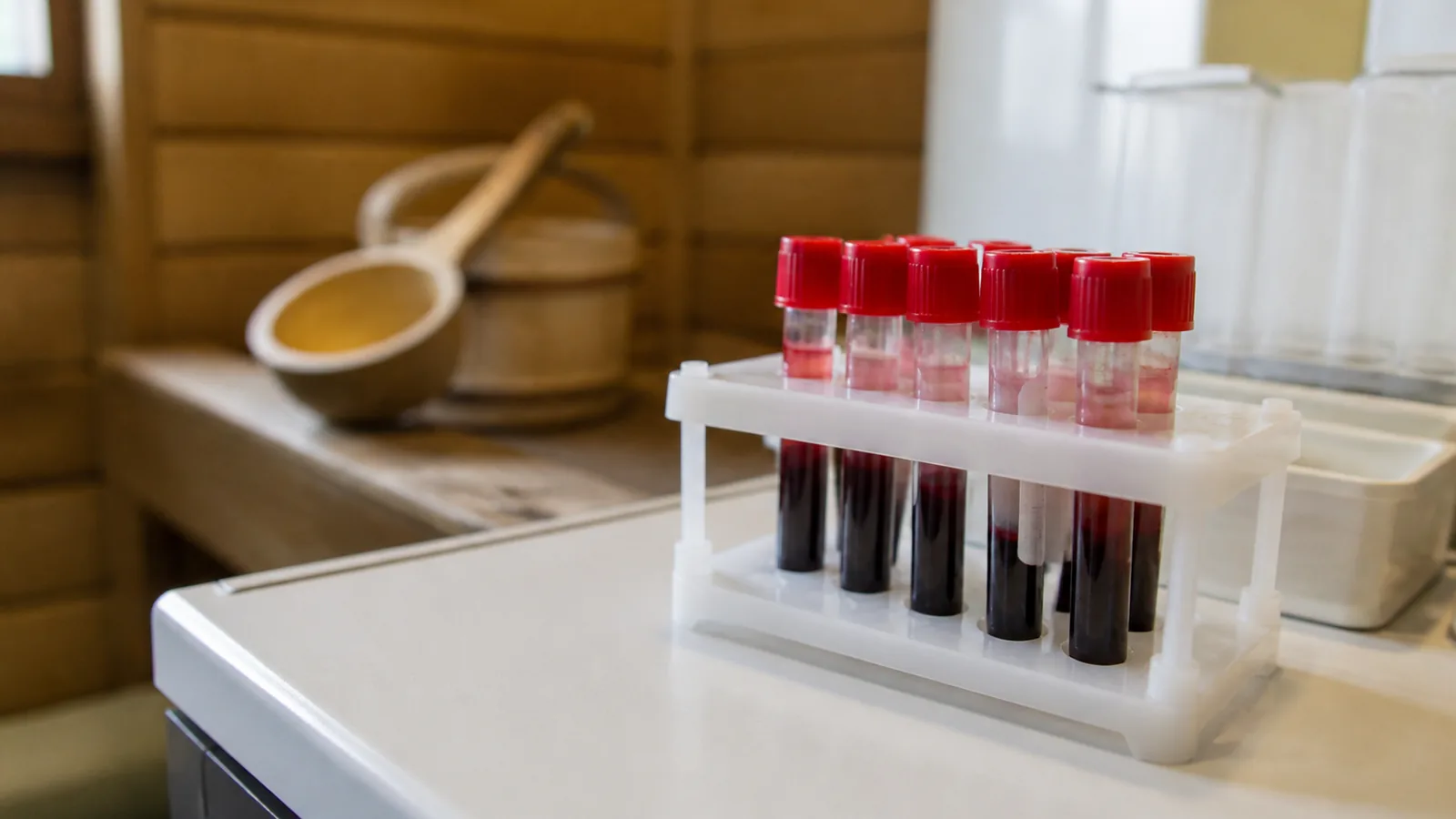
For years I’d filed “the sauna boosts your immune system” in the same mental drawer as “eat more garlic the second you feel a cold coming on”: probably harmless, probably a little true, wildly oversold on a thousand wellness blogs. Then a Finnish team drew blood from people mid-sweat, and the numbers made me reopen the drawer. Every kind of white blood cell surged into the bloodstream. And the immune system’s chemical alarm, the signaling it uses to actually mount a defense, mostly never rang. Half an hour later the surge was gone.
On March 31, 2026, researchers at the University of Eastern Finland and the University of Turku reported in the journal Temperature that a single 30-minute sauna session sets off a measurable surge of immune cells. They put 51 adults (27 women, 24 men, average age 50) through half an hour at 73°C, about 163°F, with a cold shower at the midpoint and roughly two cups of water, a physician watching the whole time, and drew blood before and after.
And every type of white blood cell climbed. Neutrophils and lymphocytes, the front-line infantry your body throws at invaders, jumped right away. The mixed pool of monocytes, eosinophils and basophils climbed too, and was still elevated at the 30-minute mark. On paper, this is the “immune boost” the wellness copy has promised you for a decade.
But then the twist that made me lean all the way in. Within about 30 minutes of stepping out of the heat, the neutrophils and lymphocytes were right back where they started. And the cytokines, the chemical messengers that coordinate a real immune response, barely moved. Of 37 signaling molecules the team measured, only 2 dropped significantly, and the one that trended up (MMP-2) never crossed into statistical significance. The paper’s own title says the quiet part out loud: sauna heat induces “stronger immune cell than cytokine responses.” The cells poured out. The alarm bells stayed mostly silent.
| Measure | Value |
|---|---|
| Count | 2 of 37 cytokines that moved |
So my biology brain woke up and asked the obvious question: if the immune system isn’t sounding the alarm, why are all these cells suddenly out on patrol? A surge that appears in minutes and vanishes in minutes can’t be your bone marrow building new armies of cells. That takes days. This is something older and simpler. At any given moment a big share of your white blood cells aren’t drifting freely in the blood at all; they’re stuck along the walls of your vessels or parked in tissue reservoirs around the body. Heat, a pounding heart, and a jolt of stress hormones shear them loose all at once, and they wash into the circulating pool where a blood draw can count them. Lead author Ilkka Heinonen described it in almost those terms: sauna bathing “mobilises additional white blood cells into the bloodstream from tissues, where they are then redeposited after the session.”
Which means the sauna surge is, mechanically, close to the flush you get from a hard sprint or a bad scare. The cells were always yours. The heat called them off the bench for half an hour, then sent them back.
So is it a “boost”? That word is doing a lot of lifting it hasn’t earned. Nothing here shows anyone fought off an infection better, or made a single new cell, or built any lasting defense. The cells left storage, took a lap, and went home before the participant had toweled off. What I do appreciate: the work was funded by the Research Council of Finland, a government body, not a supplement brand or an infrared-cabin company with product to move. The receipts are clean. But clean receipts on a 30-minute mobilization still add up to a mechanism, not an outcome.
Where it gets more interesting is that the same Finnish sauna-research world has been playing a much longer game. A long-running Kuopio cohort followed 1,935 men for a median of 25 years and found that men who used the sauna 4 or more times a week had a 41 percent lower risk of respiratory disease than men who went once a week or less. That’s observational, and confounded in the obvious way: people who sauna 4 times a week may simply be healthier to begin with. So I hold it loosely. Whether the acute flush has anything to do with that long-term signal is a hypothesis, not a finding. But it’s a tempting one: send your immune cells out to patrol often enough, over decades, and maybe the surveillance starts to pay off. Maybe.
Now the honest counterweights, because heat doesn’t fix everything. A randomized cross-over trial found that a single sauna session did nothing for postprandial blood glucose in people with type 2 diabetes. Heat is not a metabolic cure. And the type of heat matters more than the wellness market admits: one NIH-funded study found that a far-infrared sauna raised muscle temperature without budging core (intestinal) temperature. The demargination flush leans on your core heating up and your heart rate climbing, so a gentle infrared cabin that leaves your core cool may not produce the same surge. A traditional 73°C Finnish sauna plainly does.
A few things this study genuinely cannot tell you, and they matter. The team lumped monocytes, eosinophils and basophils into one bucket rather than counting them separately, and didn’t measure natural killer cells or specific T-cell subsets at all. They used an ear thermometer as a stand-in for core temperature. And the participants were Finnish adults already carrying cardiovascular risk factors, so this isn’t a clean read on a healthy 25-year-old. Where all those mobilized cells actually went, and whether they did anything useful once they got there, nobody yet knows.
This is my conclusion. I’ll keep taking the sauna, and I’ll keep loving it. But I’ve stopped telling myself the 30-minute session is charging up my immune system, because the neutrophil and lymphocyte count is back to baseline before I’ve dried off. My real reasons are the ones the evidence supports: the decades of cohort data pointing at fewer respiratory illnesses, and, frankly, how good I feel afterward. I won’t reach for it as a cold remedy, and if I ran a wellness blog I’d retire “immune boost” from the headline for good. The flush is lovely. What I won’t do is keep calling it a boost.
Sources
- Temperature – Heinonen et al., “Acute Finnish sauna heat exposure induces stronger immune cell than cytokine responses” (2026)
- EurekAlert – “Sauna bathing may boost immune responses,” University of Eastern Finland release with author quotes (2026)
- StudyFinds – coverage detailing the 37 signaling molecules and cell-group results
- ScienceDaily – “A single sauna session sends immune cells surging” (2026)
- European Journal of Epidemiology – Kunutsor, Laukkanen & Laukkanen, “Sauna bathing reduces the risk of respiratory diseases: a long-term prospective cohort study” (2017)
- Experimental and Clinical Endocrinology & Diabetes – single sauna session and postprandial glucose in type 2 diabetes, randomized cross-over trial (2024)
- Journal of Applied Physiology – far-infrared sauna raises muscle temperature without changing intestinal temperature (2025)