For years I treated the sauna like a tune-up for my immune system, some vague notion that the heat was sweating out trouble and flipping a switch somewhere useful. So a headline promising that a single session “sends immune cells surging” should have felt like vindication. Instead it made me put my coffee down. The surge Finnish researchers actually measured is close to the opposite of the story I had been telling myself: the heat did not appear to be building anything up. It briefly moved cells around, and how hot each person got barely predicted the move at all.
Here is what happened in the room. A team led by Jari Laukkanen at the University of Eastern Finland, with Ilkka Heinonen at the University of Turku, sat 51 adults with an average age of 50 in a traditional Finnish sauna for 30 minutes at 73°C, with a brief cold shower at the halfway mark and about two cups of water to drink. Then they drew blood and counted. Every class of white blood cell in circulation went up right away: neutrophils, lymphocytes, and the cluster of monocytes, eosinophils, and basophils the lab groups together as MXD cells. The work, funded by the Research Council of Finland, ran in the journal Temperature.
So far, so “boost.” But the number that stopped me was how fast it unwound. The neutrophils and lymphocytes dropped back to baseline within about 30 minutes of stepping out, while only the slower MXD group was still elevated at the half-hour mark. This was not a system building anything. It was a system moving cells around and then putting most of them back.
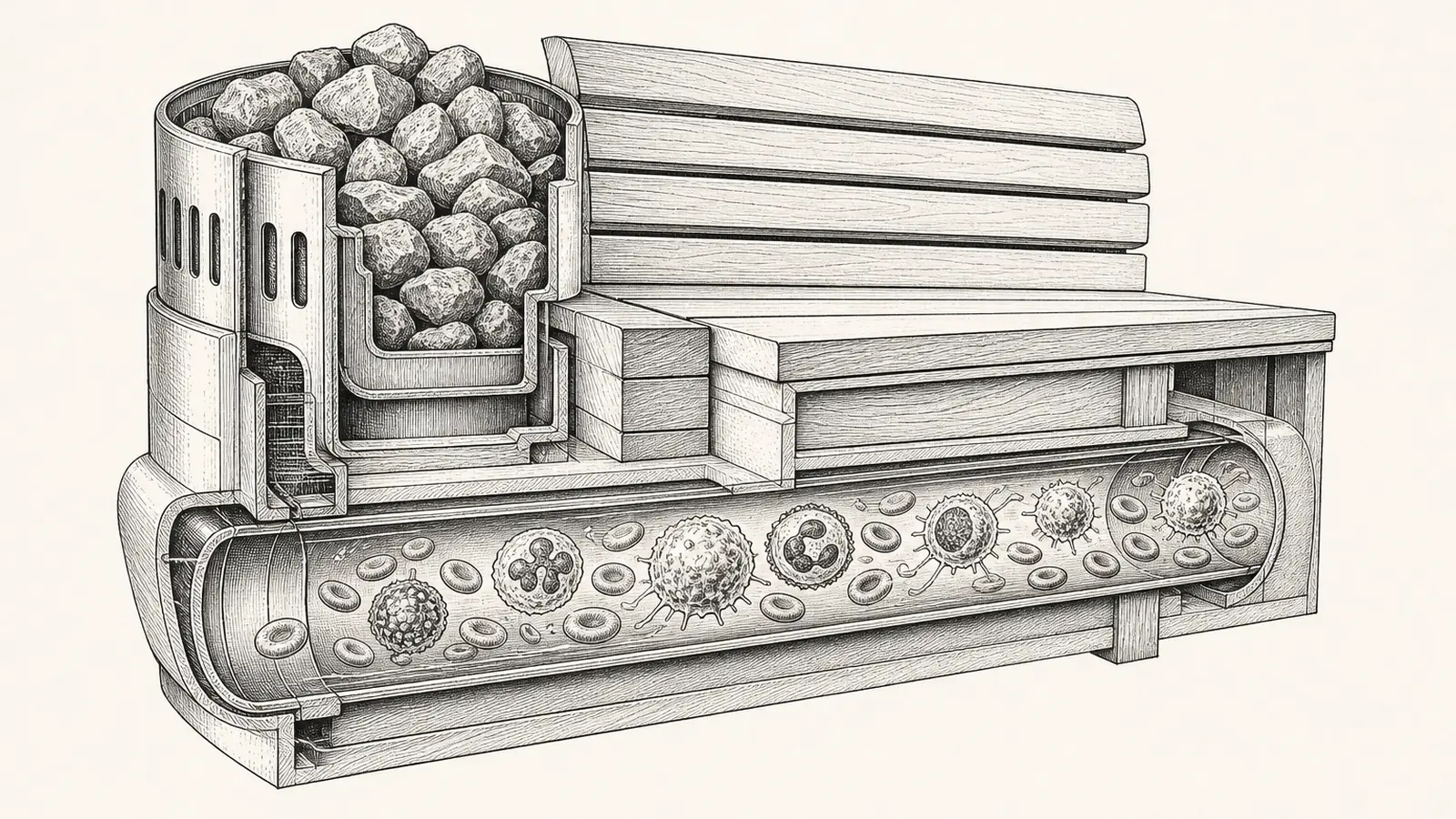
That is the word the researchers keep reaching for, and it matters: mobilization. The cells did not get manufactured in a hot rush. A big fraction of your white blood cells sit parked in the tissues and along the vessel walls at any given moment, and the sauna shook them loose into the flowing bloodstream where a blood draw can finally see them, and then they drifted back to their posts. Think of it less as recruiting new soldiers and more as sending the ones already on base out to patrol for half an hour.
If the sauna were genuinely ramping up an immune response, you would expect the chemical messengers to light up too, and this is where it gets strange. The team measured 37 immune-signaling molecules, the cytokines that actually coordinate an immune reaction, and the average levels barely moved. Just 2 of the 37 changed significantly, and both went down. The alarm system did not so much sound as sink a little quieter.
Wait, why would the cells pour into the blood while the signals that are supposed to summon them stay flat? That is the question that flips this from a wellness headline into something worth chasing, and the answer buries the intuitive version even deeper. When the researchers checked whether the cell surge tracked how much each person’s body temperature rose, roughly 2°C on average, they found essentially no relationship. The cytokines were the opposite. Where anything lined up with the temperature climb, it was the chemical signals doing the lining up, dozens of small correlations, while the big splashy cell response ignored the heat entirely. So the temperature drove a faint chemical flicker and had almost nothing to do with the thing everyone points to in the headline. I did not see that coming, and reading between the lines of their own careful framing, neither did the authors.
Let me be honest about the spin, because “surging immune cells” is carrying most of the coverage. The data underneath say something smaller. A transient reshuffle of cells that reverses in half an hour, with two cytokines nudged downward and no link to how hot you got, is not a stronger immune system. The study cannot tell you where those cells came from, what they did while they were out, or whether any of it makes you more resistant to one real-world infection. Mobilization might be an ingredient in “enhanced immune surveillance,” but that phrase is a bet on a mechanism, not a demonstrated benefit. The press-release voice and the data voice are not saying the same thing.
None of this means the sauna is idle, and I did not want to lose that in the skepticism. Laukkanen is not a random lab that wandered into sauna research. His group ran the long Finnish cohort that made sauna respectable in the first place. In a prospective study of 2,315 middle-aged men published in JAMA Internal Medicine, men who used the sauna four to seven times a week had roughly half the rate of fatal cardiovascular events of once-a-week users, and a lower risk of dying from any cause, in a graded dose-response gradient that held after adjustment. That signal is the backdrop that makes this immune-cell work worth doing. The mobilization study is a hunt for the how underneath that epidemiology, and it just has not found it yet. One blood draw’s worth of reshuffled cells is not the bridge from “sitting in heat” to “living longer.”
The rest of the sauna literature keeps handing over the same humbling lesson: one session moves less than the hype wants. In a randomized crossover trial in people with type 2 diabetes, a single sauna session did nothing measurable for post-meal blood glucose. And when a separate group tracked temperature during an infrared sauna, they found muscle temperature climbed while core intestinal temperature barely moved, a reminder that “sauna heat” is far more local and uneven than the whole-body language pretends. The physiology is quieter and more particular than the marketing.
The tidy version, heat goes up so immunity goes up, fell apart the second someone measured both ends of it at once. The cells and the temperature went their separate ways, and the cytokines mostly shrugged. That is not a letdown. That is the sauna being genuinely stranger than the wellness copy, and I would take the strange true thing over the flattering one every time.
So this is my conclusion, coffee back in hand. I am still going to sit in the sauna, because a cardiovascular signal earned over a 20-year cohort is a reason I trust, and because I like how I feel when I climb out. But I am not going to sit there picturing my white blood cells arming up for flu season, and I am not going to tell my sister the heat is boosting her immunity. This study is the reason I now know it is not that simple, and knowing the quieter truth has not cost me the sauna. It just cost me the story I used to tell about it.
Sources
- Temperature – Laukkanen, Heinonen et al., “Acute Finnish sauna heat exposure induces stronger immune cell than cytokine responses” (2026)
- ScienceDaily – “A single sauna session sends immune cells surging” (2026)
- StudyFinds – analysis of the sauna immune-cell study, protocol and cytokine details (2026)
- JAMA Internal Medicine / ACC Journal Scan – Laukkanen et al., sauna frequency and cardiovascular and all-cause mortality (2015)
- Experimental and Clinical Endocrinology & Diabetes – single sauna session and postprandial glucose in type 2 diabetes, randomized crossover trial (2024)
- Journal of Applied Physiology – muscle vs. intestinal temperature during far-infrared sauna (2025)