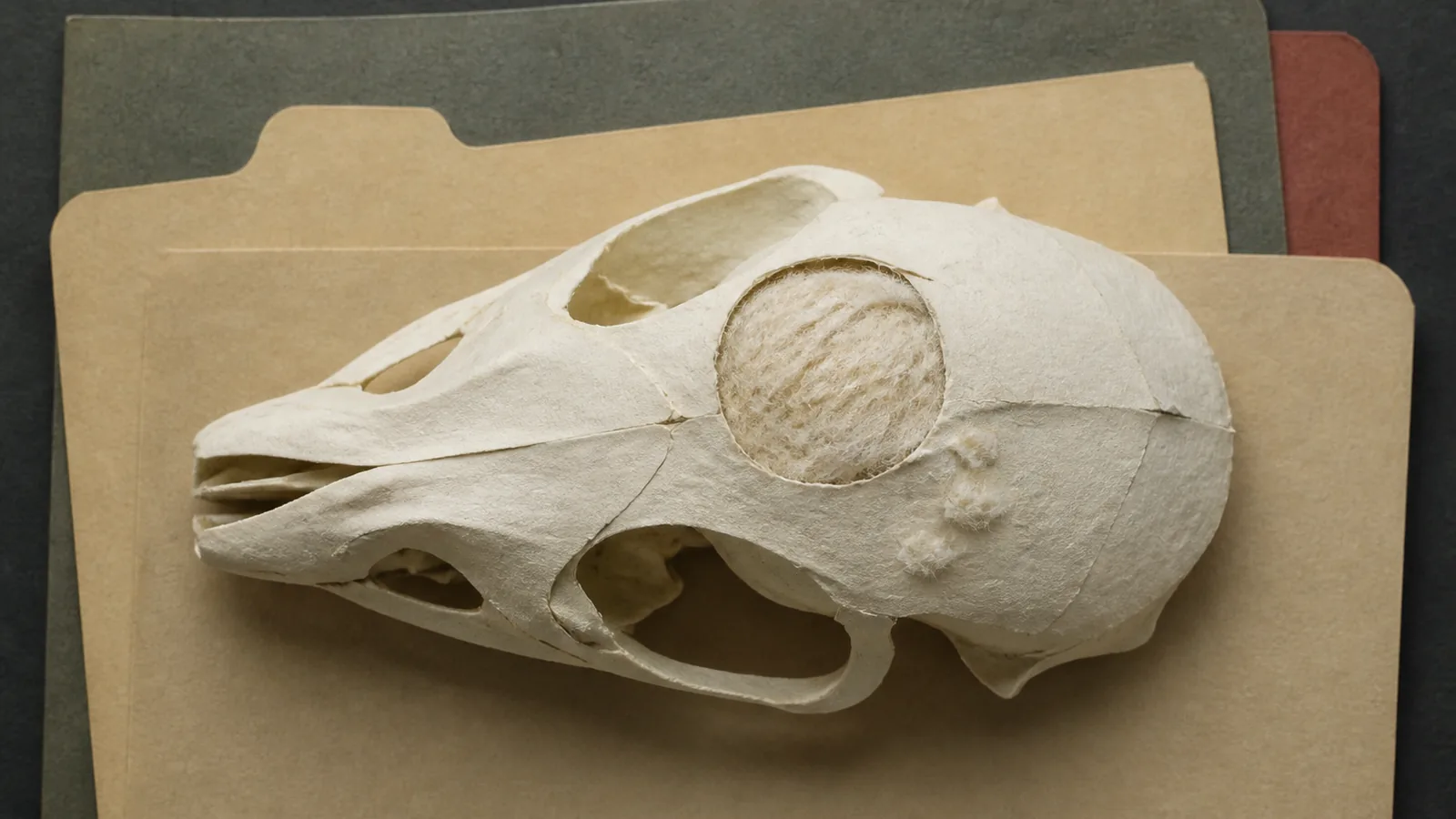
Dr. Sherif Elsharkawy has a word for what his lab did to a sheep’s fleece, and the word is milestone. The academic clinical lecturer at King’s College London’s Faculty of Dentistry told the university’s press office that his team’s wool-derived membrane, tested in the skulls of rats, “positions keratin as a potential new class of regenerative biomaterial that could challenge the long-standing reliance on collagen.” From a research perspective, he said, this is a major milestone. By this week the claim had traveled the usual circuit, landing on ScienceDaily under a headline announcing that scientists had turned wool into a material that helps regrow bone.
The wool won on organization. It did not win on the metric that fills the defect.
It is a good story, and most of it is true. It is also a story in which the wool lost. Run head to head against collagen in the same rats, the collagen membranes grew more bone overall. Keratin’s edge was architectural: straighter, better-aligned fibers, a structure that more closely resembled healthy bone. Collagen’s edge was volume, which is the thing a surgeon packing a hole in a skull actually needs. The wool won on organization. It did not win on the metric that fills the defect.
Strip the milestone back to what the team ran and it is the standard two-stage gauntlet every biomaterial has to clear. First the dish: human bone cells were seeded onto the keratin membrane, where they grew and switched on the markers of osteogenic differentiation, the biological throat-clearing that precedes any actual bone. Then the animal. The group cut critical-size defects into rat skulls, holes engineered too large to close on their own, implanted the membranes, and watched over the following weeks. The work ran in the journal Biomaterials Advances. The bone came back, integrated with the surrounding tissue, and held stable through healing, growing in with fibers better aligned and more organized than the tissue collagen produced. Collagen has anchored guided-bone-regeneration products for decades. Beating it on architecture is a genuine and interesting result.
Which is where the framing gets ahead of the record. “Could challenge the long-standing reliance on collagen” is a sentence about the future carrying a lot of weight on behalf of a result where the challenger lost the head-to-head on quantity. The actual milestone is narrower and still worth having: wool keratin cleared a rat skull at all. How many rat skulls, the announcement does not say. Nor does it name a funding source or a competing-interest statement, the two lines a reader is entitled to before deciding how hard to lean on a preclinical readout. The cited evidence stops at human cells in a dish and protein in a rodent. No one has put the material in a person.
None of which is unusual, and that is rather the point. This is a small-animal proof of concept, the kind that fills materials-science journals every month and clears its endpoints honestly. What travels is not the study. What travels is the framing, and the framing skipped several rungs: from a rat calvarial model to “could replace collagen,” from a dentistry press office to a wire feed, with no human trial, no comparative device study, and no disclosed sample size in between.
Give the underlying idea its due, because it is the sound part. Wool is an agricultural byproduct the farming industry often pays to discard, and turning a cheap, renewable, absurdly abundant fiber into a surgical membrane is exactly the sort of scrappy, unglamorous materials work that deserves more attention than it usually gets. Collagen scaffolds are typically sourced from cattle and pigs, with the cost and supply constraints that implies. A protein you can shear off a hillside every spring is a real argument about sustainability and supply.
It is not yet an argument about a patient. Between a rat’s skull and a human jaw sit dose, geometry, immune response, degradation timing, and the small matter of a controlled trial, and every one of those has ended promising biomaterials before. Elsharkawy told the press office the work is “much more than an early materials concept.” Read as written, the record says it is a well-run early materials concept that grew less bone than the material it hopes to unseat, in an unstated number of rats, funded by someone the announcement declines to name.
Sources
- King’s College London – Scientists turn wool into sustainable material for bone repair (Elsharkawy quotes and the keratin-vs-collagen comparison)
- ScienceDaily – Scientists turn sheep’s wool into a material that helps regrow bone (2026-08-12)
- PubMed – Bone regeneration of rat calvarial defect using biomimetic keratin-based membranes
- Biomaterials Advances (ScienceDirect) – full study record
- MedicalXpress – Scientists transform wool into bone repair material (earlier announcement)