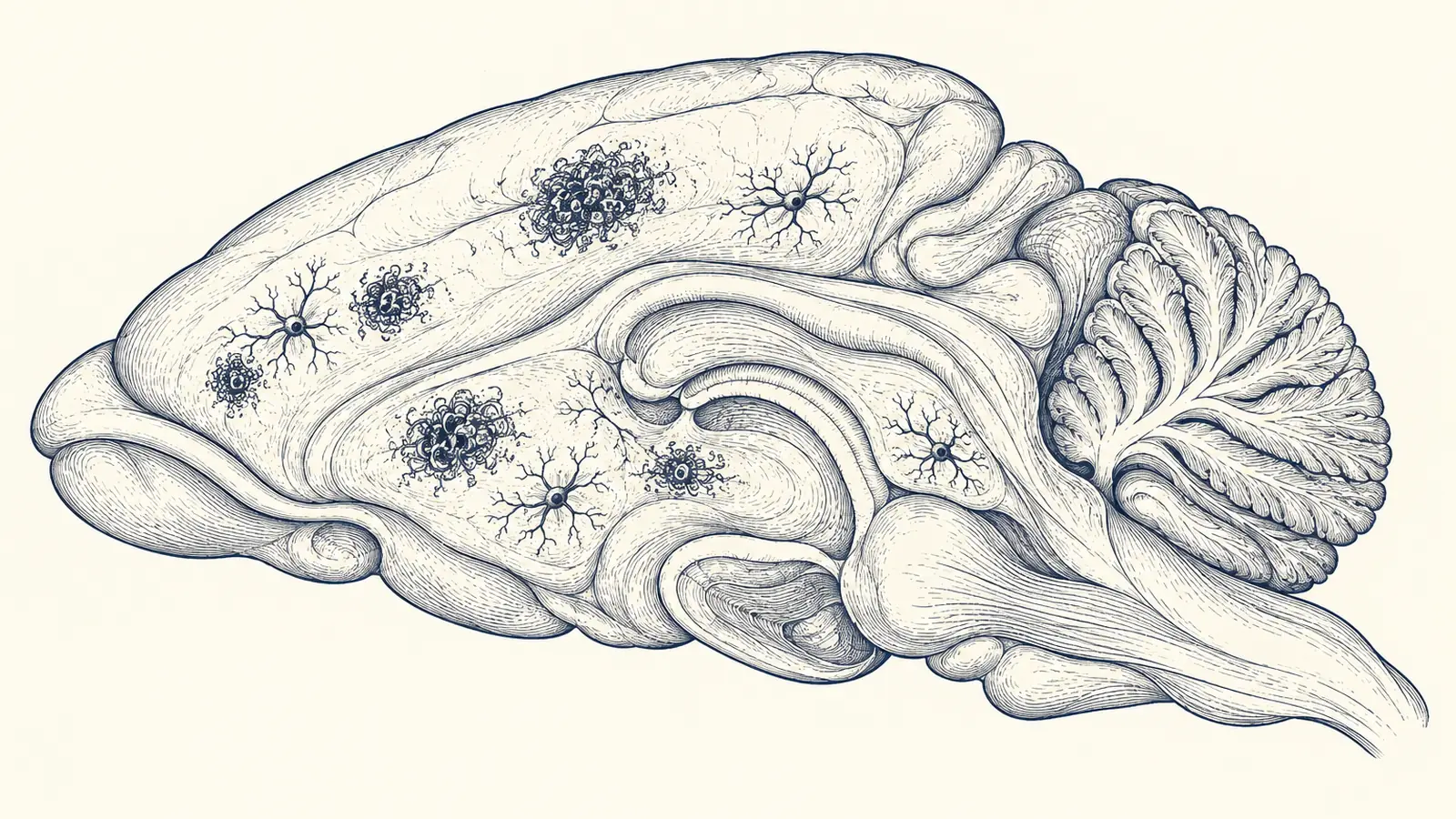
I went into this paper assuming what I suspect most people assume: that the wrecked sleep of Alzheimer’s is collateral damage from a brain clogging up with plaque, so more gunk means worse nights. A University of Kentucky mouse study broke that picture with one experiment. When the researchers cleared out most of the brain’s resident immune cells, the microglia, mice bred to build amyloid plaques got back more than two hours of sleep a day, and their plaque burden didn’t budge.
as if the microglia are partying all night, and keeping the brain awake.
The paper, Constantino et al., Alzheimer’s & Dementia (2026), came out in June and is circulating again under a “mind-blowing” breakthrough headline, a phrase senior author Shannon Macauley used herself in the university’s release. Its argument is that sleep loss in these mice runs through the immune response to plaque, not through how much plaque there is.
The curve that refused to bend
Nicholas Constantino, the first author, and Macauley recorded brain waves and muscle tone in female APP/PS1 mice, a standard amyloid strain, alongside normal littermates. At 6 months, when plaques are only starting to appear, the amyloid mice were already getting about 1.5 to 2 hours less non-REM sleep per day than controls. Non-REM covers everything from light dozing down to the deep slow-wave sleep people mean when they say “restorative,” and the study measured the whole stage.
By 18 months, plaque burden had grown about 2.5-fold in the cortex and close to 5-fold in the thalamus, a relay hub that helps drive sleep rhythms, yet the sleep deficit sat at the same 1.5 to 2 hours. “I expected that as plaque burden became more severe, sleep disruption would also worsen,” Constantino said in the release. So did I. A plateau like that doesn’t clear amyloid of all blame, since something has to trip the switch. What it looks like is a response that flips on at the first sign of plaque and then stops scaling with the amount.
Aging and amyloid also went after different stages of sleep. Normal aging cut REM sleep and left non-REM alone, and the paper’s figure legend says it flatly: “Aging, not amyloid plaques, causes REM sleep loss.” If that split holds up in people, an overnight EEG might one day help separate early Alzheimer’s from ordinary aging. Nobody has shown that yet.
Why would an immune cell keep you awake?
Microglia are the brain’s cleanup and defense crew. They sense debris, wrap around it and pour out inflammatory signals. Whole-brain light-sheet imaging (three mice per group) showed them spreading into the thalamocortical and white-matter networks that coordinate sleep, and in the same animals the cortex ran hyperexcitable, with its networks drifting out of sync. Macauley put it plainly in the release: it is “as if the microglia are partying all night, and keeping the brain awake.”
To find out whether the cells were the cause or just at the scene, the team fed the mice pexidartinib (PLX3397), a drug that blocks CSF1R, a receptor microglia need to survive. Two weeks on it removed 86.8 percent of the microglia, and the mice slept about 2 hours 20 minutes more per day, non-REM and REM combined. Their non-REM bouts got longer, which gave them more chances to slip into REM. One week in, the gain was already about 1 hour 20 minutes. Plaque burden didn’t change, and the drug did nothing to sleep in normal mice, so it isn’t simply knocking the animals out.
“It is not the plaques themselves, or solely dysfunctional neurons, that cause sleep loss but actually microglia,” Macauley said. That’s a bit stronger than the data allows. The drug sleep recordings came from 4 to 8 mice per group, all female, and microglia weren’t the only cells that shifted. Astrocytes, another support cell, changed too, and the authors wrote that “we cannot rule out that this shift in astrocyte activity may also contribute to sleep rescue.” What the experiment shows is that removing microglia restored sleep. It doesn’t show that microglia act alone.
Then there’s the experiment I keep turning over. Microglia grow back once the drug stops, and ten days after withdrawal, with the cells back in place, the amyloid mice were still getting about 1 hour 40 minutes more non-REM sleep per day than untreated amyloid mice. So if the culprit cells are back, why didn’t the sleep loss come back with them? My best guess is that the trouble lies in the cells’ state rather than their presence: the fresh microglia hadn’t yet picked up the inflamed, plaque-reactive behavior of the ones they replaced. That’s a hypothesis, not a finding. The paper also muddies it, because the same section says sleep showed no changes after repopulation and never reconciles that with the gain. Still, if the idea holds, it points away from destroying microglia and toward resetting them.
Where this cuts against the plaque business
The anti-amyloid infusions on the market rest on the premise that clearing plaque is the goal. Eisai and Biogen ran the Clarity AD trial of lecanemab, published in the New England Journal of Medicine, which randomized 1,795 people. After 18 months the treated group had declined 0.45 points less than placebo on the CDR-SB, a dementia scale that runs to 18, and brain swelling or effusions showed up on MRI in 12.6 percent of the people on the drug.
Clarity AD measured cognition and daily function, not sleep, and a mouse study can’t tell you what lecanemab does to a person’s nights. What the Kentucky result does is pose a question the plaque-removal model hasn’t answered: if an early symptom tracks the immune reaction to amyloid rather than the amount of amyloid, why assume that shrinking the amount is the lever? A 2024 letter in Alzheimer’s & Dementia makes things more awkward. It asked whether these antibodies lower plaque by activating microglia in the first place. Nobody has tested whether that drug-induced activation looks anything like the sleep-stealing state in the Kentucky mice. The companies selling these infusions should be made to find out.
The amyloid program has given outsiders other reasons for doubt. In 2024 Nature retracted the landmark 2006 paper that made one amyloid assembly, Aβ*56, a leading suspect in memory loss. The notice cited figures showing “signs of excessive manipulation, including splicing, duplication and the use of an eraser tool” and concluded that “the data cannot be verified from the records.” First author Sylvain Lesné disagreed with the retraction, and six of his co-authors agreed with it. Today’s infusions don’t stand on that one paper. But the field leaned on it for 18 years, which is reason enough to take a study that restores sleep without moving plaque seriously.
Nobody’s grandmother is getting pexidartinib
Pexidartinib is sold as Turalio for a rare joint tumor. The FDA approved it in 2019 with a boxed warning for serious, potentially fatal liver injury and a restricted prescribing program. No one is proposing to strip most of a patient’s brain immune cells to buy back sleep. And the APP/PS1 mouse carries amyloid without tau tangles, so it models one slice of the disease, not a human patient.
The funding and conflicts are on the record. NIH’s National Institute on Aging and NIGMS paid for the work, along with the Cure Alzheimer’s Fund, the Coins for Alzheimer’s Research Trust and BrightFocus. The University of Kentucky has filed two patent applications naming Macauley as inventor, and co-author Dave Rubinow was an employee of LifeCanvas Technologies, which makes light-sheet imaging equipment. None of that overturns the data. It does mean the “paradigm shifting” label, which is how Macauley described the findings, comes from a lab with a stake in the shift.
Calm them down instead
I’m most eager to see what the lab does next. Instead of wiping out microglia, the team wants to settle them down with drugs already approved for other uses: metformin, the long-generic diabetes pill, and stiripentol, an antiseizure medication. The goal is to change how microglia burn fuel and to dial down their overactivity, ideally improving sleep before memory loss sets in. Neither drug has been tested for this in the model yet.
The group also sees portable EEG as a cheap, repeatable biomarker. “Portable EEG systems could allow us to monitor people in their home environments,” Macauley said. She pictures rural Kentucky clinics screening at-risk patients before sending them on to specialists. Nobody yet knows whether the mouse non-REM signature even shows up in people.
Macauley worries that patients “lose their brain’s primary cleaning cycle, creating a feed-forward loop”: inflamed immune cells steal sleep, and the lost sleep weakens the brain’s overnight maintenance. That loop hasn’t been shown in humans, but a few nights in a sleep lab would be enough to start testing it.
If someone I love were weighing a plaque-clearing infusion, I’d ask the prescriber what it does to their sleep, and I wouldn’t accept “the plaque is going down” as an answer.
Sources
- Constantino et al., Alzheimer’s & Dementia (2026)
- University of Kentucky College of Medicine: “Two hours of sleep restored” study release (July 2026)
- Van Dyck et al., “Lecanemab in Early Alzheimer’s Disease,” New England Journal of Medicine (Clarity AD, 2023)
- Nature retraction note for Lesné et al., “A specific amyloid-β protein assembly in the brain impairs memory” (2024)
- Pomara and Imbimbo, “Do anti-Aβ monoclonal antibodies lower brain plaques in Alzheimer patients through microglia activation?” Alzheimer’s & Dementia (2024)
- FDA: Approval of pexidartinib (Turalio) for tenosynovial giant cell tumor (2019)
- ScienceDaily: “Mind-blowing” Alzheimer’s breakthrough coverage (October 2026)