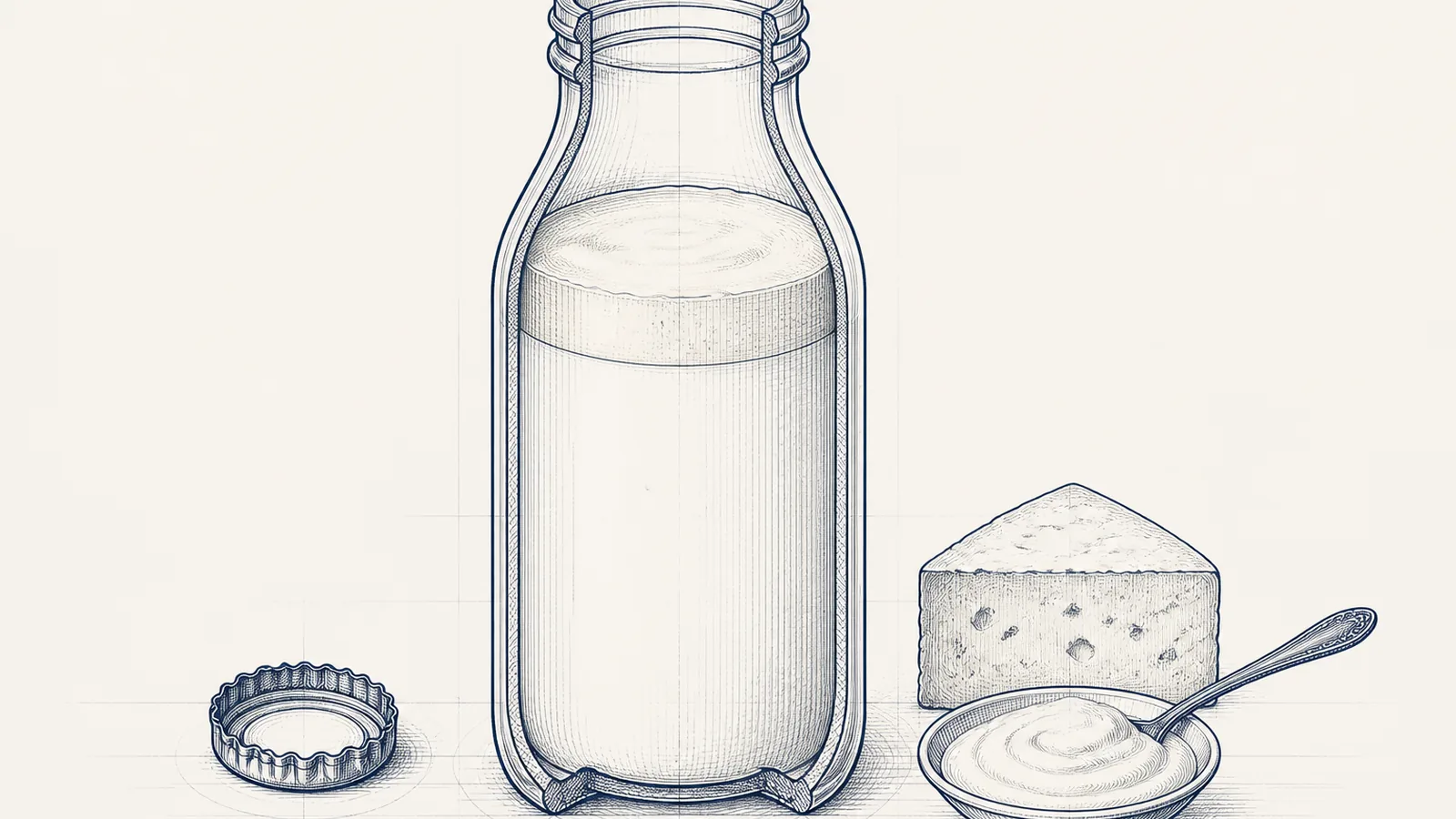
For twenty years I bought the carton with the blue cap. Skim, or 2 percent on a bold day, and I did it on autopilot, the way you follow a rule you never once stopped to check. Full fat was for other people. Full fat was the thing you were supposed to have grown out of. So when I opened the new dairy trial out of the University of Toronto, I expected to nod along with the usual warning about saturated fat and move on.
That is not what happened.
Harvey Anderson’s group at the Temerty Faculty of Medicine put 74 adults with overweight or obesity onto one of three diets: a low-dairy calorie-restricted plan, or one of two plans built around 3 full-fat dairy servings a day, and ran it for 12 weeks. At the end, the people eating all that dairy fat showed no meaningful worsening in body weight, body composition, or cholesterol. No adverse lipid shift, no early signature of insulin resistance. What did move was their blood pressure, and it moved in the good direction. They also took in more calcium, more protein, and more vitamin D than the group that skimped. You would struggle to design a result more at odds with the advice most of us absorbed as gospel.
I want to be upfront about who paid for this, because it is the first thing I look for and it should be the first thing you look for too. The trial ran on money from Dairy Research Cluster 3, part of Canada’s AgriScience program, and Mitacs. That is dairy money, and it means you hold the finding at arm’s length until independent evidence lines up behind it. It does not mean you throw the finding out. So I went looking to see whether anything lines up.
Quite a lot does. A 2025 review in The American Journal of Clinical Nutrition worked through the prospective cohort evidence and landed on a blunt line: “the body of evidence does not support differentiation between regular-fat and low-fat dairy foods in dietary guidelines for both adults and children.” The PURE study, 140,000 people across 21 countries, found higher dairy intake tracked with cardiovascular benefit, and that benefit did not hinge on stripping the fat. Fermented full-fat dairy, the yogurt and the cheese, kept turning up as neutral or protective for heart disease and type 2 diabetes. This review carries its own dairy fingerprints, tied to funding from the U.S. FDA and a Dutch dairy group, with several authors reporting dairy-industry ties. Read it knowing that. It still has to answer to the cohorts it cites, and those cohorts are enormous.
Here is what nags at me. The low-fat rule was sold as the cautious, evidence-based default, and it was never built on trials like this one. It was built on arithmetic. Dairy fat is saturated, saturated fat raises LDL on a spreadsheet, so strip the fat. That extrapolation became the first Dietary Guidelines for Americans in 1980, which steered the country toward low-fat and fat-free dairy, and it hardened into more than forty years of skim milk in school cafeterias. The burden of proof got quietly flipped. Skeptics were told to justify the cheese, while the people who pulled the fat out were never asked to justify that.
- 1980low-fat dairy enters US guidelines
- 2025review finds no basis to differentiate
- 2026trial finds cholesterol holds on full-fat
But the thing I could not let go of is the mechanism. If dairy is loaded with saturated fat, why doesn’t it behave the way the spreadsheet insists? Why would 3 servings a day not push cholesterol up?
The answer is a piece of biology I find kind of delightful, and it has a name: the milk fat globule membrane. Every droplet of fat in milk is wrapped in a triple layer of phospholipids, cholesterol, and protein, and that wrapper is rich in a molecule called sphingomyelin. Sphingomyelin has long saturated tails that grip cholesterol down in the gut, folding it into ordered little complexes that are harder to dissolve and harder for your intestine to pull in. The fat is technically there. The membrane sits on top of it and slows how much of it ever crosses into you. And this is not a hunch. It is why controlled work keeps finding that butter, which loses most of that membrane when churning strips it out, raises cholesterol more than cheese does at the same dose of milk fat. Same fat, different wrapper, and the cholesterol goes a different way. Whole milk and cheese arrive with the membrane intact. The spreadsheet that condemned them treated the fat as if it showed up naked, and it never did.
Once you see the matrix, the rest clicks. It is why a 2025 JAMA Pediatrics viewpoint openly asked whether steering kids toward low-fat milk was ever right, arguing whole-fat dairy “may have a null or even protective effect on children’s weight, adiposity, and cardiovascular health.” It is also why the nuance holds: a 2024 analysis in JHEP Reports found low-fat and high-fat dairy act differently on fatty liver disease, a reminder that “dairy” is not one thing you can flatten into a single line on a food label. None of this is a license to eat butter by the stick. It is permission to stop treating a block of cheese like a moral failing.
The change here is about credibility, not chemistry. For a generation the official position was that whole dairy was guilty and you were on the hook to prove otherwise. Every time someone finally runs the trial, small as these trials are, the conviction fails to stick, and the 2026 Toronto result is only the latest to walk. So here is where I have landed. I bought the blue cap for twenty years on the strength of arithmetic nobody ever checked in actual people, and I am done doing that. I will buy the full-fat yogurt and the real cheese, and I will not wait for the guideline to catch up before I do.
Sources
- ScienceDaily – full-fat dairy 12-week randomized trial (Anderson et al., The Journal of Nutrition, 2026)
- The American Journal of Clinical Nutrition – Regular-fat and low-fat dairy foods and cardiovascular diseases (2025), full text via PMC
- American Society for Nutrition – Which to Choose: Full-fat, Low-fat, or Non-fat Dairy?
- JAMA Pediatrics – Is Low-Fat Dairy an Appropriate Recommendation for Children? (2025)
- JHEP Reports – Differential effects of low- or high-fat dairy on MASLD (2024)