For years I have been the person at dinner telling everyone that fiber is the virtuous nutrient, the roughage you choke down to feel responsible, the quiet background player that does nothing dramatic. A paper out of Princeton just made me rewrite that speech. Fiber matters, sure, but the thing that stopped me cold was what your gut bacteria do the second they run out of it.
The wall your body builds to keep the peace becomes lunch.
They start eating you.
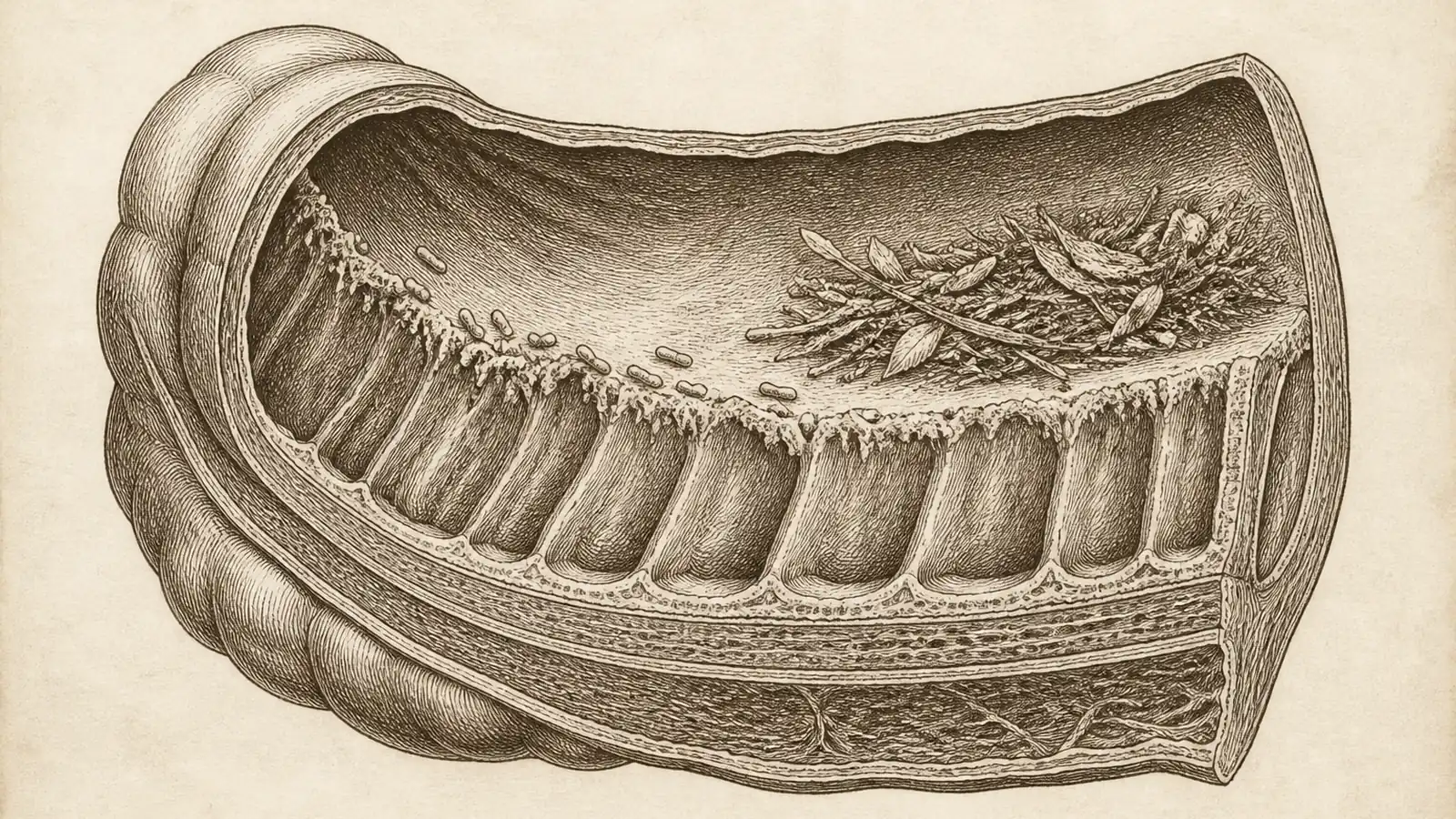
Not the whole of you. They come for the mucus lining, the slick protective layer coating the inside of your gut that holds trillions of microbes at arm’s length from the tissue underneath. When there is no fiber left to feed on, the bacteria in a mouse gut turned on that lining and began stripping protein out of it, digesting the very barrier meant to hold them back. The wall your body builds to keep the peace becomes lunch. And what got under my skin was the reason there was no fiber to begin with: a diet problem we engineered on purpose.
This was shown in mice, rats, and human cells, not in a clinical trial, so hold the certainty. What earns your attention is the method. Jenna AbuSalim and Joshua Rabinowitz at the Ludwig Institute for Cancer Research tagged individual proteins with heavy, non-radioactive atoms and followed exactly where each one went, work published in the Proceedings of the National Academy of Sciences. That tracing lets them say what most microbiome work only gestures at: not just which chemicals the bacteria made, but which protein each one was built from.
The bacteria in your colon take protein, break it down, and spin the leftovers into a family of compounds called phenols. Some are good for you. Some are frankly toxic. For years that was the whole picture, a shrug: bugs make phenols, some helpful, some not, nobody could say why. The isotope tags cracked it open. The harmful phenols, p-cresol sulfate and phenol sulfate, trace back to the amino acid tyrosine in your own host protein, the mucus lining itself. The beneficial ones, hippuric acid and phenylpropionate, come almost exclusively from phenylalanine in tough plant protein that survives digestion and reaches the microbes intact.
Wait, why would the same bug make a poison out of one protein and something useful out of another? It comes down to what you hand it, and how much. Starve these microbes of plant material and they scavenge the only protein within reach, your own mucus, and the tyrosine in it routes straight to the toxic end. Feed them a steady supply of digestion-resistant plant protein and they stop gnawing the wall, because there is something better on the menu, and the phenylalanine routes to the healthy end instead. Same microbes, same machinery. The output flips on what you did or did not eat.
AbuSalim’s team gave those plant proteins a name: Prif, for proteins imitating fiber, the indigestible ones that slip past your own enzymes and land in the colon still whole. Fiber suppresses the mucus-eating. Prif does the second half of the job, pouring in the raw material that becomes the good phenols. Rabinowitz has floated the idea that food packaging might one day list Prif right under fiber.
So why should you care what your bacteria do with a stray amino acid? Because p-cresol sulfate is not a lab curiosity. It is a uremic toxin, one of the compounds that piles up in the blood as kidneys fail, and higher circulating levels track with vascular damage, aortic calcification, and worse cardiovascular outcomes in chronic kidney disease. The phenols the mice churned out off their own gut lining are the same ones nephrologists spend whole careers trying to clear out of sick patients. A mechanism pinned down in a mouse is pointing straight at a chemical we already know harms people.
And this is the kind of finding that gets turned into a product. Rabinowitz is candid that interest in manipulating the microbiome is everywhere right now, and you can already see the shape of what comes next: a Prif supplement, a functional-food additive, a capsule that promises to reprogram your phenols while you keep eating the same stripped, refined diet that emptied your colon in the first place. Sell the patch, never name the cause. And the cause is not mysterious. Milling strips the fiber. Protein isolates and refined flours get prized precisely because they digest cleanly and leave nothing resistant to reach the colon. We built a food supply that starves the very bugs that keep our gut wall intact, and now the fix gets floated as a nutrient you might spot on a label someday.
I would rather just feed the bugs. This is a mouse-and-cells study, and I am not going to pretend it proves that a bowl of lentils drops your p-cresol sulfate on a blood panel. Nobody has run that trial. The jump from mouse mucus to human kidneys is a hypothesis, not a promise. But the mechanism is clean, it lines up with everything we already knew about whole plants and gut health, and the move it points to is cheap and low-risk for most people. So I am not waiting for the Prif label. I am eating the lentils and the beans and the whole grains with the tough parts still on, the foods that were always going to reach my colon intact, and I am doing it so my microbes never get hungry enough to come for the wall.
Sources
- PNAS – AbuSalim & Rabinowitz, “Digestion-resistant proteins support the healthy metabolite profiles associated with plant-based diets,” 2026;123(32)
- ScienceDaily – “When gut microbes run low on fiber, they may start eating you” (Aug 2026)
- EurekAlert (Ludwig Institute for Cancer Research) – “A new light on the microbiome and its metabolites”
- PMC – “Gut-derived uremic toxins and cardiovascular health in chronic kidney disease”