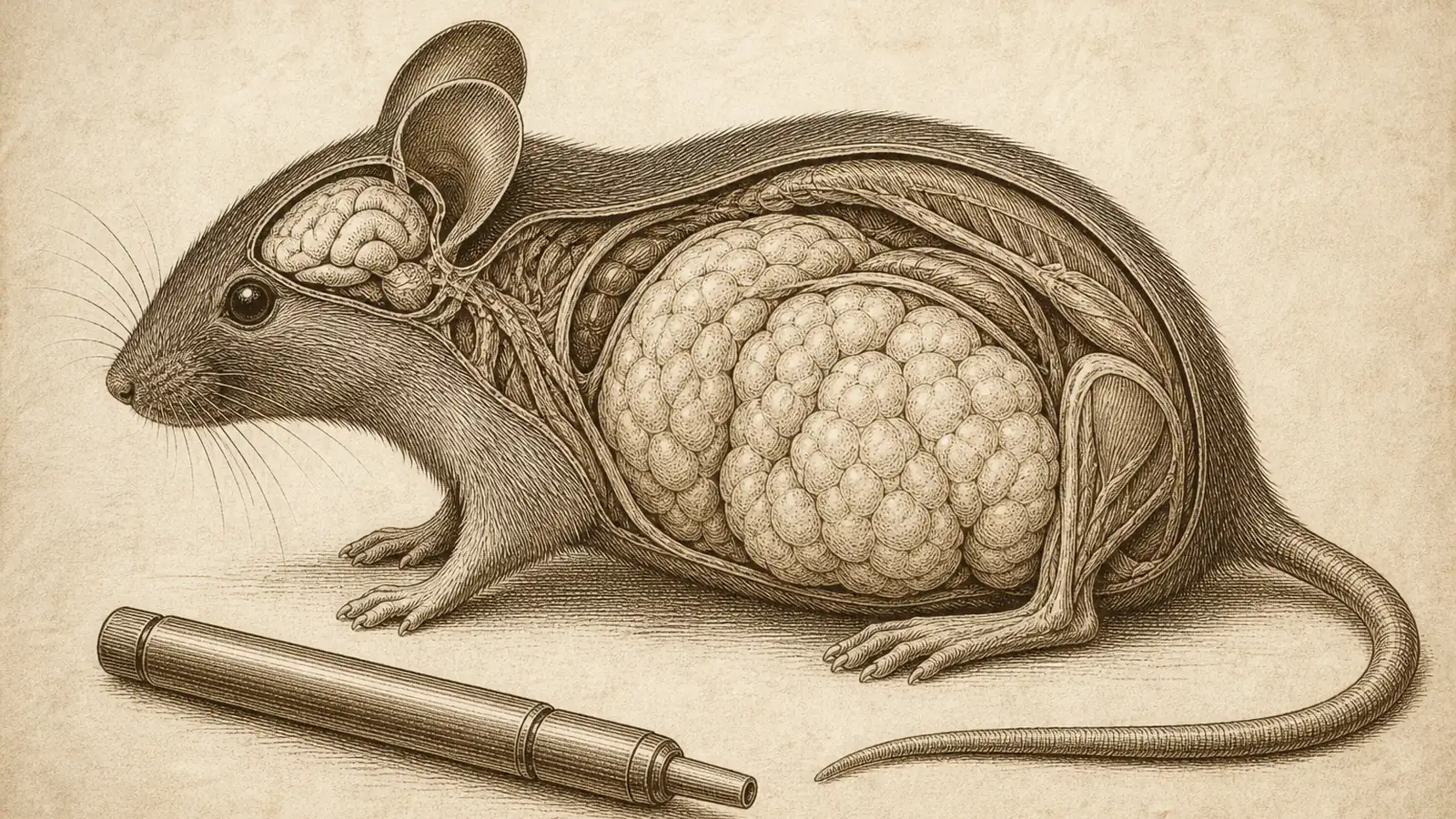
The mice kept eating less. They just stopped losing weight. About 15 days after a Yale team disrupted one specific set of neurons, the animals were still on semaglutide and still picking at their food like model patients, and the fat they had shed came right back. I have spent years writing about these drugs on the assumption that eating less was the entire trick, so a result where the appetite stays suppressed and the weight returns anyway took that assumption apart in front of me. The tidy off-switch story I had been carrying is wrong, and how it is wrong changed the way I read every GLP-1 headline since.
The picture I used to have was simple. You take the shot, the part of your brain that screams eat goes quiet, you eat less, the weight comes off. Clean and mechanical. So the finding out of Yale reads as a near-inversion of that picture. In a study published in Proceedings of the National Academy of Sciences in August 2026, researchers in the lab of neuroscientist Tamas Horvath, with PhD candidate Mateus d’Ávila as lead author, went looking at AgRP neurons, the classic hunger cells that fire when you are running an energy deficit and nag you toward the fridge. The obvious guess is that an appetite-killing drug must be shutting those cells up. Sustained semaglutide did the reverse: it switched them on, recruited them, and then leaned on them to finish the job.
That is how they caught the mechanism. When the researchers used genetic tools to silence or remove AgRP neurons in female mice, the animals still ate less on the drug, exactly as the old story predicts, yet they regained the lost fat within about 15 days. Same reduced appetite, no lasting weight loss. So the eating was never carrying the result on its own. Something ran through the hunger circuit and did a large share of the work, and once that circuit went dark the burning stopped even while the eating stayed down.
So what are those neurons actually doing while they burn fat? Why would the brain’s hunger alarm be the thing stripping off adipose tissue instead of defending it? That is the question the study chases, and the answer rearranged how I think about the whole drug class. AgRP neurons do not just make you want a sandwich. They run the body’s entire response to an energy shortfall, including how it pulls stored energy out of fat. “AgRP neurons coordinate a much broader response to energy deficit, including how the body mobilizes and uses stored energy, like fat,” d’Ávila said. The researchers’ model is that the brain reads the drug-induced deficit the way it would read a fast, fires its starvation program, and that program reaches into fat stores and burns them down. Semaglutide, on this account, does not override your survival wiring. It borrows it and aims it at the fat you are carrying.
The catch here is not that a mouse study is thin, though it is one colony of animals worked out with genetic tools that silence and remove neurons rather than a trial in people. The catch is where the signal showed up. The effect was clear in female mice, the males did not respond the same way under the conditions tested, and nobody yet knows why. Obesity neuroscience has a long and slightly embarrassing habit of running everything in male animals and assuming the female brain works the same way. Here the headline result is female and unexplained, which tells you how much of this circuit has been mapped with half the population left out.
It also puts the drug’s most talked-about failure in a different light. d’Ávila’s framing, and Yale’s, leans pharma-friendly: map this pathway and you can build “more efficient drugs.” Maybe. But there is a read sitting right in the data that means more to the person paying hundreds of dollars a month. If the hunger neurons are what sustain the fat loss, then the regain people see when they quit is not simply willpower folding. It is the same circuit standing down. In semaglutide’s own STEP 1 trial extension, participants lost 17.3 percent of their body weight on the drug and, a year after stopping, had regained roughly two-thirds of it, settling at a net 5.6 percent. The mouse work does not prove the human mechanism, but it offers a clean hypothesis for why the weight comes back: take the drug away and the starvation program that was doing the burning quiets down. That is not a story about weak patients. It is a story about a mechanism that was never built to be permanent.
None of this is a niche lab curiosity. Semaglutide is the molecule inside Ozempic, FDA-approved for type 2 diabetes in 2017, and by 2025 roughly 1 in 8 American adults said they had taken a GLP-1 drug. AgRP neurons, meanwhile, have become one of the busiest targets in obesity science, with other labs finding the brain physically ensnares these same neurons in a net-like scaffold as obesity sets in. We are handing a drug that reroutes a deep survival circuit to tens of millions of people while the basic wiring diagram is still being redrawn in mice, and redrawn, it turns out, mostly in female ones. The distance between how confidently these drugs are sold and how recently anyone worked out what they do to the brain is wide, and worth holding onto.
| Measure | Value |
|---|---|
| Count | 1 of 8 US adults, 2025 |
If I were on one of these, I would stop treating it as a switch I flip and forget. The Yale work tells me the drug is borrowing my own starvation wiring, and borrowed things get called back. I would treat the injection as the easy part and the coming-off as the actual project, planned with a doctor long before I needed it, instead of assuming the weight would simply stay gone. The neurons kept the score in those mice. I would bet mine would too.
Sources
- PNAS – d’Ávila et al., “AgRP neurons are required for the weight-lowering effects of GLP-1 receptor agonists in female mice” (2026)
- Yale News – “New study may change how we think about GLP-1s” (Aug 10, 2026)
- Diabetes, Obesity and Metabolism – Wilding et al., “Weight regain and cardiometabolic effects after withdrawal of semaglutide: the STEP 1 trial extension” (2022)
- KFF Health Tracking Poll – “1 in 8 Adults Say They Are Currently Taking a GLP-1 Drug” (2025)
- ScienceAlert – “GLP-1s May Be Working in an Entirely Different Way Than We Thought”
- Nature – “Brain goop that traps hunger neurons drives obesity” (2024)
- FDA – Ozempic (semaglutide) application NDA209637, Novo Nordisk