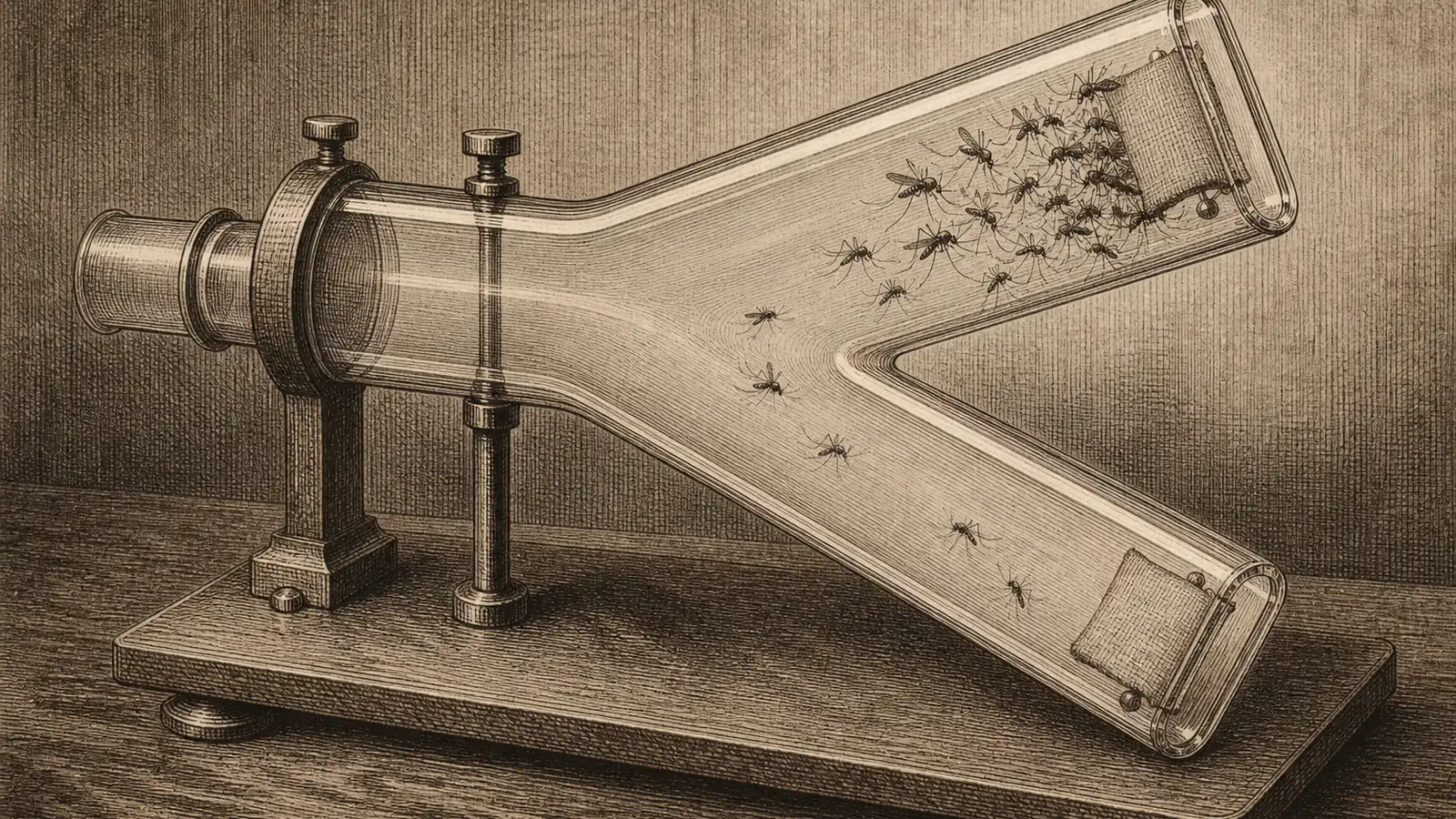
At Rockefeller University, in Leslie Vosshall’s lab, the experiment that settled a very old backyard argument came down to a few nylon sleeves and a mosquito’s nose. Volunteers wore the nylon against a forearm until it carried their skin scent. The researchers cut the fabric into squares, loaded them into the two arms of a Plexiglas olfactometer, and let female Aedes aegypti pick a side. One person, logged as Subject 33, drew the insects toward her scent trap after trap. Another, Subject 19, they mostly left alone.
The gap was not close. In the study, published in Cell in 2022, Subject 33 was about 100 times more attractive to the mosquitoes than Subject 19. Maria Elena De Obaldia, who ran the work, did not hedge about what that looked like from across the room. “It would be obvious within a few seconds of starting the assay,” she told the university. “This is something real. This is not splitting hairs. This is a huge effect.”
If you have ever stood in a group and been the only one covered in welts, it was never your imagination, and it was almost certainly never your fault. That second part is the problem for a whole industry.
The folk canon of mosquito bites is a canon of personal failure and personal fixes. Your blood is too sweet. You should eat more garlic, take vitamin B, wear the woven citronella band, clip on the ultrasonic buzzer, run the app that plays a frequency only mosquitoes supposedly hate. Every one of these carries the same flattering promise, that the bites are a switch you can throw and you are one purchase away from being left alone. The drugstore shelf and the endless “mosquito repellent” listings online are built on it.
The Rockefeller data point somewhere much less convenient. The magnets were magnets because their skin produced high levels of carboxylic acids, the oily organic acids that sit in sebum and get worked over by ordinary skin bacteria into a personal scent signature. Magnets made a lot of these acids; the people the mosquitoes ignored made much less. “There’s a very, very strong association between having large quantities of these fatty acids on your skin and being a mosquito magnet,” Vosshall said. And across a validation group that brought the total to 64 participants, the trait held steady, not over a weekend but over years. Subject 33 came back a year later and was still Subject 33.
You cannot scrub that off before a barbecue, and Vosshall would not promise you could. The experiment to turn a Subject 33 into a Subject 19 through diet or the skin microbiome, she said, “we haven’t done that experiment. That’s a hard experiment.” If it worked at all, “that’s all very speculative.” The thing that decides whether mosquitoes want you is close to fixed, written into your skin chemistry, and nobody has shown you can rewrite it from a supplement bottle.
Which brings us to the aisle sold on the opposite premise. The most rigorous head-to-head test of consumer repellents, a New England Journal of Medicine study by Mark Fradin and John Day, put wristbands in the ring against skin-applied repellents. The bands, whether they carried DEET or citronella, gave essentially no protection, because a repellent only works in the thin envelope of air right at the skin it sits on. A band at your wrist does nothing for your ankle. As the entomology has been summarized, wristbands are “typically shown to be the least effective of the commercially available repellents,” their vapors “just aren’t strong enough to block mosquito bites,” and patches “containing vitamin B1 offer no protection.”
The DEET on your skin works. The band on your wrist does not.
Go down the rest of the aisle and the pattern holds. The ingested cures are a graveyard: a scoping review of thiamine, vitamin B1, the perennial internet favorite, found nothing to support it. The electronic and ultrasonic buzzers do no better. When Cochrane reviewers pooled ten field studies of electronic mosquito repellents, every one found no difference in the mosquitoes landing on a bare arm whether the device was running or switched off. The sound gadget and the vitamin patch are selling the same nothing at different price points.
Be fair to the folk canon where the evidence gives it anything, which is not much. Two things genuinely move the odds, and neither is a failing you can correct. Pregnant women, running warmer and breathing out more carbon dioxide, draw roughly twice as many mosquitoes as their non-pregnant counterparts. And in a Burkina Faso trial, volunteers became measurably more attractive to Anopheles gambiae after a bottle of beer. These are edges around the finding, not rivals to it. Blood type, the folk theory that refuses to die, rests on far thinner evidence than the confidence with which people repeat it. The stable, hundred-fold engine is your skin.
None of this is a field trial of who catches malaria. It is laboratory work, arm-odor squares fed to caged yellow fever mosquitoes, and whether the same acids rank you against every biting species outdoors is a fair open question. What is not in question is the size of the effect or where it lives.
So the consumer verdict runs against the marketing. The bites are not a character flaw, and mostly not a purchasable fix. The things with evidence behind them are boring: DEET or picaridin on the actual skin, long sleeves, staying in at dusk when the biters work hardest. The things with the best packaging, the bands and the buzzers and the B-vitamin patches, are the ones the data keeps failing. Subject 33 can buy every one of them. The mosquitoes will find her anyway.
Sources
- Cell – De Obaldia et al., “Differential mosquito attraction to humans is associated with skin-derived carboxylic acid levels” (2022)
- Rockefeller University – “Why some people are mosquito magnets” (2022)
- New England Journal of Medicine – Fradin & Day, “Comparative Efficacy of Insect Repellents against Mosquito Bites” (2002)
- The Conversation – “Health Check: do wrist bands work to repel mozzies?”
- Bulletin of Entomological Research – “Thiamine (vitamin B1) as an insect repellent: a scoping review”
- Cochrane Database of Systematic Reviews – Enayati, Hemingway & Garner, “Electronic mosquito repellents for preventing mosquito bites and malaria infection” (2007)
- The Lancet – Lindsay et al., “Effect of pregnancy on exposure to malaria mosquitoes”
- PLOS ONE – Lefèvre et al., “Beer Consumption Increases Human Attractiveness to Malaria Mosquitoes” (2010)