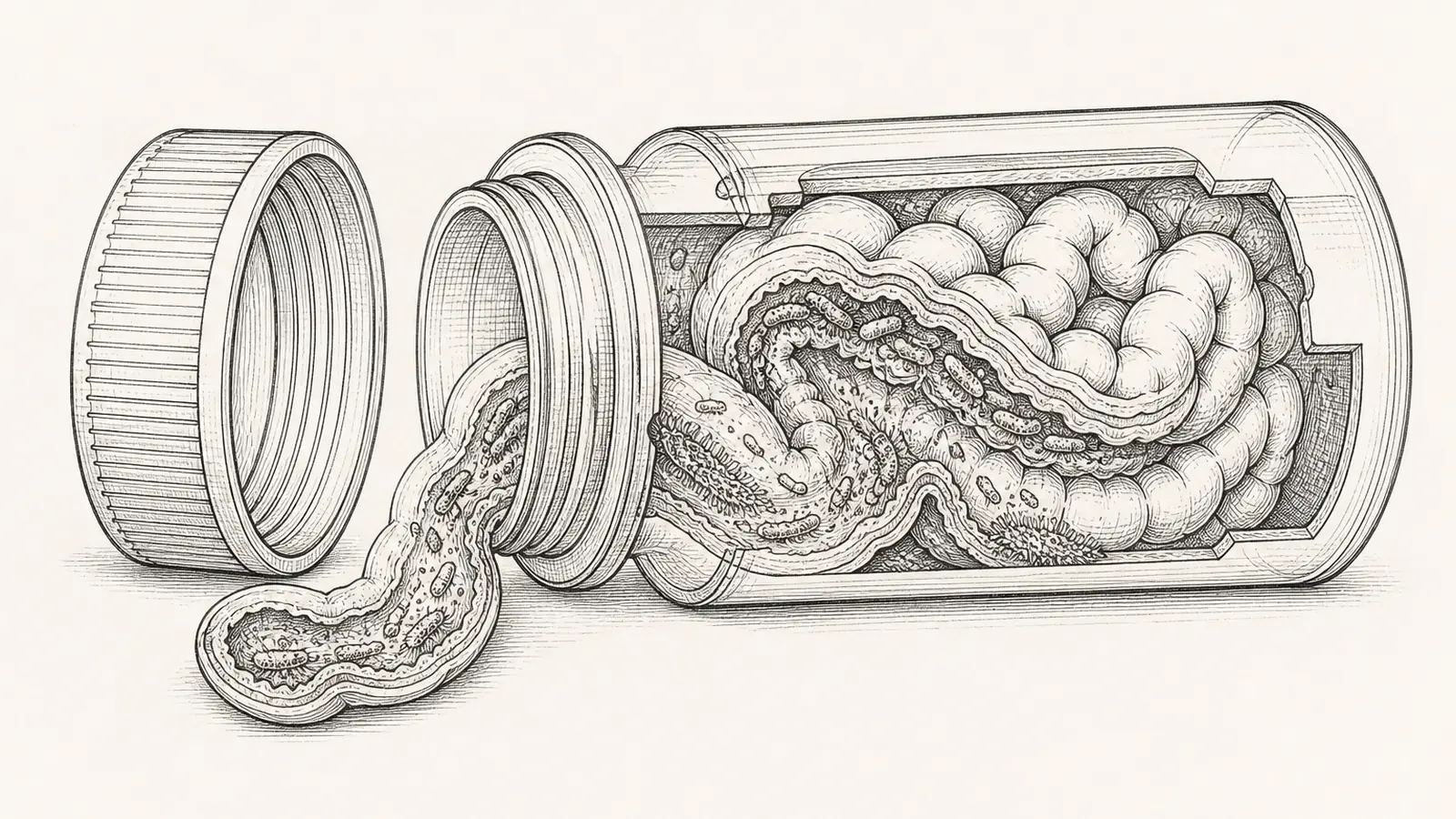
I used to think of finishing a medication the way you think of closing a door. The course ends, the bottle goes in the recycling, your blood clears the drug in a few days, and you go back to whatever your normal was. Turns out I had the last part wrong. Your blood does clear the drug. The ecosystem you carry in your gut can keep the record for years.
That is the uncomfortable finding in a study out of the University of Tartu’s Institute of Genomics, published in mSystems. The team, led by Oliver Aasmets and Elin Org, did the thing most microbiome research skips: they matched the stool samples of 2,509 people in the Estonian Biobank against those same people’s prescription records going back five years. Not “what are you taking now,” the usual question, but “what have you swallowed since 2019.” Then they looked at whose gut still showed it.
Nearly everything showed it. Of 186 drugs examined, 167, about 90 percent, were linked to differences in the microbiome, and 78 of them, roughly two in five, still left a detectable mark after people had stopped taking them. For a chunk of these drugs the association held even when the last dose was more than 3 years in the past. Antibiotics, sure, we half-expect that. But also proton-pump inhibitors, the acid reducers millions of people take for heartburn. Also beta-blockers. Also antidepressants. Also benzodiazepines.
The benzodiazepine finding is the one that stopped me. These are Xanax-class, Valium-class drugs. They work on GABA receptors in your brain, and you would not expect a brain drug to touch your colon at all. Yet the researchers found their footprint on the whole microbial community rivaled that of broad-spectrum antibiotics, and it lingered years after the last pill. So here is the question I could not put down: why would a drug aimed at your nervous system reshape the bacteria in your gut, let alone keep reshaping them long after it has washed out?
Part of the answer is that a lot of drugs are accidental antibiotics. Back in 2018, a screen in Nature found that roughly one in four non-antibiotic drugs directly inhibited the growth of gut bacteria in the dish, across every therapeutic class tested. Your medication does not have to be aimed at bacteria to flatten them. But that explains the hit, not the memory, and the memory is where I stopped skimming. Your gut is not a chemistry beaker that resets when you rinse it. It is an ecosystem. Knock out a few resident species and something else moves into the empty real estate, feeds on what they used to eat, and settles in. When the drug leaves, the newcomers do not politely hand the territory back. The community locks into a new arrangement and stays there. What persists is not the drug. It is the rearranged neighborhood the drug left behind.
Before anyone panics and flushes their prescriptions: these are associations, not proof of harm, and any one drug’s effect is modest. No single pill is rewriting your gut on its own. What gives the paper its weight is the combination, the breadth of the marks, how long they persist, and the fact that they pile up with use. The longer and more often people took a drug, the bigger the imprint. If you are one of the many people on three or four chronic prescriptions renewing on autopilot, the marks stack.
This is where I part ways with how the finding is being packaged. The researchers frame it, accurately, as a “hidden confounder,” a warning to other scientists that if you tie some gut bug to a disease without checking what drugs a person took years ago, you may be measuring the pharmacy instead of the illness. Fair. But read past the methods language and there is a blunter story sitting right there. The drugs doing this are not exotic. Proton-pump inhibitors, SSRIs, benzodiazepines and beta-blockers are everyday prescriptions, handed out for years at a stretch, often with a refill button and not much conversation. A public biobank now says they leave a years-long imprint on an organ we are only beginning to understand, and the establishment reflex is to treat that imprint as a statistical nuisance to adjust away rather than a cost worth counting. I think it is a cost worth counting.
One more receipt, because this publication runs on them. The work was funded by the Estonian Research Council and an EMBO grant, ordinary public science. It was also funded by the Biocodex Microbiota Foundation, the philanthropic arm of a company that sells probiotics. A conclusion that says common drugs scar your gut for years is convenient for anyone whose business rests on the premise that a disrupted microbiome is a problem you can buy your way out of. That does not make the finding wrong. The biobank design is strong, and the prescription-record linkage is a level of rigor most microbiome studies never reach. But you deserve to know whose commercial premise a result happens to flatter, and here a probiotics foundation helped pay for one that flatters it.
So what do I actually do with this? Not stop a medication I need. That would be its own kind of foolish, and nothing here supports it. But I have quietly retired the belief that “I finished the course” means “there was no lasting effect.” The next time an acid-reducer or a benzodiazepine renews by default, the one that just keeps refilling because nobody revisited it, I would treat that refill as an active decision, and I would make my doctor walk me through whether I still need it. The dose ends. I am done assuming the recycling bin is where a prescription’s story stops.
Sources
- mSystems – Aasmets et al., “A hidden confounder for microbiome studies: medications used years before sample collection” (2025)
- mSystems – companion commentary, “The gut remembers: the long-lasting effect of medication use on the gut microbiome” (2025)
- ScienceDaily – “Common medications may change your gut for years” (2026)
- Nature – Maier et al., “Extensive impact of non-antibiotic drugs on human gut bacteria” (2018)
- Biocodex Microbiota Foundation – microbiome research grant program