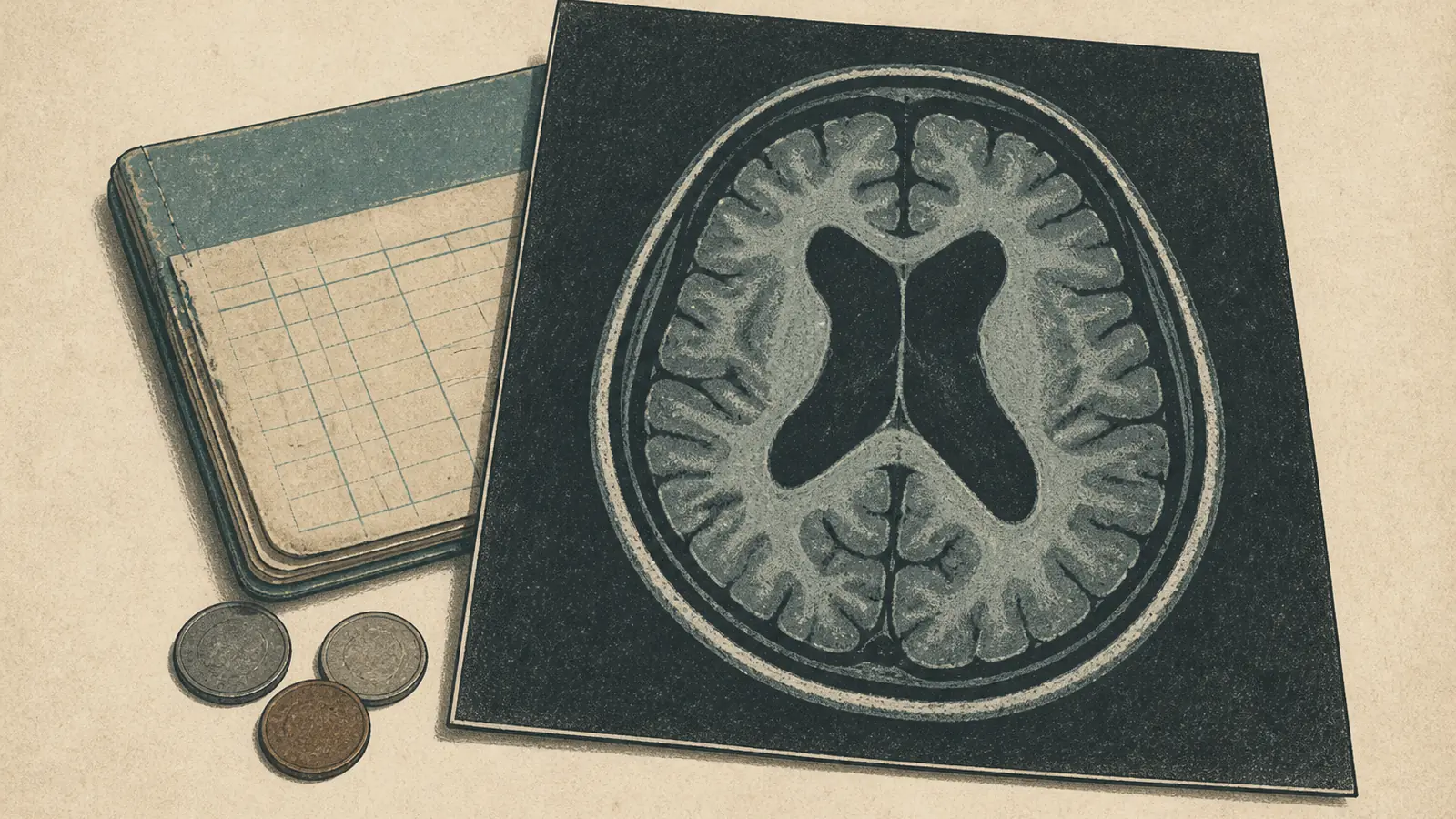
I used to file money stress in the same drawer as a bad night’s sleep. Something that makes you snappy and foggy for a week, then lifts once the paycheck clears. Then a team at University College London put a brain scan next to that assumption, and it turns out twenty years of a tight bank account can show up in the actual tissue between your ears, decades after the tight years themselves.
What I did not expect was the timescale. The researchers were not asking people, in some bad moment, whether money felt tight. They were reading a ledger that runs the length of a life. The MRC National Survey of Health and Development has followed a group of Britons born in a single week of 1946, checking in decade after decade, and this analysis, led by Jacques Wels and Praveetha Patalay, drew on 2,759 of them. That long a run let the team do something most studies of this question cannot: separate the person who hit one rough patch from the person who spent twenty years underwater.
They drew two lines. One was persistent low income, sitting in the bottom fifth of household earnings at least twice across ages 26, 43, and 53, which caught about 16 percent of the group. The other was persistent hardship, self-reported financial strain crossing a threshold at least twice between ages 36 and 53, about 12 percent. Then they looked at how those people’s minds, and later their brains, had held up.
By age 53, the people who had lived with chronic low income scored measurably worse on verbal memory, by about a sixth of a standard deviation (−0.16, on a scale where 0 is no gap, with a confidence interval of −0.21 to −0.11). Processing speed took a smaller hit. I want to be honest that these are modest numbers, because a sixth of a standard deviation is not a cliff. But it held up after the researchers controlled for the things that usually explain this away: sex, childhood social class, how well you scored on cognitive tests as a child, your years of education, and symptoms of depression and anxiety. So this is not just “poor kids stayed poor and started behind.” The adult grind seems to leave its own mark, separate from where you began.
Then there is the scan. In a smaller neuroimaging substudy of a few hundred participants, the people who had endured persistent low income showed greater ventricular volume in their late sixties and early seventies, about 4.67 milliliters more, though with a wide confidence interval running from 1.01 to 8.32. The ventricles are the fluid-filled spaces inside the brain, and they tend to widen when the brain tissue around them pulls back, empty space growing as substance recedes. I would not hang a diagnosis on that number. It is an observational finding, nobody was randomly assigned to poverty, and the imaging rests on a few hundred people rather than the full cohort, so the study cannot prove hardship caused the change instead of tracking alongside something it never measured. What it can offer is a direction, and the direction stays consistent from the memory tests to the scan.
Wait, though, why would a bank balance reach all the way into the skull? That is the question I could not put down, and the biology points to a genuinely unsettling route. Chronic worry is not only a feeling; it is an endocrine state. When stress runs long instead of short, the HPA axis stays switched on and cortisol regulation drifts, the daily rhythm flattening and the off-switch getting sticky. The hippocampus, the seahorse-shaped structure that files new memories, happens to carry one of the highest densities of glucocorticoid receptors in the brain, which puts it directly in the path of that hormonal signal. Sustained cortisol exposure suppresses the birth of new neurons there and, over years, is linked to the hippocampus physically shrinking. Researchers call the cumulative bill “allostatic load,” the wear that piles up when a system built for occasional emergencies is asked to run in emergency mode for a decade. Verbal memory was the thing that slipped first in this cohort, which is exactly what you would expect if the strain were landing where those receptors sit. The study cannot prove that pathway ran the result, but it is the plausible road the evidence keeps pointing down.
Here is where the framing usually goes sideways. The reflex, when a study says “cognitive decline,” is to reach for a molecule to sell against it: a supplement, a coming Alzheimer’s drug, something you can bill. Notice that the people who actually ran this study did not go there. Patalay’s own read was that supporting people through financial hardship and reducing chronic poverty could help prevent cognitive decline and future dementia. The intervention she pointed at is material, not pharmaceutical. That inverts the usual story, the one where your brain is a private organ failing on its own schedule and the only open question is which pill you take. This data says the organ is porous to the conditions you live in, and that years of economic strain are a public-health exposure in their own right, the way lead or air pollution are. The authors declared no competing interests, and the work was funded by the Medical Research Council and Alzheimer’s charities rather than anyone with a product to move, which is worth noticing precisely because the pill version of this story usually comes with a sponsor.
I find the material read more persuasive than the pharmaceutical one, because it matches how bodies actually work. Stress you cannot escape does not stay in your head. It runs through the adrenal glands and the bloodstream and settles, eventually, in the tissue. So I have stopped treating a stretch of money trouble as a mood to wait out. It is an exposure, and the thing that blunts an exposure is not a supplement I can buy at the moment my memory is already thinning. It is not being left underwater for twenty years in the first place, which is a policy question wearing a health costume. I would fund the thing that prevents the exposure, and I would stop pretending the brain fails on a private schedule.
Sources
- Innovation in Aging – Liu, Wels, Patalay et al., “Persistent financial adversity and cognitive aging” in the 1946 British birth cohort (2026)
- Frontiers in Aging Neuroscience – chronic stress, cortisol dysregulation, and hippocampal vulnerability (2026)
- McEwen & Gianaros – stress, allostatic load, and brain plasticity (PMC)
- ScienceDaily – “Money problems may age your brain faster” (2026)