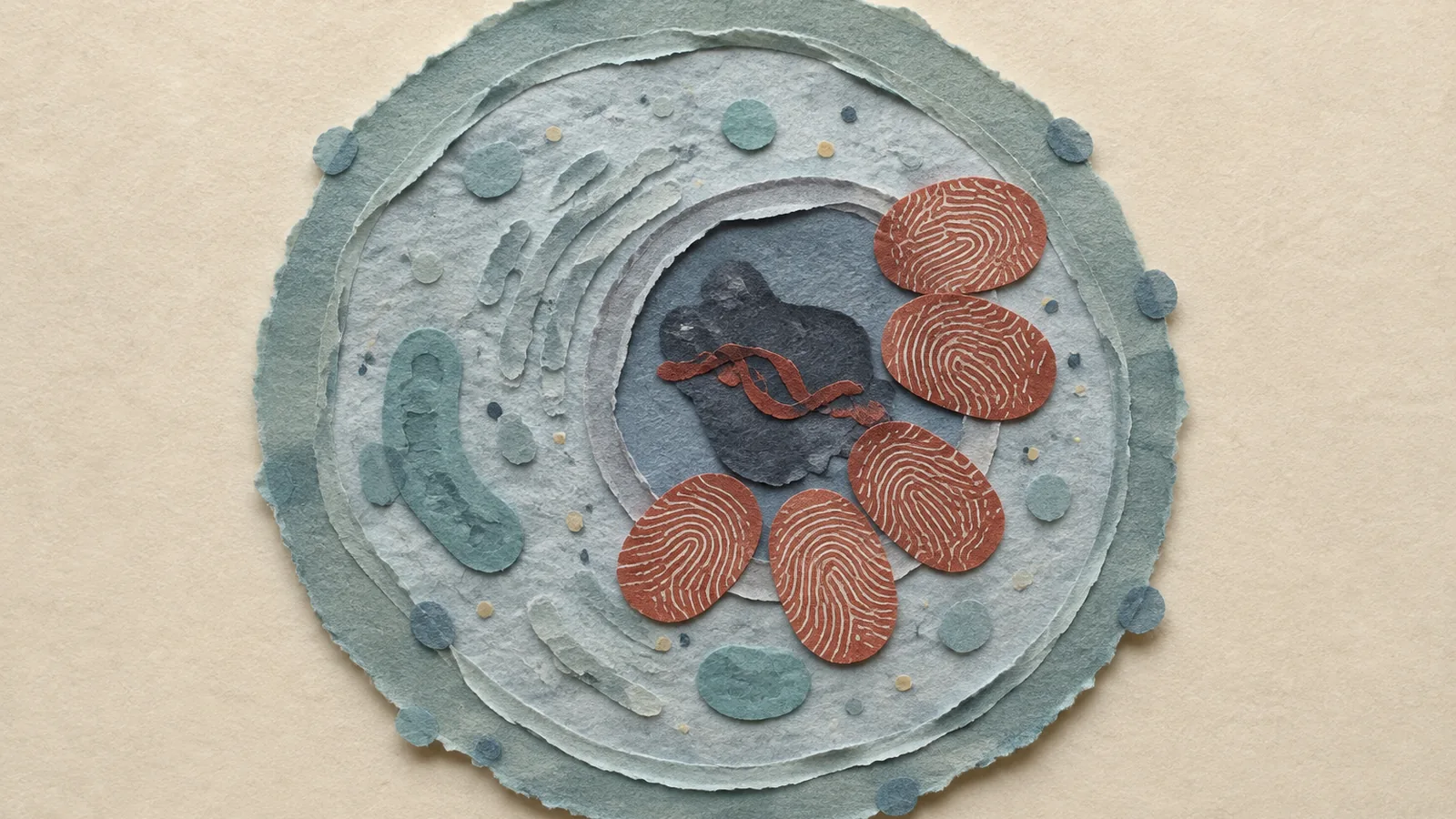
For as long as I have been reading about HIV, the reservoir has lived in my head under settled bad news. The virus tucks its genome into resting immune cells, goes quiet, stops making the proteins that would give it away, and just sits there. That silence is the whole problem. It is why forty years and a working drug regimen still cannot deliver a cure: you cannot kill what your immune system cannot see. I had filed the latent reservoir away as a locked box.
A study out in Nature Immunology on September 1 says the box was never locked. Something has been picking through it the whole time.
What caught me was how the researchers found it. They pulled more than 6,000 proviral DNA sequences from 104 people who had been on antiretroviral therapy for years, then sorted those people by a quirk in their immune wiring. The ones who carry the HLA-C2 allotype, a variant that arms a specific class of natural killer cell, carried noticeably fewer intact proviruses. Fewer of the complete, still-dangerous copies of HIV. The broken, defective copies were still there in force. The functional ones had been thinned out. And the effect showed up only in people on treatment; during untreated infection, HLA-C2 did nothing. Long-term therapy seems to have created the conditions for the reservoir to be pruned, and the pattern pointed at natural killer cells.
So why would that be? I had to stop and work through the biology, because it runs backwards from how you would expect. Natural killer cells are the immune system’s blunt instrument, the innate responders that hit anything looking wrong without waiting for a formal introduction. But they are not born ready. An NK cell has to be educated, and the education is strange: it learns to kill by first learning what normal looks like. The receptor doing the teaching here, KIR2DL1, is an inhibitory one. It reads the HLA-C molecule sitting on healthy cells and, in effect, gets told to stand down. And yet an NK cell that grows up seeing its matching HLA signal becomes a stronger killer, licensed and loaded, while one that never sees it stays sluggish. The inhibitory handshake is what arms the gun.
So what does an armed KIR2DL1 cell hunt? Absence. It patrols for cells that have stopped showing their HLA-C, the missing self that says something has tampered with this cell from the inside.
And here HIV walks straight into it, which made me grin. One of the virus’s signature survival moves is to strip HLA off the surface of the cells it infects. Its Nef protein pulls down HLA-A and HLA-B to blind CD8 T cells, which can only spot an infected cell by the viral fragments displayed on those molecules. No HLA, no T-cell target. A second viral protein, Vpu, goes after HLA-C, and HLA-C is exactly the molecule KIR2DL1 reads. The study found that Vpu variants that most aggressively downregulate HLA-C were tied to smaller reservoirs in HLA-C2 carriers. The trick HIV evolved to duck the T cells is the same trick that rings the dinner bell for natural killer cells. Erase your HLA to hide from one branch of immunity and you light yourself up for the other. The cells that hid hardest from the T cells look like the ones that got picked off, and what survived in the reservoir seems to carry the fingerprints of that culling.
The signal got cleaner in people whose KIR2DL1 cells also wore NKG2C, an activating receptor that reads a stress molecule called HLA-E. Those double-positive cells tracked inversely with intact virus: more of them, less functional reservoir. It is still a correlation. But now it is a correlation with two independent handholds pulling the same direction, which is what a working mechanism tends to leave behind.
I want to be honest about what this is and is not, because HIV cure science has a long history of leads that dazzle in a cohort and stall at the clinic. This is an association study in 104 people. Nobody was cured. HLA-C2 is a genotype you are born with, not a prescription. And the broader wake-the-virus-and-let-immunity-clear-it idea, the shock-and-kill approach that has eaten a decade of funding, has a graveyard of disappointing trials behind it. A 2022 Nature Communications study, backed by amfAR and the NIH’s infectious-disease institute, had already shown that pairing latency reversal with natural killer cells could shrink the reservoir in animals. The idea has been circling for years. What this new work adds is human evidence that the pruning is already happening on its own, in real patients, written into their viral DNA. That is why it lands harder for me than another engineered-cell announcement: nobody manufactured this signal in a lab, they read it out of people.
Which is the useful contrast, because there is no shortage of the manufactured kind. A separate team at Case Western Reserve reported this year that they had expanded and souped-up NK cells from HIV-positive donors to hit reservoir cells harder, and they are already talking about off-the-shelf therapy and human trials within two years. I have heard within two years attached to HIV cures for most of my adult life. I hold that timeline loosely. The genotype data is the sturdier thing, precisely because nobody built it to impress anyone.
For decades the reservoir has been described as inert, invisible, a problem of things we simply cannot reach. This work says it has a shape, and that shape was carved by the part of the immune system we tend to treat as the crude one. Earlier KIR and HLA genotype studies already hinted that a person’s innate wiring changes how HIV behaves, but those looked at disease progression. This is the first time I have seen it read the reservoir itself, under treatment, at the level of individual proviruses.
I am not going to pretend a genotype is a cure, and I am not booking anyone a victory lap over 104 patients. But I have stopped believing the reservoir is a sealed vault, and I have started reading it as an ongoing fight the body never fully quit. The next time someone tells me natural killer cells are the immune system’s dumb muscle, I am going to point them here and ask why the dumb muscle is the one leaving edits in HIV’s own code.
Sources
- Nature Immunology – Armendariz et al., “Innate immune imprints shape HIV-1 reservoir cell persistence during long-term antiretroviral therapy” (primary study, 2026)
- Nature Immunology – “Natural killers blast HIV reservoir landscape” (News & Views, 1 September 2026)
- Nature Communications – “Latency reversal plus natural killer cells diminish HIV reservoir in vivo” (2022)
- MedicalXpress / mBio – “Targeting HIV’s hidden reservoirs: Lab-enhanced natural killer cells show promise” (Case Western Reserve, 2026)