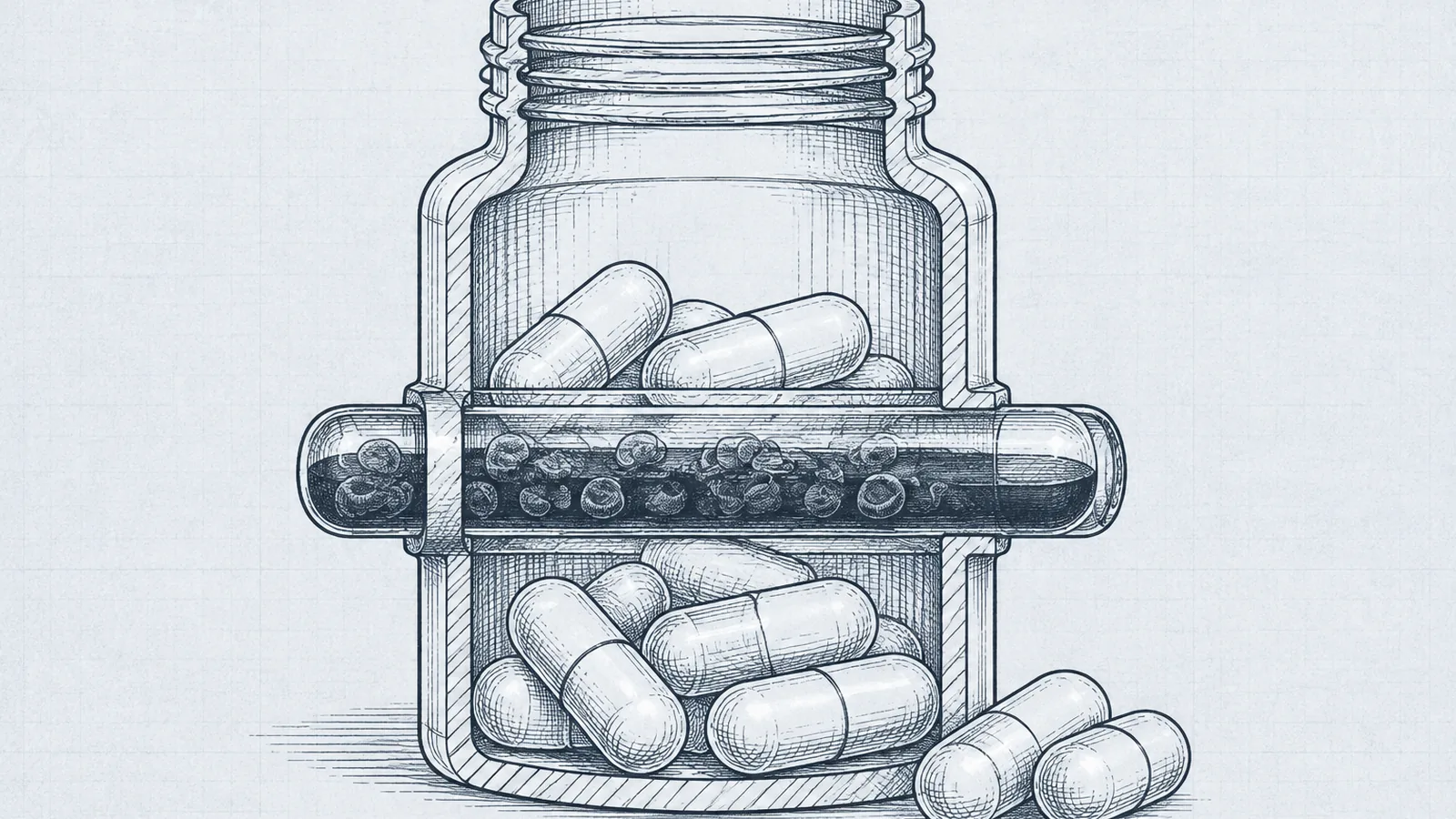
I have always filed amino acids under “harmless.” They are the beads that string together every protein in your body, the raw material your cells were built from, and something about that made me assume you could not really overdose on a building block. Take a little extra of the stuff you are literally made of, and worst case your body shrugs and pees it out. That was my working model right up until I read the numbers on tyrosine. More than 270,000 people, and the men carrying the most of it in their blood died sooner, by nearly a year on the genetic estimate.
Tyrosine is the amino acid tucked inside a whole aisle of “focus” and “mental energy” capsules. It is the precursor your neurons convert into dopamine and norepinephrine, so the marketing writes itself: 500 to 1,000 milligrams a day to sharpen alertness and push back the fog of stress. It sounds clean. It sounds like feeding your brain its own favorite ingredient.
Then a team from the University of Hong Kong and the University of Georgia went looking at what higher tyrosine actually tracks with over a lifetime, and for men the answer was fewer years of it. The study, published in Aging, pulled blood-metabolite and genetic data from 272,475 people in the UK Biobank, with 23,964 deaths over a median of 11 years. What lifts it above another correlation is the second method layered on top. Alongside the plain observational look at who died sooner, they ran a Mendelian randomization analysis: they used gene variants that nudge a person’s tyrosine up or down from birth as a kind of natural, lifelong randomized experiment. If a trait only correlates with early death because sick people happen to have it, genetics usually breaks that spell. Here it did not. In men, higher genetically-set tyrosine predicted about 0.91 fewer years of life (95% confidence interval −1.60 to −0.21). In women, the same genetic push produced −0.36 years, and the interval ran straight through zero, meaning no clear effect at all.
The observational side pointed the same way, quietly. Each standard-deviation step up in blood tyrosine came with a 3 percent higher risk of dying in men (hazard ratio 1.03, 95% confidence interval 1.01 to 1.05), and essentially nothing in women (1.00, 0.98 to 1.03). Small per step. But a molecule sold in daily-dose capsules is not a one-step exposure.
Here is where I stopped skimming and started arguing with the page. Why would the same amino acid, doing the same biochemistry, cost a man a year and leave a woman alone? A metabolite does not know your sex. Except it kind of does, because the machinery that handles it is soaked in sex hormones the whole time.
The authors chase this into the mechanism, and it is stranger and better reasoned than “men are just frailer.” Tyrosine sits at the head of the catecholamine pathway, the dopamine-norepinephrine-epinephrine cascade that governs stress and drive, and that whole cascade is regulated by sex hormones. Men also run higher tyrosine at baseline than women do, so they start further up a curve that bends the wrong way. And tyrosine tracks with insulin resistance, the slow metabolic drift where your cells stop answering insulin’s knock and your liver and muscle start quietly mismanaging fuel. There is even fly work where depriving the body of tyrosine tamps down the mTORC1 and insulin-signaling pathways, the same growth-and-nutrient sensors that, dialed down, keep turning up in longer-lived animals. Feed the sensor more of its trigger, this reasoning goes, and you may be pressing the accelerator on aging itself.
What the study cannot do, and this is what the supplement industry will lean on, is prove that a capsule shortens your life. Mendelian randomization measures the effect of the tyrosine level you were born tending toward, set by your genes and running for decades, not the effect of swallowing 800 milligrams before a work sprint. The authors say it plainly: their data does not support long-term tyrosine supplementation for lifespan, but it also cannot convict a specific pill. Two details sharpen that picture rather than blur it. Tyrosine was not linked to cardiovascular or cancer death in the cause-specific analysis; it was its cousin phenylalanine that carried those weak signals (hazard ratios 1.03 and 1.04), and phenylalanine’s own lifespan association vanished once tyrosine was accounted for. The work was funded by the NIH’s National Institute of General Medical Sciences, and the authors declared no conflicts, worth saying out loud in a field where the loudest voices usually have a bottle to move.
So sit with what the focus claim actually rests on. The best evidence for L-tyrosine, from a 2015 review of the cognition trials, is that it can hold up mental performance under acute stress, sleep deprivation, and cold, the punishing states military researchers study, and mostly when your dopamine and norepinephrine are already run down. Under ordinary, non-stressed conditions the benefit largely evaporates. So the honest trade is this: a drug-store amino acid that may sharpen you a little during a genuinely brutal week, sold as a daily habit, now sitting next to a 272,475-person analysis suggesting the molecule is not the inert building block I had assumed, and may be least friendly to exactly the men most likely to be buying it for focus and energy.
I keep coming back to how tidy the marketing story was and how untidy the biology turned out to be. My “amino acids are harmless” model was lazy, and this cracked it open. So here is my actual decision. I am not going to take a daily tyrosine capsule to feel a little more switched-on. If I want the amino acid, I will get it from food and let my body meter the dose, the way it is built to.
Sources
- Aging (Aging-US) – Zhao, Sun, Zhang & Ye, “The role of phenylalanine and tyrosine in longevity: a cohort and Mendelian randomization study” (2025)
- PMC – full text of the tyrosine/phenylalanine longevity study (effect sizes, mechanisms, limitations, funding)
- PubMed – study record and abstract
- Journal of Psychiatric Research – Jongkees et al., “Effect of tyrosine supplementation on clinical and healthy populations under stress or cognitive demands: a review” (2015)
- ScienceDaily – “Popular brain supplement linked to shorter lifespan in men”
- EurekAlert – “High tyrosine levels linked to shorter lifespan in men”
- Nootropics Depot – L-Tyrosine 500 mg product page (marketed dosing and focus/alertness claims)