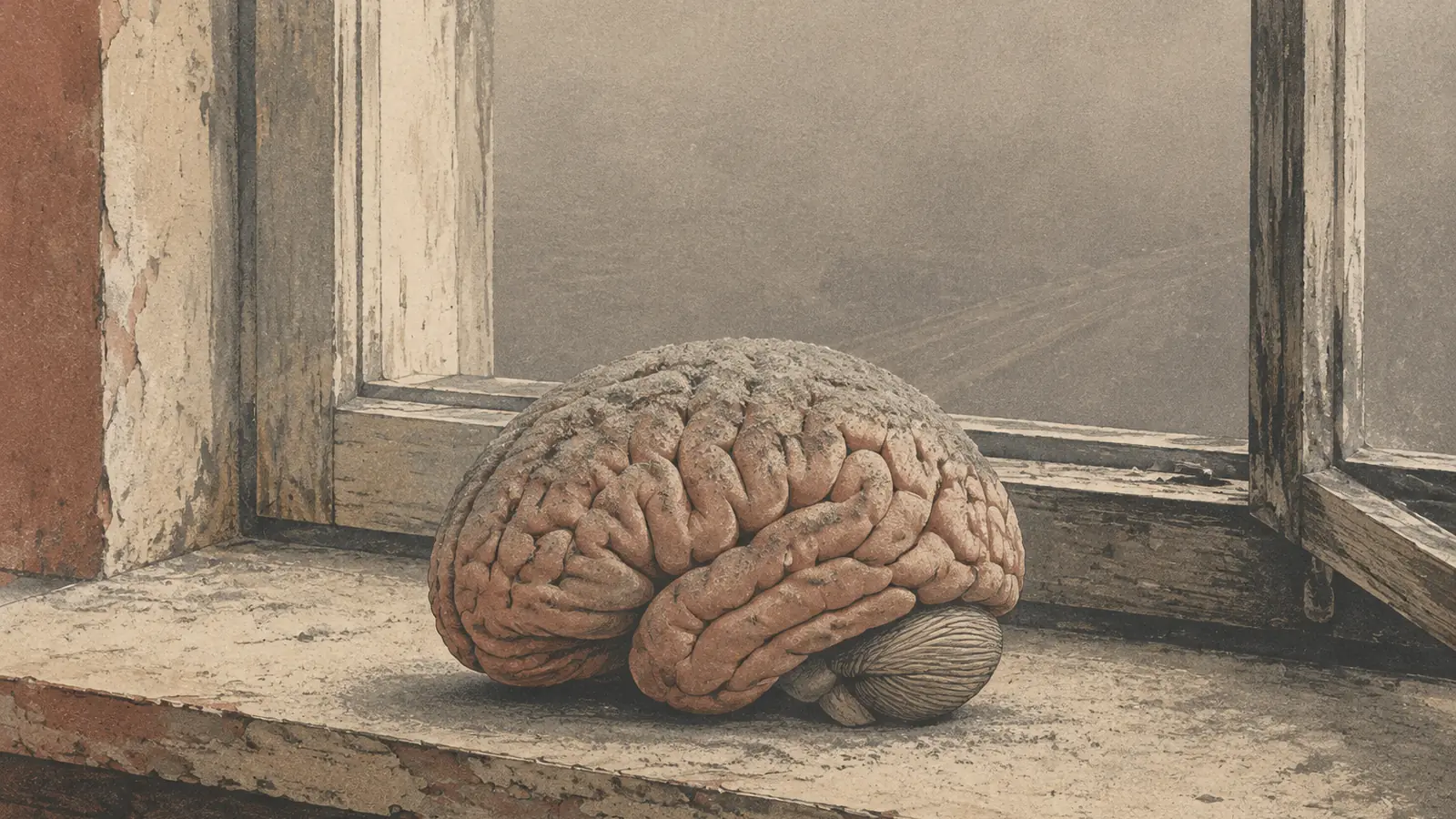
For years I filed air pollution under the wrong organ. Bad air was a lung thing, maybe a heart thing, something you worried about with asthma or a freeway at the end of the street. It never crossed my mind that the soot off a tailpipe might have a route to the part of me I most want to protect at 80: my memory, my judgment, the person I still am.
Then a number stopped me. In a CHARLS study of nearly 8,000 older adults, each 10 micrograms per cubic meter of long-term PM2.5 exposure was tied to a 15.7 percent rise in serum hs-CRP, a standard marker of the low-grade inflammation your body runs when something is quietly irritating it. Round it and call it 16 percent more inflammation in the blood, year after year, from the ordinary air outside the window. And a new CHARLS analysis in Environmental Health takes that finding somewhere it usually doesn’t go: instead of chasing one pollutant against one outcome, it pools several pollutants against a single composite neurodegenerative risk score and asks whether that systemic inflammation is what carries the damage from your lungs up to your brain.
The question is hard to shake for a physical reason. You breathe in a particle smaller than a fraction of the width of a hair. It lodges in your lungs. So how does something stuck in your airway end up wearing on neurons a long way north? One major hypothesis is that the particle never has to make the trip at all. It sets off an alarm where it lands, and the alarm is what travels.
That alarm is inflammation, and the evidence that dirty air rings it is not subtle. In that same study the effect climbed with the pollutant. PM2.5 raised hs-CRP by 15.7 percent (95% CI 10.9 to 20.8). Coarser PM10 pushed it 12.8 percent. The nitrogen dioxide that pours off traffic, 11.8 percent. PM2.5 also raised the odds of a clinically elevated CRP, above 3 milligrams per liter, by 19 percent. That is an immune system sitting on low-grade high alert, for years, because of what is in the air.
And chronically activated immune signaling is not gentle on a brain. The prevailing idea is that fine particles keep the microglia, the brain’s resident immune cells, in a low simmer that grinds on neurons across the very years that hold your memory. On paper it is a clean story: air inflames the blood, the blood inflames the brain, the brain slips. The new composite-score work leans into that story.
But I want to be straight about what complicates it, because this is genuinely unsettled and pretending otherwise would be its own kind of spin. Another CHARLS analysis, 6,434 people followed from 2011 to 2015, found air pollution tied to cognitive decline independent of hs-CRP. Cleaner air tracked with less decline (OR 0.934, 95% CI 0.925 to 0.943), and the same held for PM1, PM10, and NO2. But when the researchers formally tested whether hs-CRP was the middleman, it wasn’t: no significant mediation for any pollutant, every p-value above 0.23.
So which is it? Both can be true at once, and that is what makes it interesting to me rather than contradictory. Maybe hs-CRP is just too blunt a yardstick, one number standing in for a sprawling cascade, and the couriers that matter are cytokines it never counts. Or maybe inflammation is only one lane, and the particles are also taking a more direct road, slipping up the olfactory nerve or crossing a leaky blood-brain barrier to do harm the immune system never touched. The composite-score approach is an attempt to stop squinting at single markers and watch the whole pattern. I read it as a step forward, not a closed case.
What is not in doubt is the size of the stakes. The largest reckoning we have, a 2023 systematic review and meta-analysis in The BMJ led by Harvard’s Chan School, pooled 16 studies. In the 9 that actively went looking for dementia cases, risk rose about 17 percent for every 2 micrograms per cubic meter of annual PM2.5. Read that increment again. Two micrograms. That is a rounding error in most air-quality conversations. An earlier cohort in Neurology reported harm in the same direction.
This is where the science turns into something more like a citizen’s complaint. That dementia signal showed up even when annual exposure sat below the EPA’s own standard of 12 micrograms per cubic meter. So the dose moving these needles is not a catastrophic industrial plume. It is the ambient, permitted, this-is-fine level of particulate that hangs over ordinary cities, the level the standards were written to tolerate. The burden of proof has been quietly parked on the wrong side. We are asked to prove the air is dangerous, instead of asking the agencies who set the thresholds to prove it is safe at the levels they wave through.
I am not going to wait for that to be adjudicated. The mechanism is plausible, the inflammation is measured, and the cost of acting early is close to nothing. So here is what I actually do. I run a HEPA filter in the room where I sleep. I check the particulate number before a long run the way I check the forecast, and on the bad days I move the workout indoors instead of talking myself into it. None of that is a cure, and I won’t pretend it lowers my risk by some figure I can name. But when the evidence says the air is talking to my immune system, and my immune system may be talking to my brain, I would rather quiet that conversation where I can than find out in 30 years which lane the damage took.
Sources
- Environmental Health (2026) – The association of long-term air pollution with a composite neurodegenerative risk score among Chinese elderly: evidence from the CHARLS
- Environmental Health Perspectives / PMC – Systemic inflammation (C-reactive protein) in older Chinese adults is associated with long-term exposure to ambient air pollution
- PMC – Air pollution is linked to cognitive decline independent of hypersensitive C-reactive protein: insights from middle-aged and older Chinese
- The BMJ (2023) – Ambient air pollution and clinical dementia: systematic review and meta-analysis
- Harvard T.H. Chan School of Public Health – Air pollution may increase risk for dementia
- Neurology (2023) – Association of long-term exposure to air pollution and dementia risk