For a couple of years I have carried around a tidy little story about aging. As you get older, some of your cells stop dividing but refuse to die, turning into “zombie” cells that squat in your tissues and leak inflammation, and the smart move is to hunt them down and kill them. That is the whole senolytics pitch. So when I saw a headline about scientists finding “how” these cells fuel inflammation, I braced for another reason to want them dead.
You might just have to cut off their groceries.
This study says something else, and it is the reason I read it twice. You might not have to kill the zombie cells at all. You might just have to cut off their groceries.
The work, published in Nature by a team spanning Mayo Clinic, Sanford Burnham Prebys, Imperial College London, Albert Einstein and the University of Glasgow, went looking inside senescent cells at the thing that keeps them screaming: a program called the senescence-associated secretory phenotype, or SASP. SASP is what makes a zombie cell dangerous instead of just idle. It is the cell pouring out a steady broth of inflammatory signals that wear on every tissue around it. “Senescent cells are not completely inert,” Sanford Burnham’s Peter Adams put it. “They remain metabolically active and have an inflammatory program causing them to secrete inflammatory molecules.”
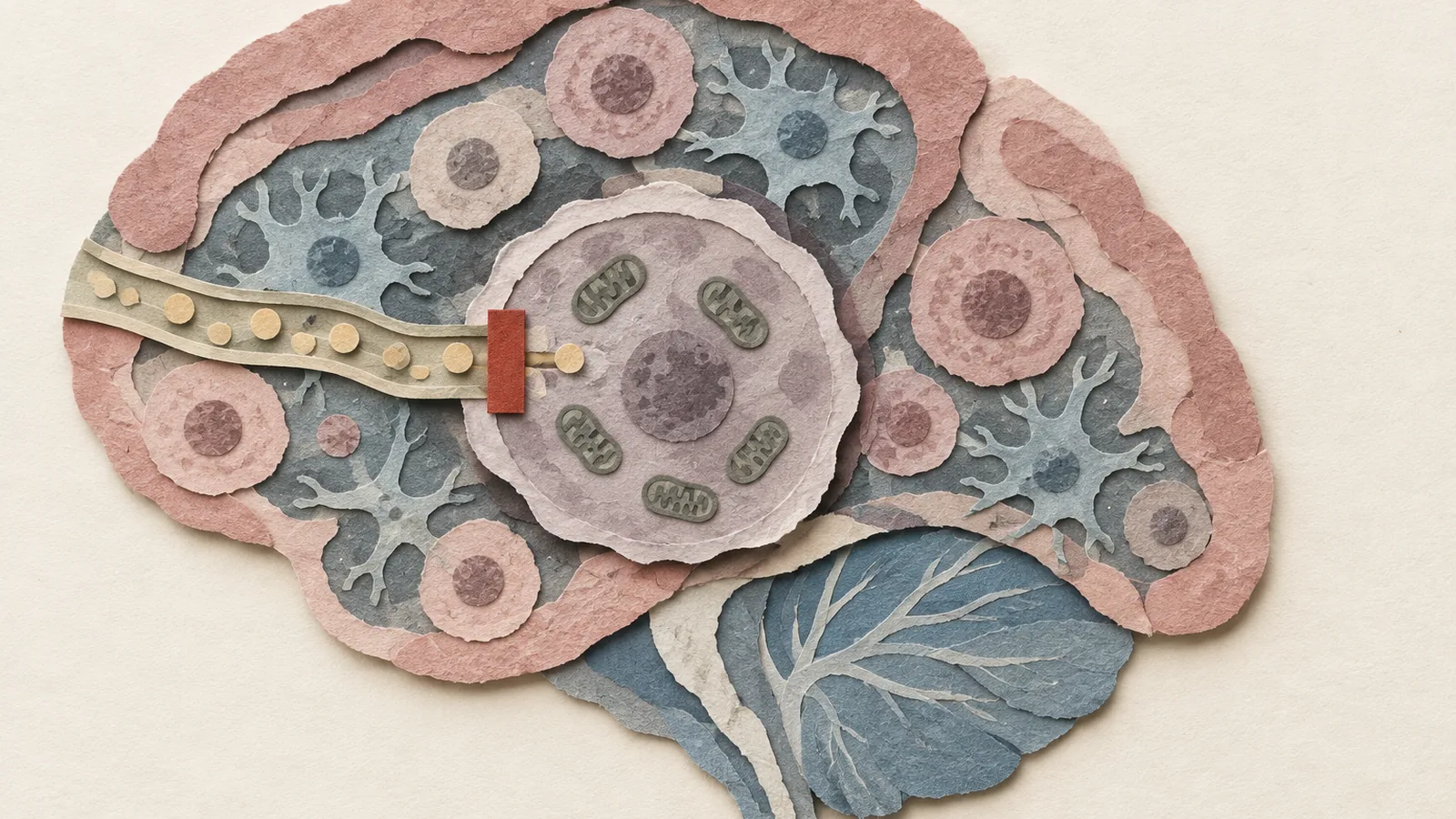
Here is where I had to slow down, because the mechanism is genuinely strange, and it runs through the mitochondria, the little organelles you were taught to file under “batteries.” In these old, stuck cells the mitochondria are malfunctioning, and they misbehave in two directions at once.
The first path is the one you would expect. Damaged mitochondria spring leaks, and bits of their own DNA and RNA spill out where they do not belong. Your cell reads loose DNA floating around the cytoplasm as a red alert, the same innate-immune alarm (the cGAS-STING danger sensor) that trips when a virus breaks in, so it throws inflammatory transcription factors at the problem. Fine. That fit my mental model.
The second path is the one that got me. Those same broken mitochondria ramp up production of a molecule called acetyl-CoA, which I had always filed under metabolism, the workhorse of how you burn fuel. But acetyl-CoA has a second job most of us never hear about. It is the raw material for acetylating histones, the spool-proteins your DNA winds around. Pile acetyl groups onto those spools and the winding loosens. And when the DNA around your inflammatory genes loosens, those genes go from locked in a drawer to sitting open on the desk, ready to be read.
Wait, so the cell’s fuel chemistry is literally deciding which of its own genes are readable? That is the question I kept circling. The inflammation is not simply switched on by an alarm. One arm of the broken machinery pries the inflammatory genes open while the other arm floods the cell with the signal to transcribe them, two mitochondrial failures converging on the same fistful of genes. “It turns out that there is a convergence of at least two biological pathways related to mitochondria,” Adams said. “One alters how DNA is stored to promote areas related to SASP, and the other boosts the expression of the exposed SASP genes.”
So they cut one arm off. Using a compound called CTPI-2, they blocked the transporter that feeds acetyl-CoA production (the citrate carrier, if you want the name on it), starving the epigenetic half of the partnership. The leaky-DNA alarm was still firing. But with the acetyl-CoA supply choked, that signal was not enough to keep the SASP genes open, and they stayed wound up tight and mostly unreadable. “Even though the immune signaling from leaky mitochondria was still present,” Adams said, “disrupting the metabolic signal made SASP genes less accessible.” In aging mice, the researchers reported, CTPI-2 lowered inflammation across multiple tissues and, in their words, “improved tissue function and healthspan.”
Let me be honest about the distance still to travel, because it is most of the distance. This is mice and a research-tool compound, and the anti-aging field is a graveyard of drugs that quieted inflammation in a cage and then died on contact with a human body. And the money does not reward caution: this project was backed by the usual NIH institutes alongside longevity philanthropies like the Saudi-backed Hevolution Foundation and the Glenn Foundation, the kind of funding that flows toward an anti-aging headline, not toward the boring humility a decades-long human therapy would demand. My own pharmacology worry is simpler. Any drug that chokes acetyl-CoA this broadly is going to touch far more than zombie cells, and I would want to see what that costs a whole animal before anyone gets excited.
But strip the hype off and what is left is a genuinely different idea from the one I walked in with. The reigning strategy is to kill senescent cells outright, which is blunt, and not every senescent cell is a pure villain; some of them do real work healing wounds and helping wall off tumors. This points at a gentler lever: leave the cell alive, turn down the metabolic signal it uses to shout, and the tissue around it gets quieter. Adams called reducing acetyl-CoA to cut inflammation “a novel therapeutic strategy that should be explored,” and for once the press-release verb is doing honest work.
What I actually take from it, sitting here with my tidy old story in pieces, is small and concrete. I am not going hunting for a senescence drug, and I would treat anyone selling me one as a scam, because there is no real one yet. What changed is how I picture the inside of my own cells. I have stopped thinking of mitochondria as batteries that only make energy. If a cell’s fuel chemistry can decide which of its inflammatory genes are open for reading, then the organelle I was taught to think of as a power plant is also sitting at the switchboard, and that is the image I will not be able to un-see.
Sources
- Nature – Martini et al., “Mitochondrial metabolism and epigenetic crosstalk drive the SASP” (2026)
- EurekAlert / Sanford Burnham Prebys – “Altered metabolism in zombie-like cells helps promote destructive inflammation as we age”
- ScienceDaily – “Scientists find how ‘zombie’ cells fuel inflammation as we age”
- Nature News – “How to kill the ‘zombie’ cells that make you age” (2024)