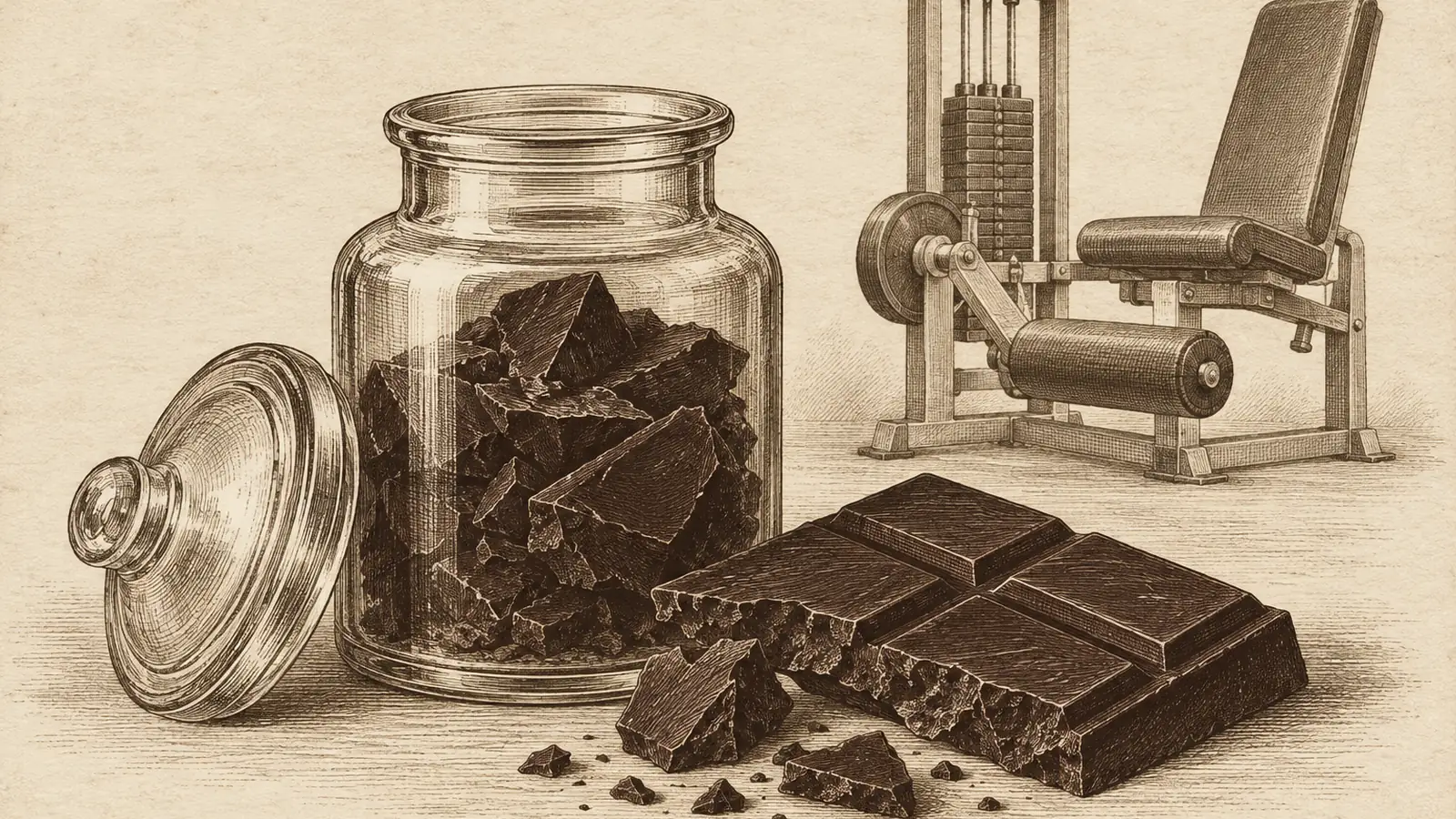
I have always treated a fasted morning workout as an exercise in ignoring my own body. Empty stomach, quiet gym, one rule I never broke: do not think about food, because dwelling on a meal while you are hungry and about to fail on your last set only makes the whole thing harder. So a study that hands hungry men a jar of dark chocolate to sniff before they lift, then watches them do more work instead of less, lands as a small insult to everything I assumed about how hunger and effort fit together.
Then I read the numbers. A randomized, double-blind crossover trial out of the University of Malaya, published in Frontiers in Physiology, put 23 resistance-trained men (average age 23, lifting at least twice a week for two-plus years) through leg extensions after a 10-hour overnight fast. Same protocol every visit: sets of 10 reps at 80 percent of their 10-rep max, grinding to exhaustion, three and a half minutes of rest between sets. The only thing that changed was what sat under their nose for 30 seconds beforehand, a suspension of 90 percent dark chocolate, a milk-chocolate emulsion, or plain water.
Sniff the 90 percent dark chocolate and the men did about 18 more total repetitions than on water, a gap with a 95 percent confidence interval of 13.8 to 22.1 and a p-value under 0.01. Milk chocolate bought about 9 extra reps. And they did not report working any harder for either one. Rated exertion, the Borg scale the researchers collected after every set, sat flat across all three conditions. More reps, no extra strain on the dial to show for it. A number that big should make you happy and suspicious in roughly equal measure, and this one earns both.
So of course the question I could not put down was this: why would a smell you are explicitly not allowed to eat make your quadriceps last longer? The researchers’ answer is that the body does not wait for the food to arrive. A rich, bitter, intensely satiating smell like 90 percent cocoa is a learned cue, and the brain reads that cue and starts behaving as though the meal is already on its way. Senior author Mohamed Nashrudin bin Naharudin calls it “an anticipatory state of fullness.” The dark chocolate did lower the men’s rated hunger and raise their sense of fullness before they lifted; the sweeter milk chocolate acted more like a pleasure cue, agreeable but not filling, and it delivered the smaller boost. This is cephalic-phase territory, the same wiring that makes your mouth water and your gut start prepping before the first bite. The smell pours in, the system leans toward “fed,” and the final reps come easier.
It is a lovely story about the body, and I want it to be true. Which is exactly the moment I get suspicious of myself.
Because the study’s own statistics do not close the loop. When the authors ran mediation analyses to test whether the appetite change actually explained the performance jump, the results came back inconclusive: the indirect effects running through hunger, fullness, and pleasantness all had confidence intervals that crossed zero. The appetite ratings moved and the reps moved, and lower hunger tracked with better performance, but the data could not show that one drove the other. The authors say it flatly, that the mechanism “remains inferential.” No blood hormones drawn, no neural activity recorded. Anticipatory fullness is the most charming explanation on the table, not a demonstrated one.
There is a blunter problem sitting in the control group. The researchers checked whether participants could tell which jar they had been given, and for the water control they absolutely could, a blinding index of 0.87, near the top of the scale. The two chocolate jars masked fine, but everyone clocked the boring one. So part of that 18-rep gap could be the quiet deflation of getting handed the nothing jar and knowing it, rather than anything happening in the cocoa. When your comparison condition is the sample people can smell is a dud, the chocolate starts with a head start it did not earn.
And smell-as-performance-enhancer has burned people before. A decade ago peppermint aroma drew a wave of headlines for supposedly boosting endurance and grip strength, and when another lab ran a controlled 10-day test, aerobic capacity did not improve at all. Aromas are cheap to bottle and easy to hype, which is exactly why the evidence underneath them earns a hard look before anyone starts selling it.
Then there is the funding, and this is the bit I find almost hard to believe. The authors declared that no financial support was received for the work and no conflicts of interest. There is no chocolate-scented pre-workout waiting in the wings, no capsule or subscription, no “clinically studied” sticker headed for a tub of powder. Walk the supplement aisle in your head for a second: a 9-rep effect this clean would already be a forty-dollar product with a proprietary blend and a shirtless man on the label. Instead it is a free trick with a real, if fragile, signal under it, and that pairing is rarer than it should be.
What it is not, yet, is proof that chocolate makes you stronger. It is 23 young trained men on one leg machine, fasted, in a single lab. Whether the effect survives a barbell squat, a fed stomach, an older or female body, or the grind of a twentieth session, nobody knows. The effect is large and the story around it is thin, and both of those things are true at once.
So no, I am not buying a chocolate candle for my gym bag or waiting for anyone to bottle the pre-workout version. But the next time I train fasted, I am going to keep a square of real 90 percent dark chocolate in the bag, break the wrapper, and take one slow breath of it before the set I expect to fail on. It is cheap and about as low-risk as interventions get, and if it buys me three reps I will happily take them. I will just trust the reps a good deal more than I trust the tidy story about why they showed up.
Sources
- Frontiers in Physiology – Naharudin et al., chocolate-odor and resistance-exercise randomized double-blind crossover trial (2026)
- Frontiers – “Sniffing chocolate could make your leg day workout easier,” researcher quotes and summary
- Journal of the International Society of Sports Nutrition – Meamarbashi & Rajabi, peppermint and exercise performance (2013)
- Applied Physiology, Nutrition, and Metabolism – Shepherd & Peart, null follow-up on peppermint essential oil and aerobic capacity (2017)