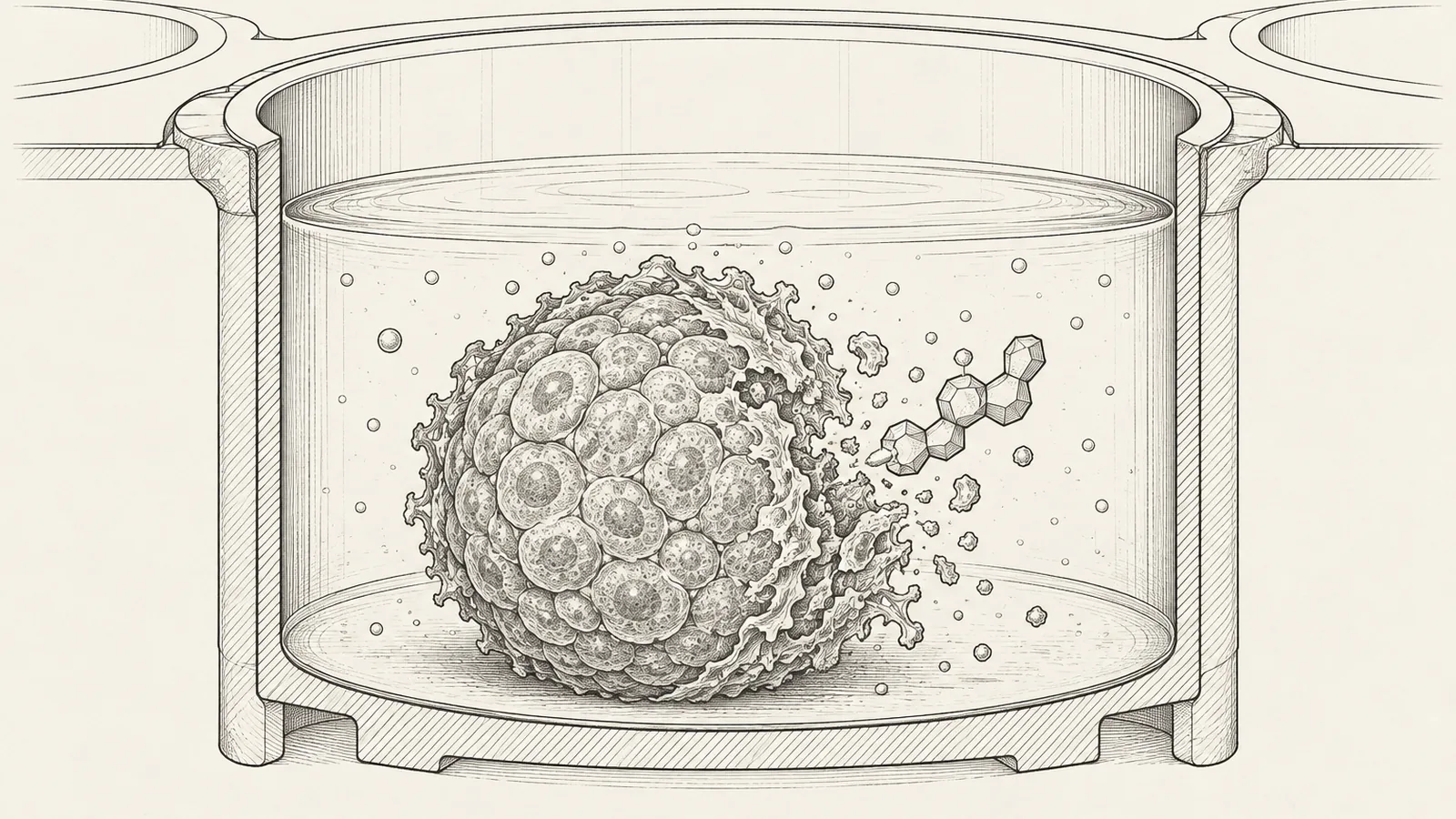
Weei-Chin Lin has spent years hunting for a switch. In his lab at Baylor College of Medicine, he and his colleagues screened thousands of chemical compounds against a single protein, a molecular junction called TopBP1 that cancer cells lean on when the drugs meant to kill them start to work. They pulled a promising molecule out of the pile, labeled it 3B6, and rebuilt it version after version until they had something sharper. They named the winner CS18, and in Science Advances they make the case that oncology has wanted to make for half a century: that it strips a tumor of the very defenses it uses to survive treatment.
By the standards of its own field, the claim is a serious one. It is also, every last data point of it, preclinical. The headline that carried it into the world, “This new drug could break cancer’s resistance to treatment,” is doing a great deal of work with the word could.
The published account centers on a corner of TopBP1 the paper calls the BRCT7/8 switch, and it is a busy piece of real estate. Think of it as the knot a cancer cell ties to hold several survival programs together at once. Through it, the tumor pins down MIZ1, a brake that would otherwise restrain the cancer driver MYC; it props up mutant p53, the version of the famous tumor suppressor that has flipped sides and gone to work for the disease; and it keeps PLK1 and CIP2A running, two proteins that help a cancer cell divide and hold itself together through the violence of mitosis. CS18 pries those complexes apart. The cell, unable to finish dividing, stalls in prometaphase and dies in what the authors call mitotic catastrophe.
In a dish, it worked across an unusually wide spread of cancers. The published data run CS18 against eight cell lines drawn from breast, ovarian, lung, and blood cancers, killing them at half-maximal potencies from 0.15 micromolar in a triple-negative breast line to 0.67 in a lung squamous line, with ovarian at 0.18 and cisplatin-resistant ovarian, EGFR-mutant lung, and acute myeloid leukemia all falling in between. It bound its intended target down in the single-digit nanomolar range. Paired with PARP inhibitors, drugs that already exploit a cancer’s broken DNA repair, it produced synergy in multiple tumor types. And in lung cancer cells that had learned to shrug off osimertinib, the standard targeted drug for EGFR-mutant disease, adding CS18 restored their sensitivity. Osimertinib resistance is one of the genuine daily defeats in an oncology clinic. In a flask, this molecule undid it.
across 8 cancer cell lines
- Lower bound
- 0.15
- Upper bound
- 0.67
Then the work moved into animals. In a breast tumor grown from a patient’s own cells and implanted in a mouse, 40 milligrams per kilogram twice a week for fifteen days suppressed the tumor’s growth, and the animals tolerated it without major weight loss. That is a legitimate result, and it is where the road, for now, ends. The cells surrendered their resistance. No patient has been asked whether their cancer will do the same.
None of that is a knock on the science, which is careful and broad. It is a knock on the compression that happens between a laboratory and a press cycle, where “reverses osimertinib resistance in a xenograft” becomes “could break cancer’s resistance to treatment,” and the mouse quietly drops out of the sentence.
There is one more line in the paper worth reading closely, and it sits in the disclosures rather than the results. Weei-Chin Lin and his coauthor Fang-Tsyr Lin are cofounders of a company, ETIEN Bio Inc. This is not a scandal; academic scientists spinning out their own discoveries is how a great many drugs reach patients at all, and the money behind the work is the respectable kind, a stack of NIH grants and Department of Defense awards. But it does mean the people telling you CS18 could break cancer’s resistance are also the people who stand to gain if you believe it, and a reader is entitled to hold both facts at once.
The deeper reason for caution is the graveyard between the mouse and the clinic, and it is crowded specifically with drugs designed to break resistance. Look at what is already sitting in the trial registry under that same banner. A German study called PROMIT is giving old-line chemotherapy to melanoma patients with primary resistance to anti-PD-1 immunotherapy, on the theory that the chemo will pry the resistance open; it enrolled 38 patients in a single-arm phase 2 with no control group, and it has posted no results. A Chinese trial pairing dalpicilib with cetuximab in anti-PD-1-resistant head and neck cancer is testing a resistance-breaking combination in 98 patients, randomized against cetuximab alone; it, too, has reported nothing yet. These are the drugs that already reached human beings. Most preclinical winners never get that far, and most of what dazzles in a xenograft never dazzles in a person.
| Trial | Patients | Results posted |
|---|---|---|
| PROMIT | 38 | none |
| Dalpicilib + cetuximab | 98 | none |
CS18 has not entered that gauntlet. It has not been given to a single patient, and the paper does not pretend otherwise; the pretending happens later, downstream, in the headline. What Baylor has is a well-characterized molecule that hits a clever target, performs across a striking range of tumors in the lab, and has a company and a plausible mechanism behind it. That is a good day for a cancer researcher. It is not yet a good day for anyone with cancer.
Weei-Chin Lin now has the thing every drug hunter chases: a lead asset that behaves beautifully in a mouse. The distance from there to a person is the entire history of oncology, and Lin, who has read the same registry the rest of us can, knows better than anyone how much of that history is disappointment.
Sources
- Science Advances / PMC – Lin et al., “Development of a structurally distinct TopBP1 inhibitor that enhances PARP blockade and reverses osimertinib resistance” (full text, 2026)
- ScienceDaily – “This new drug could break cancer’s resistance to treatment” (Sept 2026)
- ClinicalTrials.gov – PROMIT: dacarbazine before checkpoint blockade in immunotherapy-resistant melanoma (NCT04225390)
- ClinicalTrials.gov – Dalpicilib plus cetuximab in anti-PD-1-resistant head and neck cancer (NCT06935188)