When I read that a lupus drug had “failed” its main test, I did what I do with every failed trial: filed it under didn’t work, felt a little sad for the patients waiting on it, and started to move on. Then I looked at the actual numbers, and the filing fell apart in my hands.
Here is what “failure” looked like in WILLOW Cohort B, the phase 2 trial of enpatoran published in The Lancet. Three hundred and fifty-four adults with moderate-to-severe systemic lupus, randomized to placebo or one of three doses on top of their usual care, followed for 24 weeks. Every enpatoran group beat placebo on BICLA, the composite score rheumatologists use to say a lupus patient is genuinely better across their organ systems. The inflammatory interferon signature in their blood came down. More of them tapered their steroids while still improving. That is not what a dead drug does.
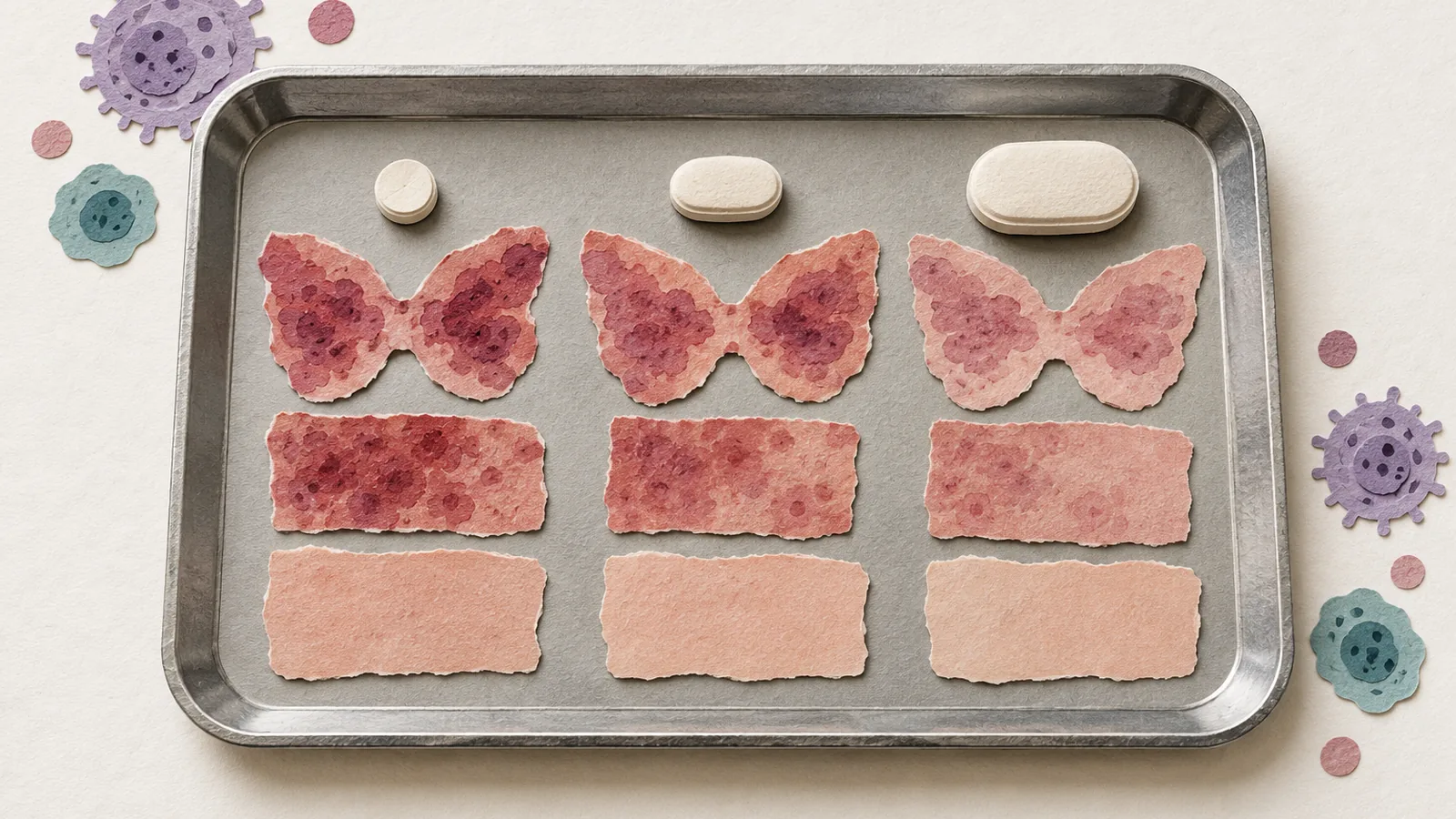
So why the “failure”? The primary endpoint was not “does it beat placebo.” It was “does the response climb as the dose climbs,” tested through a model called MCP-Mod that is built to detect a rising dose-response line. Enpatoran’s response didn’t rise. Per the Clinical Trial Vanguard breakdown, it posted 58 percent at the lowest dose, then 49 percent and 49 percent as the dose went up. The formal test came back p=0.14, a miss. On paper, a negative trial.
| Group | Value (percent) |
|---|---|
| Lowest dose | 58 |
| Middle dose | 49 |
| Highest dose | 49 |
And this is where I had to stop and think about the biology, because a plateau is exactly what this drug’s mechanism predicts. Enpatoran blocks Toll-like receptors 7 and 8, two sensors inside immune cells that, in lupus, get tricked into treating the body’s own genetic debris as a viral invader and pour interferon into the blood in response. Enpatoran sits on those receptors and shuts the sensing off. Wait, so why wouldn’t more drug give you more effect? Because a receptor is a finite thing. Once you have occupied enough of it to switch the alarm off, the extra pills have nothing left to bind. You have already closed the door, and you cannot close it harder. Block enough of a finite target and the curve flattens; that is occupancy pharmacology, not a post-hoc excuse.
Which means the trial asked a saturating drug to behave like a non-saturating one, then called it a failure when it didn’t. Feed a flat line into a test that only rewards a climbing one and you get noise back. The molecule did what its mechanism says it should. The ruler was cut for a different molecule.
If you want the cleanest sign that the drug, not the disease, was the constant here, look at the other half of the same study. WILLOW’s Cohort A tested the identical compound in lupus patients whose disease shows up mainly on the skin, and it met its skin endpoint cleanly, enough that the FDA handed enpatoran a Breakthrough Therapy Designation for cutaneous lupus. Even inside Cohort B’s systemic patients, the Lupus Foundation of America summary reports that among those with the worst skin involvement, up to 81.5 percent on enpatoran reached a 50 percent improvement in rash severity, against 41.5 percent on placebo. Same drug, same pathway. What changed was which endpoint you pointed at it.
That is the argument two lupus researchers made in a Lancet correspondence in late September, and it is a sharp one: did the drug alter the disease biology, and was a composite endpoint spread thin across every organ system and read through a dose-climbing model ever built to catch that alteration at a plateau? The trial’s own authors largely agreed in their reply, noting that all doses attained the composite more often than placebo even as the dose-response model came up empty.
Here is where I make myself slow down, because there is a version of this story that is too convenient. A drugmaker whose product missed its primary endpoint has every incentive on earth to tell you the ruler was broken, not the drug. And Merck KGaA, the German pharma company behind enpatoran through its EMD Serono arm, is using precisely this reasoning to justify pushing the drug into phase 3. “The endpoint failed, not the molecule” is both a persuasive scientific claim and a useful corporate one, and those two facts do not cancel out. Post-hoc subgroup wins are exactly how weak drugs get laundered into approvals, and lupus in particular is a graveyard of trials that looked great in a slice and evaporated at scale. So the burden is on the evidence, not the slogan.
The evidence is what makes this case stronger than the usual salvage job, and the reason is mechanistic rather than statistical. The interferon signature dropping is not a subgroup someone carved out after the fact to hunt a p-value. It is a direct readout that the drug hit the target it was designed to hit, sitting upstream of the whole inflammatory cascade. The plateau isn’t an anomaly to explain away either; it is what the pharmacology says a receptor blocker should do. When the biomarker, the mechanism, and a second cohort all point one way and only the composite endpoint disagrees, the honest read is that the endpoint was the outlier, not the drug.
The uncomfortable part reaches past one compound. If a rigid, one-shape-fits-all endpoint can bury a drug that measurably calmed the immune system in hundreds of patients, then somewhere in the discard pile of “failed” lupus trials are other drugs that did something and got filed under didn’t, killed by the ruler instead of the result.
I do not have lupus. But if I did, and my disease ran on that interferon fire, I would not let “trial failed” be the last word on this molecule. I would want to know which ruler got used before I believed the drug was dead, and I would ask harder questions of the next headline that tells me a treatment didn’t work.
Sources
- The Lancet: Enpatoran in moderate-to-severe SLE, WILLOW Cohort B phase 2 trial (2026)
- The Lancet: “Mechanism-endpoint matching in lupus, WILLOW Cohort B” (correspondence, 2026)
- The Lancet: WILLOW authors’ reply on mechanism-endpoint matching (2026)
- Clinical Trial Vanguard: “The WILLOW Trial Didn’t Fail Enpatoran. The Endpoint Did.”
- Lupus Foundation of America: Phase II enpatoran WILLOW results summary
- EMD Serono: Positive Phase 2 data for enpatoran (press release, 2025)
- FierceBiotech: Merck KGaA shares data justifying a phase 3 push despite the setback
- Rheumatology Live: Enpatoran gets FDA Breakthrough Therapy Designation for cutaneous lupus
- ClinicalTrials.gov: NCT05162586, the WILLOW study of enpatoran (M5049) in SLE and CLE