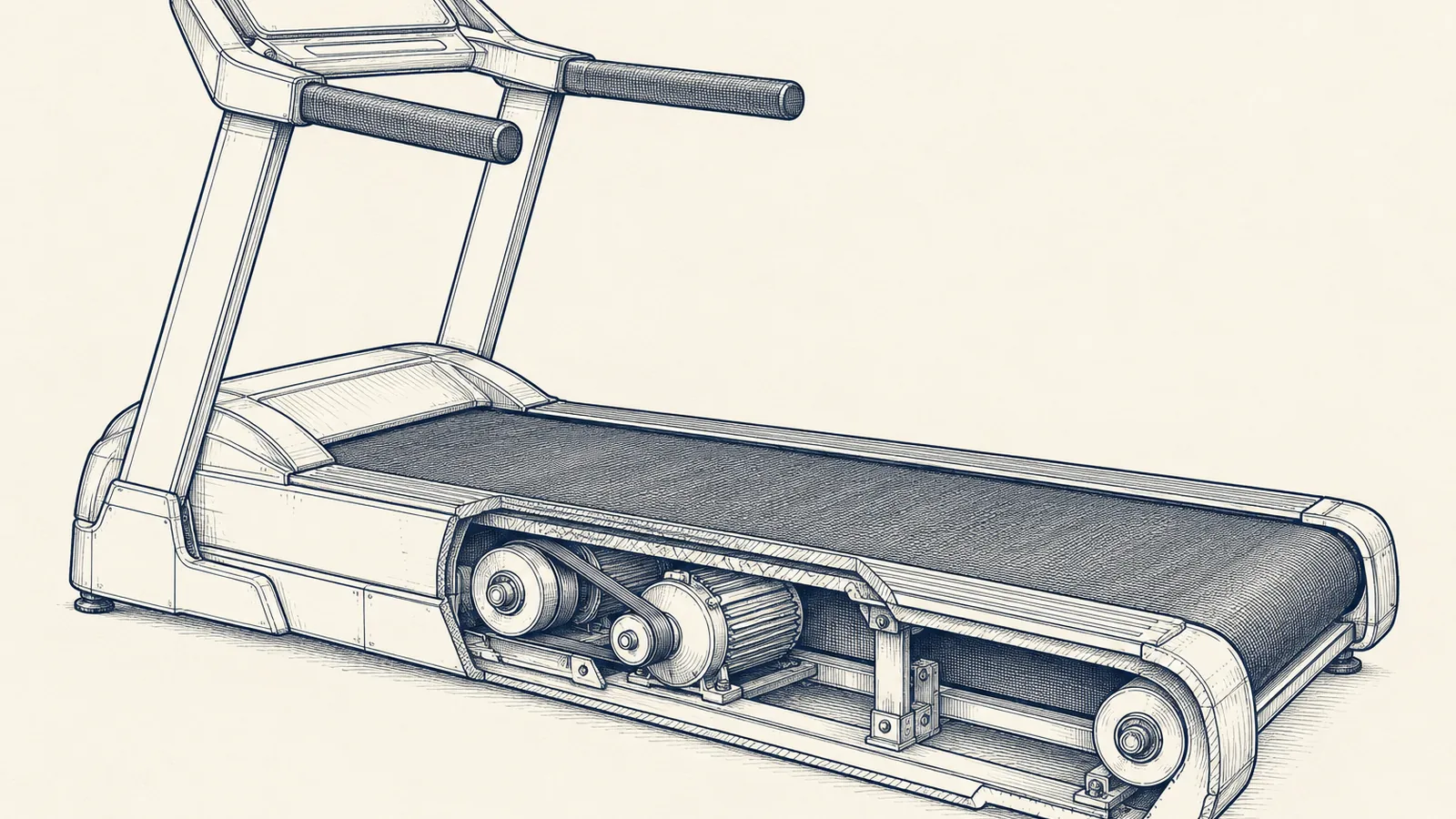
I have said the same thing to friends for years: if you want to keep your muscle after 60, you lift. Cardio is for the heart, weights are for the muscle, and a treadmill will quietly take a little of both if you let it. So a result out of Queensland snagged on me, because it points the other way. Same treadmill, same three sessions a week, same 45 minutes. The only thing that changed between two of the groups was how hard they pushed, and the lean-mass result flipped. The hard intervals held. The gentler version of the identical workout is the one that gave some away.
Once you account for the wobble in a body scan, the gap between the hard group and the moderate group may be too small to feel in real life.
That is the finding at the center of a six-month study of 123 healthy older adults, average age 72, run as a sub-study of a registered randomized trial at the University of the Sunshine Coast. Everyone did the same thing on paper: three supervised 45-minute treadmill sessions a week, with the pace set to each person’s own heart rate. One group worked at high intensity, the short hard-then-easy pattern we call HIIT. One worked at a steady moderate effort. One stayed in a low-intensity control. The researchers scanned every participant with DXA, a standard body-composition scan, at the start, at three months, and at six.
Here is the part I keep rereading. All three groups lost a modest amount of fat. Both the HIIT group (p = 0.001) and the moderate group (p = 0.016) dropped fat mass by similar amounts, and both beat the control. But the steady-cardio group paid for it: moderate training was the only one that lost fat-free mass, what the scan reads as lean tissue, showing up by three months (p = 0.005) and still there at six (p = 0.050). The interval group held onto its lean tissue, and it was the only group whose body-fat percentage actually improved on net (p = 0.017). Visceral fat, the deep belly fat that tracks with metabolic disease, fell comparably in both working groups. As lead author Dr Grace Rose put it, “high, medium and low intensity exercises all led to modest fat loss but only HIIT retained lean muscle.”
So, wait: why would a treadmill of all things protect lean tissue, and why would the easier session be the one that costs you? This was the question I actually wanted answered, because nothing about plodding cardio says “muscle-sparing.” The researchers’ own explanation is stress. Co-author Mia Schaumberg told the university that HIIT “likely works better because it puts more stress on the muscles,” giving the body “a stronger signal to keep muscle tissue rather than lose it.” Here is how I read that, and this part is physiology I am layering on, not something the substudy measured: when you push into the hard intervals, your legs cannot coast on the slow, fatigue-resistant fibers alone, so the effort reaches up into the big fast-twitch fibers, the ones that waste fastest with age. A steady moderate pace stays inside what the slow fibers can cover, the fast fibers never get recruited hard, and in a 72-year-old body that is already shedding them, that silence slowly reads as permission to let them go. If that is right, the discomfort is not a side effect of the workout. It is the workout.
That mechanism is satisfying, and it is also where the treadmill story gets smaller, because the press framing ran out ahead of the people who did the work. The ScienceDaily writeup that put this study in front of everyone is headlined “Only one workout helped older adults lose fat and keep muscle,” which lands like a verdict. The authors did not write a verdict. In the paper itself they call the body-composition changes small and “not clinically meaningful compared with exercise of lower intensity and considering measurement error.” Read that twice. Once you account for the wobble in a body scan, the gap between the hard group and the moderate group may be too small to feel in real life.
A few other things kept me honest. The arms were small, 41 in HIIT, 45 in moderate, 37 in the control, and in groups that size I would want this repeated before I leaned on it, because a handful of unusual responders can tilt a result either way. “Lean mass” on a DXA is fat-free tissue, which folds in water and organ mass, so it is not a measurement of strength, and “kept muscle” is reasonable shorthand rather than the same claim as “kept power.” And the whole thing ran six months in already-healthy seniors who could show up to a supervised gym three times a week, which is not the frail population most at risk of losing muscle in the first place. None of that makes the result wrong. It makes it a signal, not a prescription.
What I take from it is smaller and more usable than the headline. The study does not say cardio wastes muscle. It says lazy-paced cardio might, a little, while harder intervals of the identical 45-minute session did not, inside the same three-times-a-week schedule. So here is my actual decision. I am adding real intervals to the cardio I already do, pushing into the part that makes me want to stop, because that discomfort is apparently the signal doing its job. What I am not doing is dropping the weights or treating a treadmill as a muscle machine. The hard minutes are worth claiming. They do not replace the barbell, and I will not pretend they do.
Sources
- JCU ResearchOnline – open-access record and results for Rose et al. (2025)
- University of the Sunshine Coast – “Research finds exercise type to target body fat in seniors”
- Maturitas – Rose et al., “Exercise intensity influences body composition: a 6-month comparison of high-, moderate- and low-intensity training among healthy older adults” (2025; 203:108763)
- ScienceDaily – “Only one workout helped older adults lose fat and keep muscle” (Oct 2026)