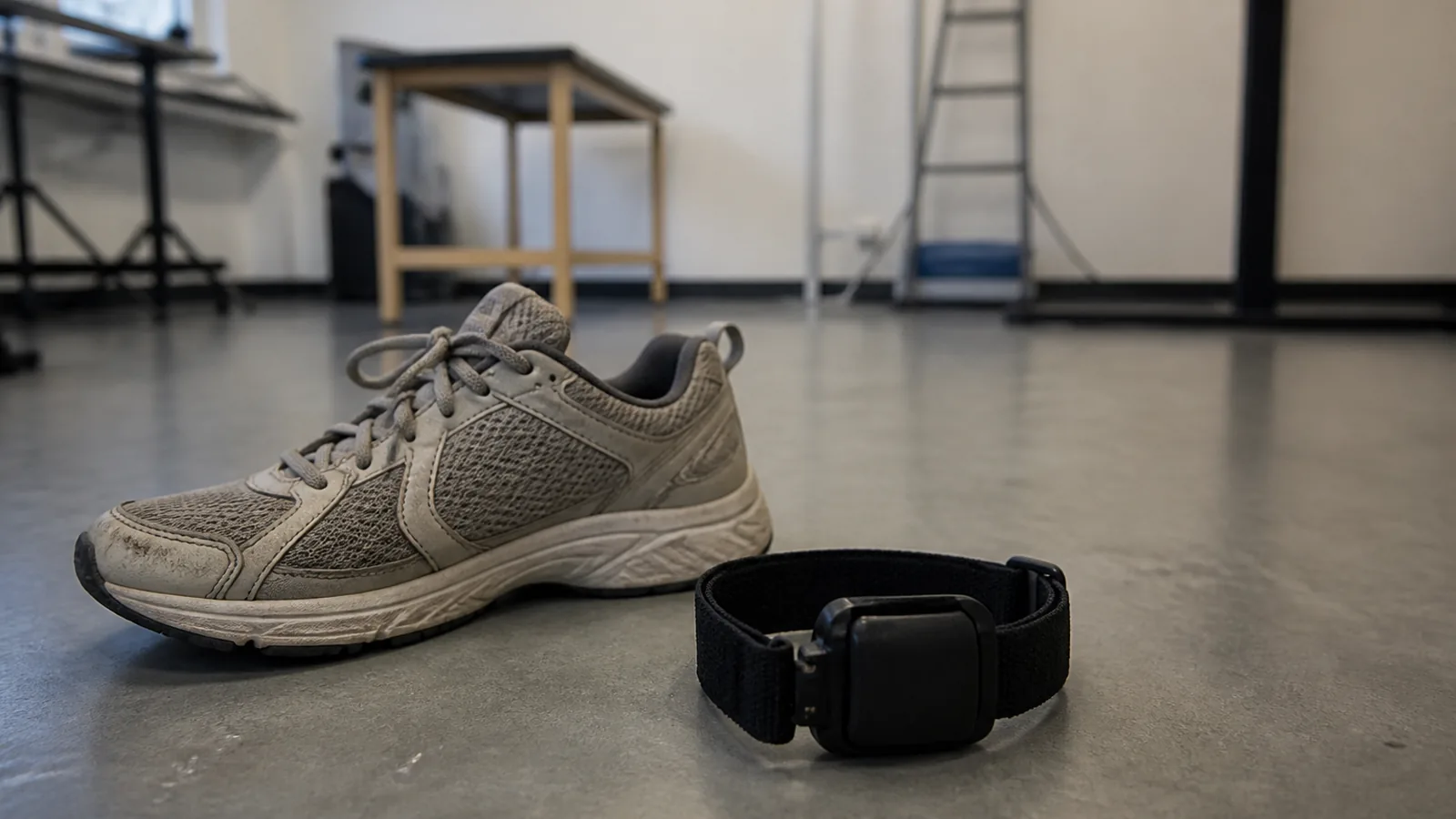
The oldest person to cross the movement lab at Flinders University was 86. The youngest was 26. Between them, in a study of 107 healthy adults wired up to record how their legs actually worked, researchers from Flinders and the University of Canberra caught something most of us feel long before we can name it: the walk that used to be free starts, somewhere in the seventh or eighth decade, to cost.
What the sensors recorded was not weakness in the ordinary sense. It was a fight. In the older walkers the muscles on opposite sides of the ankle fired at the same instant, each pulling against the other, a pattern physiologists call co-contraction, and the joint locked up just as the foot met the ground. “Stiffening the joint makes walking safer,” the study’s lead author, Cody Lindsay, told his university, “but it also means the muscles are working harder without generating as much forward movement.” The braced ankle is steadier, less likely to roll or buckle on uneven pavement, and it pushes off with less power, which is why the older participants’ strides came out shorter and their pace slower. The muscles worked harder. The body moved less.
You could file that under the ordinary arithmetic of getting old, except for what sits on the other side of it. Falls are the leading cause of injury death among Americans 65 and older, and the CDC’s own numbers are moving the wrong way. The age-adjusted fall-death rate climbed 21 percent between 2018 and 2024, from 64.7 to 78.4 deaths per 100,000 older adults.
In 2024 alone, preventable falls killed 43,020 Americans 65 and over. One in four older adults falls every year. Read against that ledger, the stiff, cautious gait stops looking like decline and starts looking like defense.
That is close to how the senior author reads it. Associate Professor Maarten Immink described the shift as a decision the aging nervous system makes on your behalf. “The nervous system adopts a safety-first approach,” he said, “compensating for age-related changes by favouring stability over performance.” The slower walk is not the malfunction. It is the workaround. And like most workarounds it bills you later: more fatigue over distance, and less in reserve to recover from a trip or a slip, which is the exact thing that ends with someone on the floor.
Here is where the press release, and the wire headlines that chase it, get out ahead of the paper. “Scientists reveal why walking gets so much harder with age,” ran the coverage. Why is a heavy word for what this study did. It compared 107 people of different ages at a single moment in time. It did not follow one 40-year-old ankle until it turned 80. A snapshot like that can show, and this one shows convincingly, that older ankles brace more and push off less than younger ones. It cannot prove that any single body sat down one year and traded its speed for stability. The safety-first story is a plausible reading laid over a correlation, not a mechanism caught in the act.
None of which makes the finding useless. The useful part is what the researchers did not reach for. They prescribed no drug and no device. Lindsay’s list was almost old-fashioned: regular physical activity, balance work such as tai chi, lower-leg strengthening, and drills that challenge coordination. Notice what leads it. Coordination and balance, not raw strength. You can build a powerful calf and still walk braced for a fall if the nervous system never relearns to trust the ground under it, and coordination is trainable by anyone with a floor and the patience to practice on it, no prescription required.
Cody Lindsay watched 107 people cross a room in Adelaide and came out the other side recommending tai chi. It is not the finding a press cycle wants, and it will not move a single unit of anything. The oldest walker in the room was 86, still upright, still covering the distance between one wall and the other. The bargain his ankles had struck was keeping him on his feet, and charging him for it.
Sources
- Gait & Posture (2026): the Flinders and University of Canberra study of ankle mechanics and muscle co-contraction across the gait cycle
- Flinders University: “From speed to stability: how ageing changes the way we walk” (researcher quotes)
- ScienceDaily: “Scientists reveal why walking gets so much harder with age”
- CDC: Older Adult Falls, Facts and Statistics