I weigh myself more than I would like to admit, and for years I have treated that number as the referee of whether anything I do is working. So a study where the referee never moved and the thing I cared about changed anyway is exactly the kind of result that stops me mid-scroll.
The scale said nothing had happened. Inside their bellies, a lot had.
A team at the State University of Campinas in Brazil took obese mice, kept them on the same high-fat diet that made them obese, and had half of them do 7 strength-training sessions in a single week. Not months. Seven sessions. At the end, the exercising mice weighed the same as the sedentary ones. The scale said nothing had happened. Inside their bellies, a lot had.
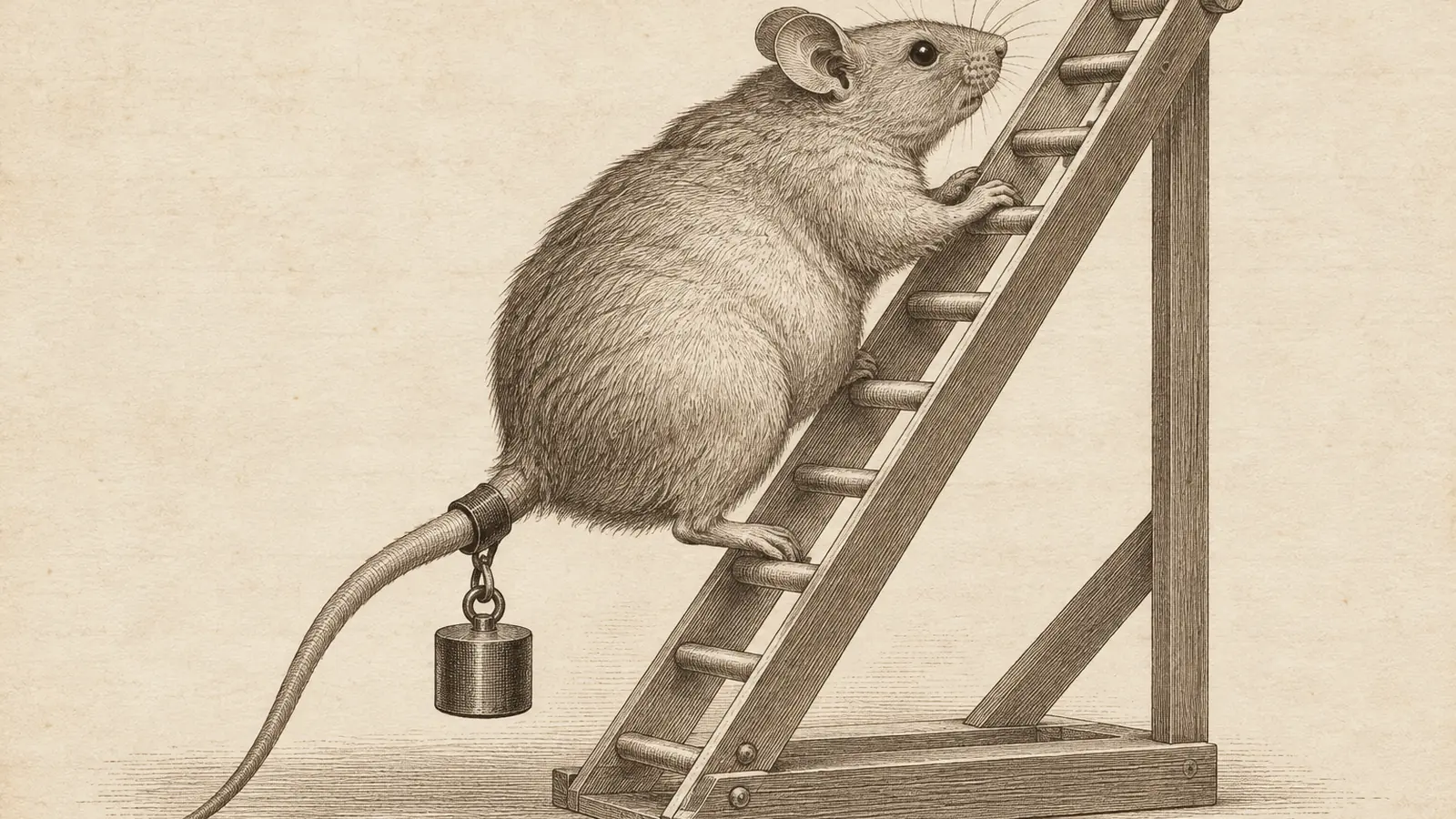
The mouse version of lifting is better than it sounds. The animals climbed a 70-centimeter staircase with weights fastened to their tails, 20 climbs a session at 70 percent of each mouse’s maximum, with 60 to 90 seconds of rest between sets. After a week, the trained mice had less mesenteric fat, the fat wrapped around the intestines that the researchers use as their model for the visceral fat packed around human organs, and their individual fat cells were visibly smaller. The adipocytes had shrunk while body weight held flat.
So how does a week of climbing stairs tell a fat cell to let go of what it is storing? This is where the biology got good.
A loaded fat cell is not a passive balloon. Its stored triglyceride droplet is wrapped in a protein called PLIN1, a lid clamped shut. Clipped to that lid is a helper called ABHD5. As long as PLIN1 holds ABHD5, nothing burns. Give the cell the right signal and PLIN1 lets go. ABHD5 floats over, grabs the enzyme ATGL, and that pairing takes the first bite out of the stored fat. In the obese sedentary mice the machinery was stuck: ABHD5 had fallen and the hand-off stalled. Seven sessions pushed the ABHD5-ATGL pairing back up, and expression of Scd1, a gene that helps the cell build new fat, dropped. The cell stopped hoarding and started releasing, on a one-week timer, before the diet changed and before a pound came off.
What got me was the second paper from the same seven-day setup, in the Journal of Endocrinology. That one looked underneath the enzymes, at the chemical tags sitting on the DNA itself. Seven days of training reprogrammed the hydroxymethylation marks in the visceral fat, the epigenetic settings that tune how those genes behave. Wait, why would climbing a staircase change which genes get chemically flagged in belly fat? I don’t think anyone fully knows yet, and that is the honest, interesting edge of this.
We are living through the GLP-1 moment, when the whole scoreboard has collapsed into one number going down. Lose the weight, win the game. And here is a drug-free intervention remodeling the most harmful fat in the body and switching the fat-burning enzymes back on with the scale completely frozen. If your only instrument is body weight, this result is invisible. You would conclude the exercise did nothing and reach for the injection. “Body weight alone does not tell the whole story about the metabolic benefits of exercise,” study author Leandro Pereira de Moura told Newsweek, and in a culture that has made the scale the whole story, that line carries more than it looks.
I am not going to oversell it. These are mice, on a male-only, seven-day, single-depot experiment measured in genes and proteins, not a woman watching her waistline. As one physician unconnected to the work, Dr. Lucy Hooper, also told Newsweek, “mice are incredibly different from humans in ways that are really important.” Nobody has run this in a person and watched visceral fat shrink in a week. The team says the work is experimental, and it is now extending the training and looking at the fat packed around the heart.
Still, the mechanism points somewhere useful. Visceral fat is the harmful kind, the fat that pours inflammatory signals into the bloodstream and disturbs metabolism all over the body, and the usual story is that you have to lose a lot of weight first to touch it. This says the cellular machinery starts turning over almost immediately, under a number that refuses to budge.
So I have made one change after reading this. I am going to stop letting the scale grade my strength workouts. The number was never measuring the thing I care about, and I would rather trust the biology that moves first.
Sources
- ScienceDaily: Just 7 days of strength training started shrinking fat cells in mice (2026)
- Life Sciences: Strength training induces ABHD5-ATGL axis to counteract mesenteric fat accumulation in obese Swiss mice (2026)
- Journal of Endocrinology: Seven days of strength training reprograms hydroxymethylation in the visceral adipose tissue of obese Swiss mice (2025)
- Agência FAPESP: Strength training causes fat cells to shrink even before weight loss
- Newsweek: Strength training shrinks fat cells in just 7 days, study finds