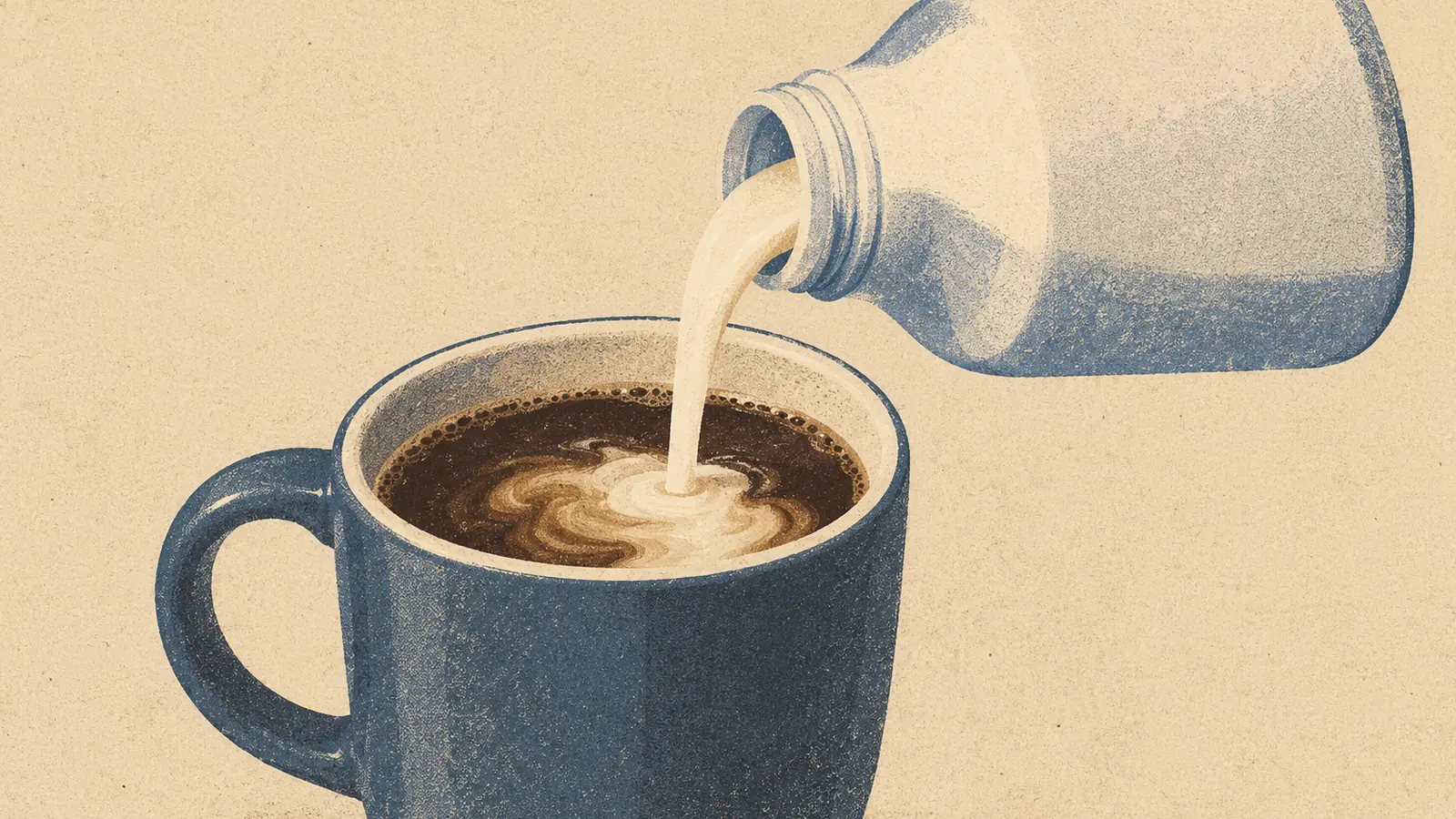
If you had asked me which thing in a coffee mug deserved suspicion, I would have pointed at the sugar without a second thought. Everyone already agrees sugar is the villain. So I wasn’t ready for fifteen years of national survey data to give that title to non-dairy creamer.
Researchers at Tufts University’s Friedman School of Nutrition Science and Policy worked through eight cycles of the National Health and Nutrition Examination Survey, covering about 30,000 adults from 2003 to 2018. Each participant completed two 24-hour dietary recalls, which are self-reported, and the authors acknowledge that what people eat and drink varies enough from day to day that those answers may not capture a person’s usual habits. The paper in the Journal of the Academy of Nutrition and Dietetics opens on a number that hardly moved: average coffee intake stayed at about 13 ounces a day for the whole period. The calories in that coffee rose anyway, climbing from 43 to 60 a day, an increase of nearly 40 percent with no additional coffee to account for it. The survey window ends in 2018, so this describes a fifteen-year drift, not this morning’s mug.
That leaves the add-ins, and I assumed sugar was responsible. The data disagreed. Sugar showed no statistically significant change over the period, and dairy milk stayed level too. The add-in that climbed was non-dairy creamer, whose calorie contribution more than doubled, from 7.71 a day in 2003 to 18.5 in 2018, until it passed sugar or syrup at 16 calories and dairy milk at 11. Creamer’s gain of about 11 calories accounts for most of the 17-calorie increase in the cup.
This flips the older picture. When University of Illinois researcher Ruopeng An studied coffee and tea add-ins in a 2017 Public Health paper, sugar was the main source of add-in calories, according to the Tufts Health & Nutrition Letter’s write-up. The two analyses cover different years with different methods, so I wouldn’t merge them into one trend line. The Tufts paper doesn’t need that comparison anyway, because its own data show creamer overtaking both sugar and milk.
So what goes into the stuff? The best-known brand, Coffee-mate, was introduced by Carnation in 1961 and now belongs to Nestlé, with a liquid version added in 1989. Its original formula is mostly corn syrup solids, hydrogenated vegetable oil, and sodium caseinate, plus small amounts of an emulsifier, an anticaking agent, artificial flavor and annatto color. Sodium caseinate is a protein made from milk, sitting near the top of the ingredient list of a product sold as non-dairy. The survey’s creamer category covers many brands and formats, each with its own label, and I would read every one of them. The template the category started from was dried corn syrup and hardened oil.
That brought me to the question I kept coming back to: how does a small pour of creamer carry more calories than a much bigger splash of milk? The survey’s 2018 averages explain it. Americans added about 21.4 grams of dairy milk a day, worth 11 calories, and about 8 grams of non-dairy creamer, worth 18.5. Averaged across everything the survey counted as creamer, that’s more than four times the energy per gram. I had to stop and work through why, and it comes down to water. Milk is mostly water, so much of what you pour is just liquid going along for the ride. Corn syrup solids are syrup with the water removed, which your gut breaks down into glucose, and oil is fat, at nine calories per gram regardless of its source. Lead author Yongyi Pan described the fat side plainly: “Non-dairy creamers can be high in saturated fat, which is calorie dense.”
| Addition | Grams per day | Calories per day |
|---|---|---|
| Dairy milk | 21.4 | 11 |
| Non-dairy creamer | 8 | 18.5 |
Seventeen calories a day sounds trivial. At the survey average, it adds up to about 6,205 calories a year, added to a drink whose volume never changed.
What worries me more is what the add-ins do to coffee’s healthy reputation. The same Tufts group, with Fang Fang Zhang as senior author, linked NHANES data on about 46,000 adults to national death records in a 2025 Journal of Nutrition study funded by the National Institute on Minority Health and Health Disparities. Black coffee, or coffee low in added sugar and saturated fat, was associated with a 14 percent lower risk of death from any cause compared with no coffee. Coffee with more of those additives showed no such link. “Our results suggest that the addition of sugar and saturated fat may reduce the mortality benefits,” Zhang said. The study’s “low” cutoffs were about 2.5 grams of added sugar and about 1 gram of saturated fat per 8-ounce cup, roughly a tablespoon of half-and-half, a tablespoon of light cream, or five tablespoons of 2 percent milk.
These are observational studies, and they can’t prove that creamer cancels coffee’s benefit or that a tablespoon of half-and-half preserves it. What they do show is a clear overlap. In the death-records study, the benefit appeared in coffee kept low in sugar and saturated fat, and over the same years the add-in that grew fastest in calories was one whose original formula is built mainly from sugar solids and fat. Non-dairy creamer is named for the ingredient it leaves out. On the label of its founding product, the ingredients it does contain are the ones that mattered more.
I’m keeping my coffee and I’m not switching to black. I’ll add one tablespoon of half-and-half, which falls inside the low category the Tufts team used, and I’ll leave the creamer on the shelf.
Sources
- Pan, Zhou and Zhang, Journal of the Academy of Nutrition and Dietetics (2026)
- Tufts University via ScienceDaily: Coffee calories have jumped nearly 40%
- Tufts Now: Black coffee linked to lower risk of death, Journal of Nutrition (2025)
- Tufts Health & Nutrition Letter on An et al., Public Health (2017)
- Coffee-mate product history and original formula