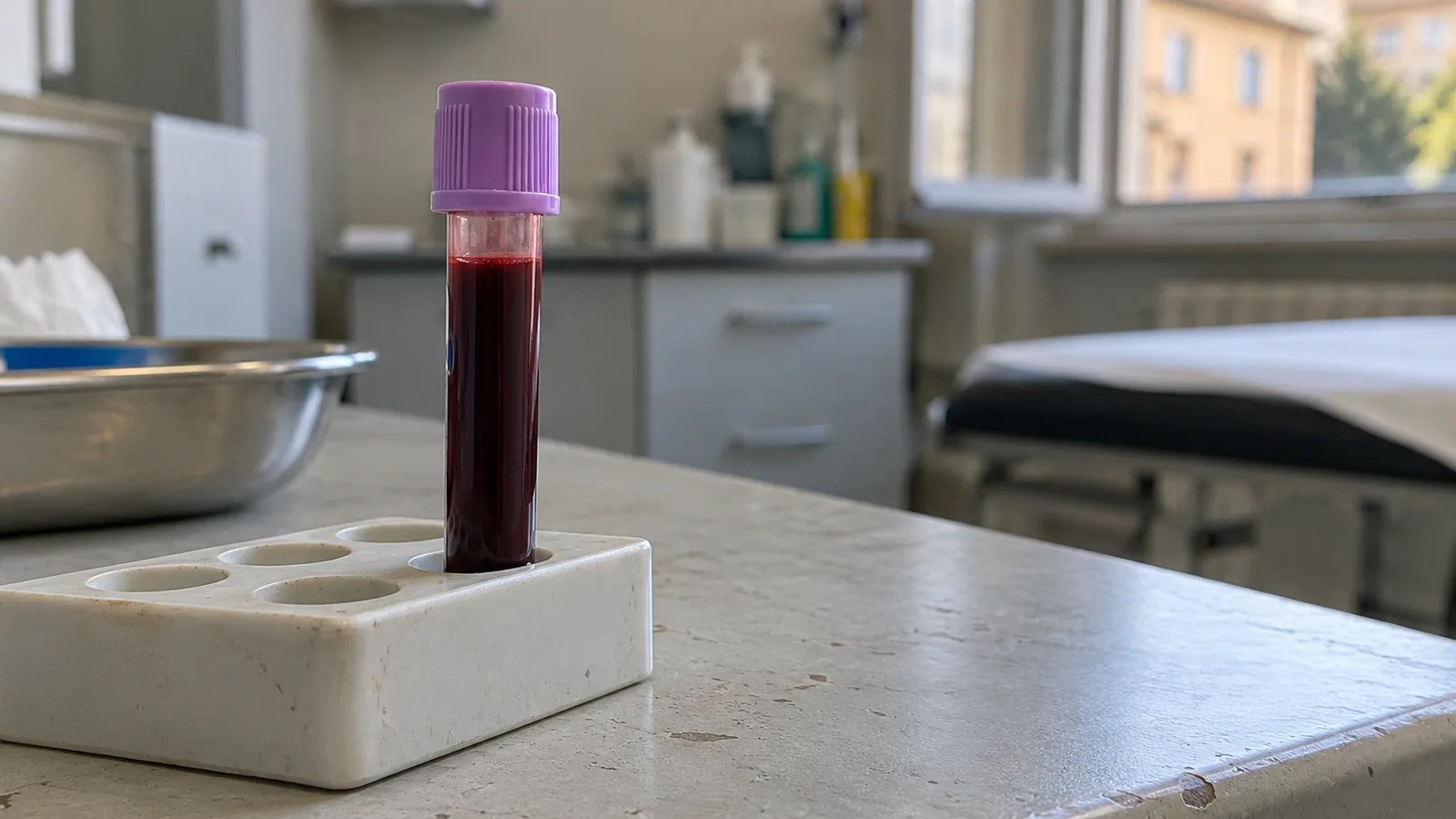
When I saw this headline, I pictured the usual cast: lean retirees on a Sicilian terrace, dragging bread through a puddle of green oil. The people behind it turned out to be 49 heart-rhythm patients in Rome with an average age of 78.4, and each of them gave one blood sample.
That sample is now circulating under a ScienceDaily headline promising that the Mediterranean diet “may boost tiny proteins that protect the heart and brain.” The proteins, humanin and SHMOOSE, are made by your mitochondria from their own separate scrap of DNA, and that idea is wild enough that I wanted the claim to hold. The trouble is the verb. A boost is a change over time, and the researchers never assigned anyone a diet or measured anyone twice.
The Frontiers in Nutrition study, published March 10 by USC’s Leonard Davis School of Gerontology and Sapienza University of Rome, is a single cross-sectional snapshot. Its subjects were a convenience sub-cohort of 49 patients with non-valvular atrial fibrillation, all aged 60 or older, pulled from a larger Rome registry because they had filled out a diet questionnaire and still had enough stored plasma. Fifty-seven percent were women and 85.7 percent had high blood pressure. That makes them a fine group for studying older heart patients and a shaky one for telling a healthy 50-year-old what to eat.
Each patient answered a nine-item Mediterranean diet questionnaire scored from 0 to 9, and 20 of the 49 scored 7 or higher. Those high scorers carried more of both microproteins in their blood, with p-values of 0.046 for each. Converted back from the log scale the paper reports, their geometric-mean SHMOOSE level ran roughly 30 percent higher than the lower scorers’ and humanin roughly 18 percent higher. I’d love for those numbers to survive. Both p-values sit a hair under the conventional 0.05 line, though, the paper reports no correction for the many comparisons it ran, and the whole sample is smaller than a high school graduating class.
| Measure | Part | Whole |
|---|---|---|
| scored 7 or higher | 20 | 49 |
The food-by-food breakdown is where it gets fun. A tablespoon or more of olive oil a day went with higher levels of both proteins. Fish at least three times a week and legumes at least twice a week went with more humanin, while eating less than one serving of white bread a day went with more SHMOOSE. Hold on to that tablespoon. It comes back.
Why would a mitochondrion care what you ate?
Mitochondria descend from ancient bacteria, and for decades the little genome they kept was assumed to hold a short, fixed list of genes for running the cell’s energy machinery. Humanin broke that assumption. A Japanese team found it in 2001 by screening genes from the brain of a person who had died with Alzheimer’s, hunting for anything that kept neurons alive in a dish while Alzheimer’s genes tried to kill them, and the peptide turned out to be encoded inside a mitochondrial gene. Pinchas Cohen, now dean of the USC gerontology school and senior author of the new paper, ran one of three labs that discovered it independently. According to Neuroscience News coverage of a 2020 Aging study, humanin also fades with age: mice lose about 40 percent of their circulating humanin over their first 18 months, naked mole rats decline only slowly across a 30-year lifespan, and 18 children of centenarians had higher humanin levels than 19 children of non-centenarians.
SHMOOSE is newer and stranger. A 2022 Molecular Psychiatry paper from Cohen’s group, as reported by Neuroscience News, found that a variant in its mitochondrial gene was associated with a 20 to 50 percent higher risk of Alzheimer’s across four cohorts, and nearly a quarter of people of European ancestry carry it. The protein sits in the inner membrane of neuronal mitochondria and grabs onto a structural protein called mitofilin, so it is bolted into the same machinery that turns your breakfast into usable energy.
So when olive oil lines up next to higher levels of both proteins, my brain leaps straight to a tidy mechanism: something in the oil, its fats or its polyphenols, nudging stressed mitochondria to pour out more of their own protective signals. Then a less flattering question elbowed in. Wait, why does the arrow have to run from the plate to the mitochondria at all? A 78-year-old whose cells still make plenty of energy may simply be the one with the stamina to buy fish and simmer beans, and the Frontiers in Nutrition study itself states that it did not adjust for physical activity, metabolic parameters, or other confounders.
One correlation holding up the heart
The cardiac half of the paper runs through oxidative stress. High adherers had lower levels of sNox2-dp, a fragment shed when an enzyme called Nox2 switches on, at 18.8 versus 25.0 pg/mL, and lower 8-iso-PGF2α, a byproduct of oxidized fats, at 122.2 versus 156.2 pmol/L. Nox2 is the enzyme your white blood cells use to spray superoxide at invading microbes. Left running chronically, that same chemical spray is thought to wear down blood vessels.
| Group | Value (pg/mL) |
|---|---|
| High adherence | 18.8 |
| Lower adherence | 25.0 |
Follow the correlations and the claim thins out fast. Humanin tracked inversely with both stress markers, but after statistical adjustment only the sNox2-dp link survived (β = −0.302, p = 0.040), while SHMOOSE showed no significant relationship with either marker. The paper can’t quite agree with itself on what that adjustment was, either: the methods say sex and body mass index, and a figure caption says age and body mass index. So the humanin–Nox2 cardioprotection floated in the paper’s title rests on one adjusted correlation, for one of the two proteins, in 49 patients. That’s a hypothesis with a pulse.
In the USC release, lead author Roberto Vicinanza called it “a new cardioprotective mechanism of the Mediterranean diet.” The same release concedes that the study was small and observational and can’t show the diet caused anything, and Vicinanza adds that the goal now is “to move from observing associations to understanding causality.” The second quote describes the study. The first one wrote the headline.
A blood test for a question you can answer yourself
Some context on the money is fair here. Cohen and Nir Barzilai are founders of CohBar, which its 2016 annual report describes as a company developing mitochondria-based therapeutics, and in the 2020 Aging paper both disclosed being consultants and stockholders. USC has filed intellectual property on SHMOOSE. The new paper declares no commercial or financial conflicts, and nothing in it suggests the data were bent. It does note that Vicinanza sat on a Frontiers editorial board at submission, which the authors say had no bearing on review.
Still, this field keeps drifting toward a product. Cohen’s suggestion in the release is that humanin and SHMOOSE “could serve as biomarkers for adherence to the Mediterranean diet and have clinical significance.” In a feeding trial, where people misremember their lentils, an objective blood marker of adherence could earn its keep. For you, the study’s own measuring stick was a nine-item questionnaire that costs nothing to fill out, and a lab test for a question you can answer on a napkin looks a lot like a product hunting for a market.
The case for eating this way never depended on these two molecules anyway. In the CORDIOPREV trial, 1,002 people with coronary heart disease in Córdoba, Spain, were randomized to a Mediterranean or a low-fat diet and followed for about seven years. The Mediterranean group had fewer major cardiovascular events, 28.1 versus 37.7 per 1,000 person-years. Its participants got a liter of extra virgin olive oil a week with instructions to use a tablespoon a day, the same threshold that lined up with both proteins in Rome, and that trial is randomized evidence about the food itself.
The Rome-USC work offers a possible molecular reason the food works, and I want someone to chase it. The next experiment is easy to describe: put people on the diet, draw blood before and after, and see whether humanin and SHMOOSE climb. That would answer whether the diet raises these proteins, which the team says is its next question. It still wouldn’t show that the proteins are what protects the heart, because that needs a test of its own.
Until then, I’m keeping my daily tablespoon of olive oil and my beans twice a week because a randomized trial earned them, and I won’t pay for a humanin test until someone shows the number moves when the plate does.
| Question | What the article reports |
|---|---|
| Study design | a single cross-sectional snapshot |
| Population | a convenience sub-cohort of 49 patients with non-valvular atrial fibrillation, all aged 60 or older |
| Limitations | did not adjust for physical activity, metabolic parameters, or other confounders |
- Frontiers in Nutrition study: Vicinanza et al., Mediterranean diet adherence and the mitochondrial microproteins Humanin and SHMOOSE (2026)
- CORDIOPREV trial: American College of Cardiology summary of Delgado-Lista et al., Lancet (2022)
- ScienceDaily headline: USC release, “Mediterranean diet may boost tiny proteins that protect the heart and brain” (2026)
- 2016 annual report: CohBar Inc. Form 10-K
- Neuroscience News coverage of a 2020 Aging study: humanin, aging and the CohBar disclosures
- Neuroscience News report on the 2022 Molecular Psychiatry SHMOOSE study