I went into this one assuming Crohn’s disease is an ambush. A young person feels fine, then a few miserable months of cramping, weight loss and bathroom urgency end with a gastroenterologist saying a word they’ll carry for life. This week’s headlines told me I had it wrong. “Your blood could reveal inflammatory bowel disease 10 years before diagnosis,” ScienceDaily announced, and the antibody shifts behind that claim do seem to start years before anyone gets diagnosed. Nobody has yet taken the prediction models built on those shifts and tried them on anyone outside the single military cohort that produced them.
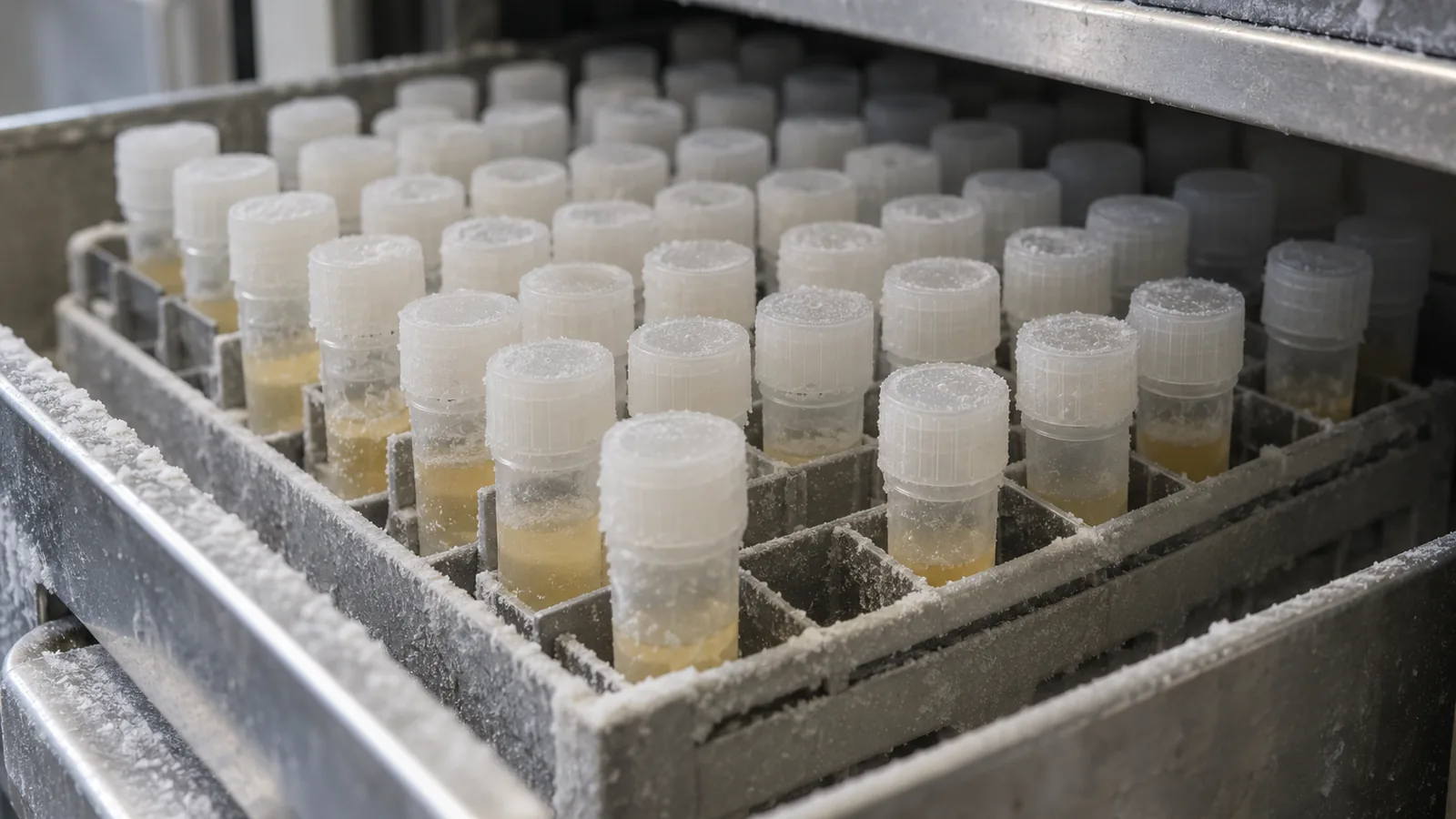
The work comes from Arno Bourgonje, Saurabh Mehandru and Jean-Frédéric Colombel at Mount Sinai, with collaborators in Vienna. It was published in Gut in July and presented again at UEG Week in Barcelona on October 19. The team pulled 2,000 stored blood samples from 500 people: 200 who later developed Crohn’s disease, 200 who later developed ulcerative colitis and 100 who stayed healthy. Each person’s blood had been drawn about 10, 4 and 2 years before diagnosis, and once more shortly after.
Most antibody tests check a handful of targets that someone picked in advance. This one, phage-display immunoprecipitation sequencing (PhIP-Seq), throws each sample at about 357,000 peptide fragments at once, according to Healio’s report on the PREDICTS paper. The fragments come from bacteria, viruses, foods and the body’s own proteins, and the assay records which ones a person’s antibodies grab. The UEG summary counts 123,980 unique antibodies detected across the cohort. Strictly speaking, what the assay logs is binding to peptides. You get a fingerprint of what the immune system has learned to recognize, not a headcount of antibody molecules, and I love how blunt that is: instead of asking the immune system about the suspects you already have, you show it the entire lineup.
People heading toward either disease had less antibody diversity than the healthy controls, and the gap showed up as far back as ten years. Future Crohn’s patients mounted rising responses against herpesviruses, Epstein-Barr virus prominent among them, and against bacterial flagellin, most strongly in those who went on to complicated or ileal disease. Future colitis patients showed rising herpesvirus responses plus autoantibodies, including one against a human protein called MADD, which Mehandru told Healio regulates inflammatory signaling. The timeline is subtler than “ten years” suggests. Mehandru described the repertoires as “remarkably stable through most of the prodrome of IBD,” with variability increasing only around 4 years out, even though disease-specific differences were “already detectable at our earliest time point, roughly 10 years out.”
Wait, why would your immune system care about a bacterium’s tail? Flagellin is the protein bacteria use to build their whip-like propellers, and your gut holds trillions of bacteria that the immune system mostly leaves alone. A climbing antibody response could mean bits of those swimmers are slipping through the gut lining and reaching immune cells that rarely meet them. The study measured the antibodies, not any leak, so that part remains a hypothesis. The Epstein-Barr signal points somewhere stranger still. Mount Sinai says the findings support molecular mimicry, the idea that antibodies raised against a virus can cross-react with human proteins that happen to look similar. The antibody data are consistent with that route to autoimmunity, but they don’t prove it.
What rearranged my picture of the disease was what disappeared. In both diseases, responses against encapsulated bacteria (the sugar-coated group that includes pneumococcus) faded as diagnosis got closer. “Loss of humoral reactivity may be as informative as gain,” Mehandru told Healio, adding that it “hints at a broader compromise in immune competence developing well before diagnosis.” I’d always pictured autoimmune disease as an immune system cranked too high. This looks more like narrowing, with the repertoire shrinking and fixing on the wrong targets while older responses fade out.
Then come the figures that made the headlines. According to the UEG summary, machine-learning models using samples taken up to ten years before diagnosis separated future Crohn’s patients from controls with an area under the curve (AUC) of 0.90. For ulcerative colitis the score was 0.84, and for telling future complicated Crohn’s from milder Crohn’s it was 0.85. An AUC of 0.90 means that if you pick one future Crohn’s patient and one control at random, the model ranks the patient as higher risk about 90 percent of the time. It’s a ranking score, and it tells you nothing about any one person’s odds of getting sick.
Look at who produced those numbers. The samples come from PREDICTS, a cohort of active-duty U.S. service members diagnosed between 1998 and 2013. Per Healio, the Crohn’s group was 87.5% men and the colitis group 92% men, with an average age of about 33 and more than 80% white. These were people who had passed enlistment physicals and got their care through the military health system, which tells you little about women, older adults or civilians. The models also picked patterns out of more than 120,000 antibody signals to separate 400 cases from only 100 controls. With that many variables and that few people, overfitting is the first thing a statistician checks for, and none of the public summaries say whether the scores came from people the models had never seen. Bourgonje said in the UEG release that “the next priority is to validate these signatures in independent, more diverse and prospectively followed populations.” Until someone does that, the 0.90 belongs to PREDICTS.
| Measure | Share |
|---|---|
| men | 87.5% |
The biology underneath has held up better than the model has been tested. In 2016, Choung and colleagues tested 100 Crohn’s patients from the Department of Defense Serum Repository for six antimicrobial antibodies, including the flagellin markers anti-CBir1, anti-A4-Fla2 and anti-FlaX. Sixty-five had at least one positive marker in their earliest sample, a median of about six years before diagnosis, and the bigger that early response, the sooner complications arrived. That repository is the same military source PREDICTS draws on, so it isn’t an independent population. The tougher check came from the Netherlands, where a team led by Bourgonje and Rinse Weersma, publishing in Gut in 2025, screened more than 167,000 participants in the civilian Lifelines cohort. They found 178 who developed IBD and saw raised flagellin reactivity before Crohn’s was diagnosed. Ulcerative colitis showed no comparable early signal there, which should temper anyone’s excitement about the colitis model’s 0.84. The ten-year headline isn’t new either: Bourgonje’s group presented an abstract with almost the same title at the European Crohn’s and Colitis Organisation congress in 2025.
There’s money sitting right next to this science. Three of those flagellin antibodies are already sold in the Prometheus IBD sgi Diagnostic Panel, a send-out test from San Diego. It combines anti-CBir1, anti-A4-Fla2 and anti-FlaX with ASCA, anti-OmpC and pANCA serology, four genetic markers and a set of inflammation markers. The panel’s own description pitches it for telling IBD from non-IBD and Crohn’s from colitis, and it makes no claim to predict disease in healthy people. Colombel, the paper’s co-corresponding author, reported consulting for Prometheus Laboratories, the company that sells that panel. Colombel’s Mount Sinai disclosure for 2025 and 2026 lists 42 consulting relationships in all, with AbbVie, Janssen, Takeda, Pfizer and Eli Lilly among them, plus equity in a private firm called Intestinal Biotech Development. Per Healio, Mehandru reports consulting, lecture fees or research grants from Arena, Ferring, Genentech, Morphic and Takeda. Mount Sinai’s release describes the study’s funding only as “institutional and philanthropic” and names no donors.
Consulting isn’t sponsorship, and nothing in these documents shows that a company shaped this predictor. Still, the people defining what a “pre-IBD” blood profile looks like also advise the firms that sell IBD tests and IBD drugs, and those incentives all point the same way. Mehandru calls it “a decade-long window” in which the immune system is “measurably abnormal but the patient may appear to be well,” and says “that window is where preventive intervention could happen.” A diagnostics company looks at a decade of healthy-looking people with abnormal blood and sees a decade of customers. Yet this study tested no intervention at all, and Mount Sinai’s own language stays in the future tense: strategies to “one day prevent” IBD.
You may not even need a 357,000-peptide chip to catch the warning. A Danish nationwide study in the American Journal of Gastroenterology compared 29,219 people diagnosed with IBD between 2005 and 2018 with 292,190 matched people without it. HealthDay’s summary of the Danish medication study reports that ten years before diagnosis, the future IBD group had 1.1 to 1.8 times as many users in 12 of 14 major drug classes, and that medication use rose steeply in the two years before diagnosis.
Among future Crohn’s patients, immunosuppressant users were 2.7 times as common, users of antianemic drugs such as iron 2.3 times, analgesic users 1.9 times, and users of psycholeptics (the class that includes sedatives and sleep aids) 1.9 times. Those records can’t tell you which prescriptions were chasing early bowel disease and which were for something else entirely. But I keep thinking about the people behind them, picking up iron, pain pills and sleep aids for years before anyone said Crohn’s, and I wonder how many of those appointments were a chance to look at the gut.
| Group | Value (times as many users) |
|---|---|
| Immunosuppressants | 2.7 |
| Antianemic drugs | 2.3 |
| Analgesics | 1.9 |
| Psycholeptics | 1.9 |
Nothing changes in the clinic yet, and the researchers say so. The signatures are “not yet ready for use in routine medical screening,” and a usable test would have to be accurate, affordable and reproducible, and shown to improve outcomes. Mehandru’s own hope is narrower: panels that “could enrich detection for high-risk individuals.” Nobody has answered the obvious next question. If you tell a healthy 25-year-old their blood says “pre-Crohn’s,” what do you offer them besides worry and a bill?
I won’t pay for one of these antibody panels until someone has tested it on people who look like me, starting with a woman who has never worn a uniform.
Sources
- Mount Sinai: Study detects immune changes up to 10 years before inflammatory bowel disease is diagnosed (July 2026)
- Healio’s report on the PREDICTS paper (cohort details, limitations, disclosures)
- Your blood could reveal inflammatory bowel disease 10 years before diagnosis (ScienceDaily, UEG Week 2026 data)
- Bourgonje AR, Mehandru S, Colombel JF, et al. Gut (2026)
- UMCG: Antibody signatures detected years before the onset of Crohn’s disease and ulcerative colitis (Lifelines, Gut 2025)
- Choung et al., Alimentary Pharmacology & Therapeutics (2016): Serologic microbial markers predict Crohn’s disease behaviour years before diagnosis
- Journal of Crohn’s and Colitis congress abstract OP01 (2025): Systemic antibody responses predict the onset of IBD up to 10 years before diagnosis
- American Journal of Gastroenterology (2023): Medication-Wide Study, medication use 10 years before IBD diagnosis
- HealthDay’s summary of the Danish medication study
- UW Laboratory Medicine test guide: Prometheus IBD sgi Diagnostic Panel
- Mount Sinai disclosure for 2025 and 2026 (Jean-Frédéric Colombel, industry relationships)