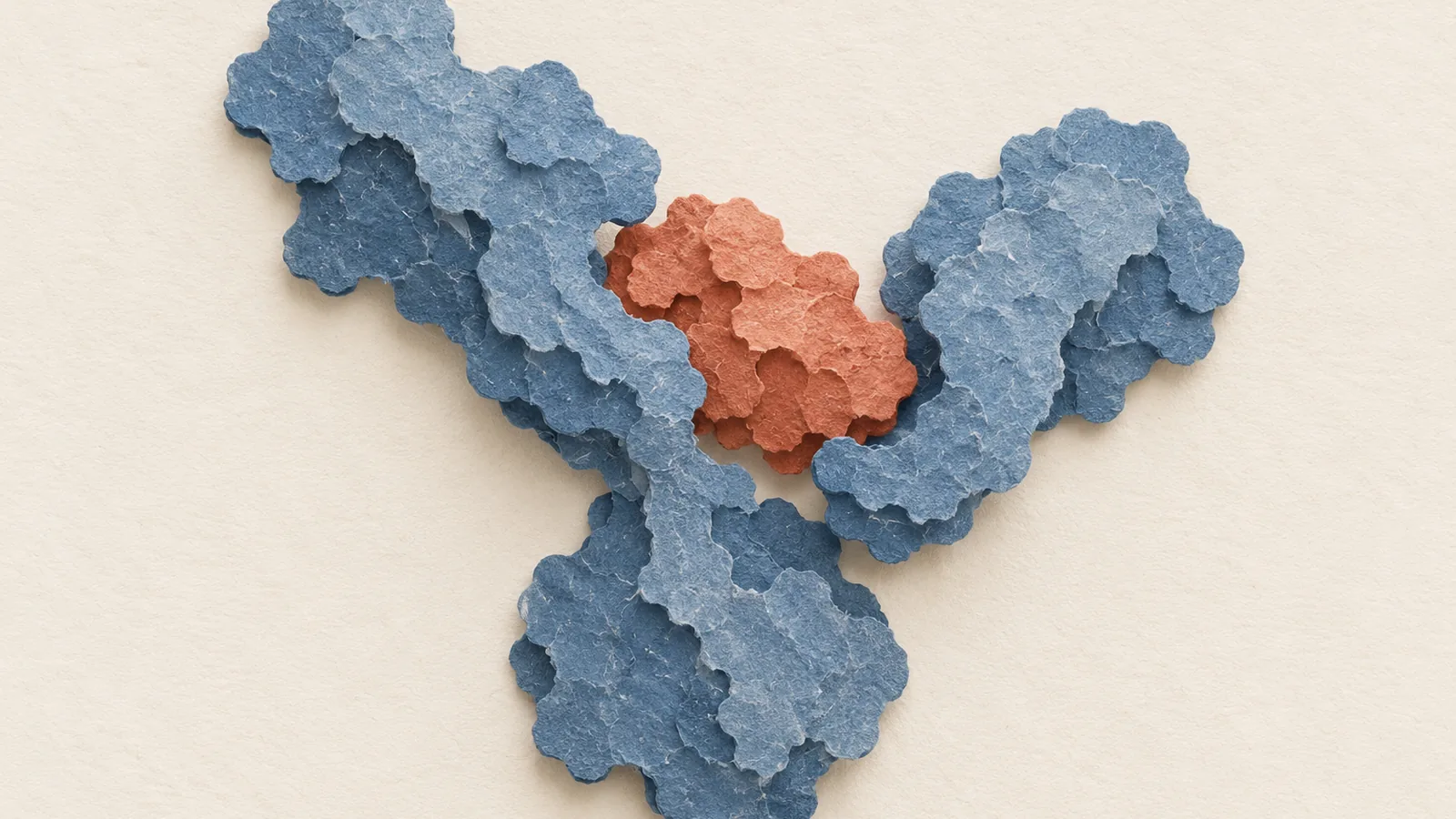
I’ve always pictured autoimmunity as an attack on a place, like the joints or the thyroid or the gut lining, so this one threw me. In a British study of 4,909 people with inflammatory bowel disease, 173 were making antibodies against a message instead: the molecule whose job is telling gut inflammation to stand down. It’s a bit like cutting the brake line rather than flooring the gas.
The paper, published in the New England Journal of Medicine in June by researchers at Oxford, Newcastle and Cambridge, found those antibodies in 3.5 percent of patients with Crohn’s disease or ulcerative colitis and in none of 1,006 people without IBD. Their target is interleukin-10, or IL-10, and in all 173 patients the antibodies neutralized it in a cellular reporter assay. Patients with high antibody activity had less detectable IL-10 in their blood, and in a subgroup tested in the lab, their immune cells answered a challenge with an exaggerated burst of inflammatory signals, which is exactly what you’d expect if the brake signal were being drained away before it arrived.
| Measure | Share |
|---|---|
| of IBD patients screened carried IL-10-neutralizing antibodies | 3.5 percent |
IL-10 is a messenger passed between immune cells, and the gut leans on it hard. In 1993, researchers deleted the IL-10 gene in mice and found that the animals developed chronic enterocolitis even though their lymphocyte development and antibody responses were normal. Nothing was wrong with the army; the off-switch was gone. In 2009, a team reporting in the same journal found mutations in the IL-10 receptor genes in four of nine children with early-onset colitis, and one child who received a stem-cell transplant from an HLA-matched sibling stayed in remission from ileocolitis for more than a year afterward.
- 1993mice without the IL-10 gene develop chronic enterocolitis
- 2009IL-10 receptor mutations found in children with early colitis
- 2024antibodies blocking IL-10 found in two young patients
- 2026the same antibodies turn up in large IBD cohorts
Then in 2024 the Newcastle group identified antibodies that attacked IL-10 in two patients with early-onset severe IBD, patients whose genes for the signal and its receptor were intact. “Later, we realised that neutralising autoantibodies against IL-10 were mimicking this effect in two little girls with colitis,” Newcastle immunologist Sophie Hambleton said in this year’s release. One of them received treatment to suppress antibody production, and the antibodies eventually disappeared and her IBD resolved.
So the brake can fail three ways. You never make it, you can’t receive it, or your own antibodies intercept it in transit. The 2026 paper asked whether that third route shows up outside rare pediatric cases, in big general IBD cohorts, and found it in roughly 1 in 30 patients.
The variant Oxford flagged 30 years ago
This is where the paper gets properly fun. Oxford scientists first connected a rare immune-gene variant, HLA-DRB1*01:03, to a severe form of IBD three decades ago, and it’s now described as the strongest genetic risk factor for ulcerative colitis. What it was physically doing in the body stayed unclear.
The antibodies point to an answer. Within the IBD cohorts, antibody-positive patients were far more likely than antibody-negative patients to carry the variant: in the larger UK IBD BioResource cohort the odds ratio was 24.7 (95% confidence interval 14.5 to 42.1), and the Oxford cohort, analyzed two separate ways, produced even higher estimates.
| Result | Value (OR) | Lower bound | Upper bound |
|---|---|---|---|
| UK IBD BioResource cohort | 24.7 | 14.5 | 42.1 |
So why would a gene for a molecule on the surface of immune cells care about a cytokine floating between them? HLA class II molecules hold up fragments of protein for helper T cells to inspect, and those T cells are what give B cells permission to make antibodies against a target. One plausible explanation, and it is a hypothesis the association data can’t prove on its own, is that this HLA version is unusually good at presenting a piece of IL-10, so the immune system learns to treat its own brake as an intruder. If that holds, the gene never hurt the gut directly. It armed an attack on the one signal the gut most needs, and I find that a far more satisfying answer to a 30-year puzzle than another anonymous risk locus.
The 1993 mice add a wrinkle. Kept in specific pathogen-free housing, the IL-10-deficient animals developed only a local inflammation limited to the proximal colon, so the missing brake mattered most when gut microbes were pushing on the gas. Those were mice with a deleted gene, not people with antibodies, and the 2026 paper didn’t look at microbes or diet. I’d still want someone to ask that question of a subgroup that finally has a name.
There’s a hint, too, about why this subgroup matters clinically. A separate study in The Lancet Gastroenterology & Hepatology, summarized by the pediatric gastroenterology blog Guts and Growth, looked at 43,762 IBD patients and found 2,009 carriers of the variant, 4.6 percent. Carriers had roughly double the odds of colectomy in ulcerative colitis or unclassified IBD (odds ratio 1.99), higher odds of colon resection in Crohn’s (1.35), and more perianal disease (1.65 in Crohn’s, 1.70 in ulcerative colitis or unclassified IBD). That study measured the gene, not the antibodies, and neither paper tracked antibodies and surgery in the same people. Variant to antibody to operating room is a hypothesis worth testing, and nothing more yet.
What “key cause” leaves out
Newcastle’s headline announced that scientists had uncovered a “key cause of inflammatory bowel disease,” and Oxford’s Simon Travis called it “the most exciting discovery in a lifetime specialising in IBD.” I’d have been giddy too. The biology is lovely. But “cause” outruns what a blood-draw study of people who already have IBD can show. It proves the antibodies are present and that they block IL-10 in the lab; it can’t say whether they came first or formed after years of inflamed tissue spilling IL-10 into the immune system’s view. The strongest causal evidence is still those two girls, one of them treated, plus a note in the paper that in one child, antibody titers and disease activity responded to B-cell-depleting anti-CD20 therapy. One child is a reason to run a trial.
The same release is sharper than its headline in one line: “IBD is not a single disease, but a group of biologically distinct disorders driven by different underlying mechanisms.” That’s the bigger idea here. The antibodies mark one subgroup, and the other 29 patients in 30 need their own mechanisms found.
The question that decides whether any of this reaches a clinic is one the authors pose themselves. As quoted by Guts and Growth, they write that “It will be informative to establish the extent to which anti–interleukin-10 seropositivity associates” with the pattern seen in inherited IL-10 defects: very early onset, colonic and penetrating disease, poor response to therapy and postoperative complications. Until that’s answered, a positive result tells you something fascinating about your immune system and nothing yet about which drug to take.
Trial and error is expensive
The money angle is where I’d watch closest. As the joint release puts it, many patients “cycle through multiple therapies without achieving lasting disease control,” and around 1 in 5 people with Crohn’s and about 7 percent of those with ulcerative colitis need major surgery within five years of diagnosis. Cambridge immunologist Rainer Doffinger argues that identifying patients early and giving them targeted treatment could “reduce reliance on expensive ongoing therapy and prevent complications,” with modest reductions translating into “savings of many millions of pounds annually for the NHS.”
That cycling is how medicine currently handles a disease that keeps looking more like several diseases, and every biologic that fails is still billed. A test that flags a sabotaged brake would cut against that model, which makes this a rare piece of academic medicine pointing toward fewer drugs rather than more. The work was paid for by public and charitable money: the NIHR Biomedical Research Centres in Oxford, Cambridge and Newcastle, Wellcome, the Helmsley Charitable Trust, the Medical Research Council and the Crohn’s in Childhood Research Association, with Danish National Research Foundation and Novo Nordisk Foundation grants also on the paper.
The savings are still a projection. The Newcastle team says its findings support the development of a blood test, which means one has to be built, and neither release announces a treatment trial. Somebody has to prove that knowing a patient’s antibody status changes what works for them.
If I had colitis that had already burned through two biologics, I’d ask my gastroenterologist to find the nearest research group testing for IL-10 antibodies, and I’d get my blood into that study rather than wait for the test to reach the clinic.
Sources
- New England Journal of Medicine: Gharahdaghi et al. (2026)
- Newcastle University: “Scientists uncover key cause of inflammatory bowel disease” (June 2026)
- EurekAlert: Oxford, Newcastle and Cambridge joint release (June 2026)
- ScienceDaily: “Scientists solve a 30-year mystery behind inflammatory bowel disease” (October 2026)
- Newcastle University: IL-10 autoantibodies in early-onset severe IBD (August 2024)
- Guts and Growth: “Interleukin-10 Autoantibodies and Development of IBD” (July 2026)
- New England Journal of Medicine: Glocker et al., “Inflammatory Bowel Disease and Mutations Affecting the Interleukin-10 Receptor” (2009)
- Cell: Kühn et al., “Interleukin-10-deficient mice develop chronic enterocolitis” (1993)