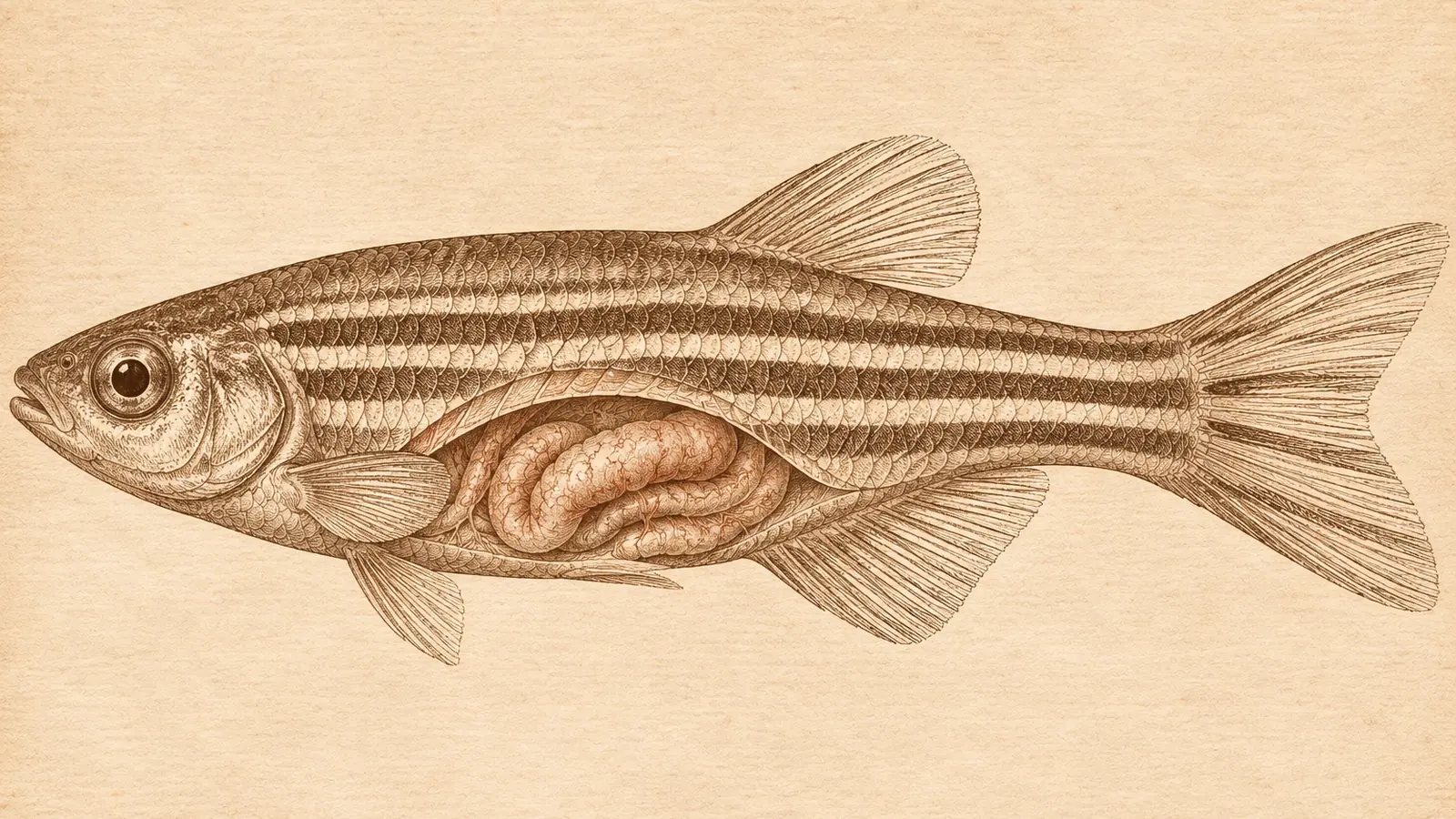
Miklos Lengyel had bred zebrafish that could not hear one particular alarm. The fish lacked the receptor for 5-oxoETE, a fatty molecule whose best-documented job was summoning neutrophils, the immune system’s first responders, to an infection. Lengyel, a postdoctoral researcher in Philipp Niethammer’s lab at Memorial Sloan Kettering Cancer Center, was studying colitis, and by any reasonable expectation fish deaf to that alarm should have had calmer guts. Instead their intestines became inflamed on their own, with no infection anywhere. “It made absolutely no sense,” he said in the institution’s release.
The finding, published in Nature on October 7, 2026, lands awkwardly for a compound that already exists. Two Montreal researchers spent years building a molecule that blocks the same receptor. They tested it in monkeys and applied for a patent on it, on the sensible theory that an alarm which calls in inflammatory cells is one worth switching off. One of them, William Powell, is also the scientist who first described the enzyme that makes the signal, in 1992.
- 1992enzyme described in human white blood cells
- 2020S-Y048 potency and monkey blood levels reported
- 2021S-Y048 tested in allergen-challenged rhesus monkeys
- 2023receptor-less fish fight infection worse
- 2026gene named; receptor loss inflames the fish gut
Thirty-four years without a gene
Powell and two McGill colleagues found the enzyme in human white blood cells, where it converted a lipid called 5(S)-HETE into 5-oxoETE, ignored the mirror-image form of its substrate, and depended on the cofactor NADP+. Nobody could identify the gene behind it, so for more than three decades the enzyme went by a name describing what it did. Yanan Ma, a postdoc in the Niethammer lab building on earlier work by former lab mate King Lam Hui, finally pinned it down by silencing candidate genes in human cells. When one called DHRS7 went quiet, the activity stopped.
Part of the delay was a model problem. The rodent version of the enzyme shows almost no activity, according to MSK’s account, and mice have no known immune-cell receptor for 5-oxoETE to bind. In humans that receptor is OXER1, and the lab’s 2023 Cell Reports paper noted that it is conserved from fish to primates but not in rodents, “precluding genetic loss-of-function studies in mouse.” “This means that you can’t study the pathway in mice,” Ma said. The knockout mouse, the field’s standard way of learning what a gene does by deleting it, had nothing to delete. So the lab turned to zebrafish, whose version of the receptor gene is called hcar1-4, and the 2023 study found what the alarm model predicted: fish without the receptor recruited fewer neutrophils and survived Pseudomonas aeruginosa infection less well, and restoring either the fish receptor or human OXER1 reversed the defect.
The alarm was also guarding the walls
Lengyel’s colitis fish broke that tidy picture. Neutrophils were the obvious suspects, so the team depleted them, and the inflammation persisted anyway. Silencing DHRS7 in the fish, which should have quieted the alarm at its source, made the inflammation worse too.
The team’s explanation is that the pathway protects the intestinal lining itself. Without 5-oxoETE signaling, the fish’s gut cells lost their defense against the low-level chemical stress produced by ordinary gut bacteria, and enough of them died to set off inflammation. The researchers tied that protection to NUDIX hydrolases, enzymes that clear damaged DNA building blocks before they can interfere with the cell. The signal is an alarm, Niethammer said, and “it’s also a shield.” All of this comes from fish and cultured cells, and none of it has been tested in a person.
A 2025 preprint from the same lab suggests how one molecule manages both jobs. DHRS7 tracks the cell’s redox state. In healthy, unstressed tissue it uses NADPH to break 5-oxoETE down, acting as a sink; under oxidative stress it consumes NADP+ and makes the signal instead. Niethammer describes a pathway “that integrates two completely different kinds of stress,” and doctoral student Zaza Gelashvili is working out its mechanical side.
The monkeys measured lungs
The blocker came out of the earlier, simpler reading. With chemist Joshua Rokach, Powell developed a series of OXE receptor antagonists, and the most potent, S-Y048, shut down 5-oxoETE signaling in human neutrophils at concentrations around 20 picomolar and stayed in cynomolgus monkey blood with a half-life of about 7.5 hours after an oral dose, according to a 2020 paper in the British Journal of Pharmacology. The authors wrote that it “may be a useful anti-inflammatory agent” for asthma, allergic rhinitis, and atopic dermatitis, and disclosed a granted patent on an earlier compound along with a pending application covering S-Y048. Funding came from Canadian and U.S. government grants, the American Asthma Foundation, and AmorChem of Montreal.
The test came in a 2021 study of 12 rhesus monkeys sensitized to house dust mite. After allergen challenge, S-Y048 cut eosinophils in lung lavage fluid by 52 percent and neutrophils by 77 percent, and it reduced mucin-containing cells in the bronchi by about 40 percent and cells positive for the mucin MUC5AC by about 60 percent. The paper reports every one of those numbers as a benefit, which in asthma, where mucus plugs the airways, is a defensible way to read them.
| Group | Value (percent reduction) |
|---|---|
| Eosinophils (lavage) | 52 |
| Neutrophils (lavage) | 77 |
| Mucin-containing cells | 40 |
| MUC5AC-positive cells | 60 |
MSK’s account mentions an independent primate study in which blocking OXER1 dampened the immune response and caused “protective mucus-producing cells that line the airway” to disappear. The release doesn’t name that study, but the 2021 rhesus experiment fits its description. The pharmacologists counted fewer mucus cells as a therapeutic effect. The gut biologists call it a lost defense.
Neither reading settles the other. Airway mucus cells are not the fish’s NUDIX-protected gut cells, and having fewer of them after an allergen challenge doesn’t show that the airway barrier was harmed. The fish raise a question the monkey work was never designed to answer, since the 2021 study examined lungs, not intestines: what happens to a gut lining that, in fish at least, needs to hear this signal, once a drug has silenced its receptor?
The human evidence so far is correlational. MSK and ScienceDaily cite mutations in DHRS7 and OXER1 found in gastrointestinal and uterine tumors, OXER1-impairing mutations linked to poorer outcomes in colorectal, pancreatic, and kidney cancers, and lower 5-oxoETE levels in intestinal tissue associated with worse outcomes in inflammatory bowel disease. None of it shows the pathway protects people. Lengyel has floated the reverse of the antagonist strategy, switching the pathway on so the gut can better withstand radiation or chemotherapy, though he says that idea needs much more work.
The Nature study was paid for by the NIH, MSK, the Starr and Tow foundations, a Marie-Josée Kravis Women in Science Endeavor fellowship, a Crohn’s & Colitis Foundation fellowship, an Experimental Immuno-Oncology Scholars fellowship, and the National Cancer Institute’s support grant to the center. MSK says the authors declare no conflicts of interest, and no drug company appears among the funders.
Powell’s name is on the 1992 paper that first described the enzyme, and it is on the patent application for S-Y048, the compound built to block that enzyme’s signal. Thirty-four years later the enzyme finally has its gene, and in a lab in New York the signal his compound was designed to silence turned out to be keeping a fish’s gut lining alive.
Sources
- Nature: Ma, Lengyel, Hui, Niethammer et al., “5-oxoETE links redox control of epithelial damage detection and resilience” (2026)
- Memorial Sloan Kettering: “Of Mice and Zebrafish,” account of the DHRS7 and OXER1 findings (2026)
- ScienceDaily: “Scientists solve 30-year-old mystery and discover a hidden defense against inflammation” (2026)
- British Journal of Pharmacology (2021): OXE receptor antagonist in allergen-challenged rhesus monkeys
- British Journal of Pharmacology (2020): S-Y048 potency and pharmacokinetics in monkeys
- Cell Reports: Ma, Hui, Gelashvili, Niethammer, “Oxoeicosanoid signaling mediates early antimicrobial defense in zebrafish” (2023)
- bioRxiv preprint: Ma et al., DHRS7 as a redox-sensing 5-hydroxyeicosanoid dehydrogenase (2025)
- Journal of Biological Chemistry: Powell, Gravelle, Gravel, metabolism of 5(S)-hydroxyeicosanoids by a specific dehydrogenase in human polymorphonuclear leukocytes (1992)