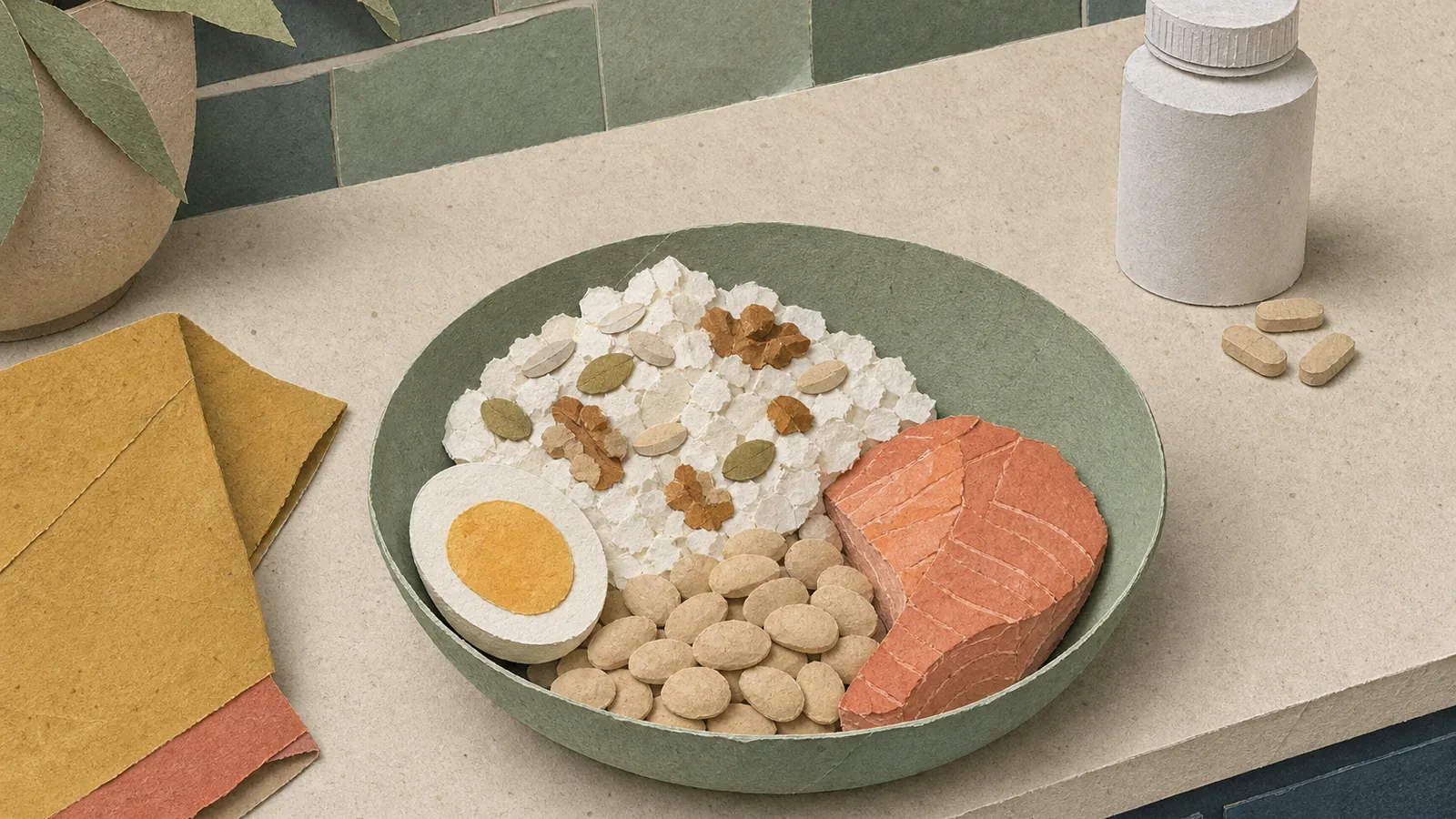
For about twenty years now, every large randomized trial of the daily multivitamin has come back null, and every careful look at protein intake in older Americans has come back short. The supplement industry has spent the same twenty years selling the first and ignoring the second. Two geriatric researchers laid the pattern out plainly in The Conversation in May, and ScienceDaily syndicated it back into the wire on Friday: most of what the aisle promises older adults is reassurance rather than a confirmed deficiency, while the nutrient that actually moves outcomes in aging sits, for the most part, in the meat case and the dairy aisle.
The piece is by Miguel G. Borda, a consultant in geriatric medicine at the University of Navarra, and George E. Barreto, an associate professor in cell biology at the University of Limerick, funded by the Norwegian Health Association and Research Ireland respectively. Neither is taking money from Bayer or any of the multivitamin houses whose products they’re quietly walking back. What they wrote is the academic version of what twenty years of trial data have already told anyone reading: the daily pill is not buying the years it claims.
Start with the multivitamin, the symbol of the whole pitch. In June 2024, JAMA Network Open published the largest cohort analysis ever assembled on this question: 390,124 adults pooled from the NIH-AARP Diet and Health Study, the PLCO cancer screening trial, and the Agricultural Health Study, followed for a median of more than 20 years across 164,762 deaths. Lead author Erikka Loftfield at the National Cancer Institute reported no conflicts of interest. The result was not a wash. Daily multivitamin users had a hazard ratio of 1.04 for all-cause mortality versus non-users in the first follow-up window (95% CI 1.02 to 1.07), and 1.06 for heart-disease death (1.01 to 1.11). The study is observational, so it cannot say the pills caused the deaths; what it can say is that across a sample that size, daily use was associated with no mortality benefit and with modest signals in the wrong direction for all-cause, cardiovascular, and cancer mortality. The “nutritional insurance” framing the industry has leaned on since the 1970s does not survive contact with a cohort that size.
The vitamin D story is the other half of the inheritance. In 2022 the New England Journal of Medicine published the fracture results from VITAL, a large randomized trial of 25,871 generally healthy U.S. adults, none selected for vitamin D deficiency, low bone mass, or osteoporosis, randomized to 2,000 IU per day of cholecalciferol or placebo and followed for a median 5.3 years, with Brigham and Women’s endocrinologist Meryl LeBoff as lead author. The hazard ratios were almost theatrically null. Total fractures, 0.98. Non-vertebral fractures, 0.97. Hip fractures, 1.01. The effect held across age, sex, body-mass index, race, and baseline vitamin D levels. Two thousand IU a day for five years, in a population that was not deficient to start with, did nothing measurable for bones. The trial does not say vitamin D is useless. It says the way the bottle is being sold, as a daily skeleton-protector for healthy adults, is not what the data show.
Where Borda and Barreto land is more useful than the negative findings, because they refuse to flatten the picture. B12 deficiency becomes meaningfully more common with age, and it is made worse by two of the most-prescribed drug classes in older Americans: metformin and proton-pump inhibitors. The pills millions of people take for diabetes and reflux quietly drag down the ability to extract B12 from food, and that deficiency shows up as fatigue, neuropathy, and cognitive symptoms that get blamed on aging itself. Vitamin D supplementation does help in people who are actually deficient. Folate matters in low-folate states, though only after B12 status is confirmed, because folate stacked on top of an unrecognized B12 deficiency masks the anemia while the nerve damage keeps progressing. None of these are pitches that run well on Instagram. They are clinical findings that require, of all things, a blood draw before a recommendation.
Then there is the omission, which is the part the marketing has never figured out how to monetize. Many older Americans are eating too little protein, and the geriatric literature now treats roughly 1.0 to 1.2 grams per kilogram of body weight per day as a sensible floor in healthy older adults. That puts a 170-pound man at about 77 to 93 grams a day, and a lot of people in that age band are not getting there. Low intake is one of the cleanest drivers of sarcopenia, the muscle-loss spiral that ends in falls, frailty, fractures, and lost independence. The supplement aisle does have whey and casein on it, but they sit in the sports-nutrition section aimed at twenty-five-year-olds, not in the geriatric care of the woman in her sixties who is, statistically, eating a small portion of chicken at lunch and wondering why her grip is going. The shelf space and the marketing dollars still go to the antioxidant bottle she does not need.
The case here is against pretense, not against pills. Some older adults need B12. Some need vitamin D. Some need folate, in the right clinical order. Almost nobody walking into a CVS for a daily one-a-day, on the strength of a television ad, needs what is actually in the bottle. The U.S. supplement industry sells about $70 billion a year, has grown through two decades of trial data that contradicted its central longevity pitch, and operates under the 1994 DSHEA framework, which lets manufacturers make structure-and-function claims without FDA premarket approval or evaluation. Bayer sells One A Day. Haleon sells Centrum. The regulatory posture on the category is so loose that it makes the FDA’s drug arm look strict by comparison, and the people paying for it are older Americans handing over twenty or forty dollars a month for products that randomized trials have, repeatedly, declined to back.
The fix is unglamorous, which is most of why it does not sell: a primary-care visit, a panel of cheap labs (B12, vitamin D, metabolic, CBC), real food with real protein in it at every meal in numbers most older Americans are not currently hitting, resistance training on a schedule because the muscle that protein builds has to be loaded to stay, and a pill bottle only where a number on a lab report demands one. The aisle will not tell you any of that, because there is nothing on the shelf with the margin of a daily multivitamin.
Sources
- JAMA Network Open – Multivitamin Use and Mortality Risk in 3 Prospective US Cohorts, Loftfield et al. (2024)
- NEJM – Supplemental Vitamin D and Incident Fractures in Midlife and Older Adults (VITAL), LeBoff et al. (2022)
- The Conversation – Why supplements aren’t a shortcut to healthy ageing, Borda & Barreto (2026)
- ScienceDaily – The supplements older adults actually need and the ones they don’t (2026)