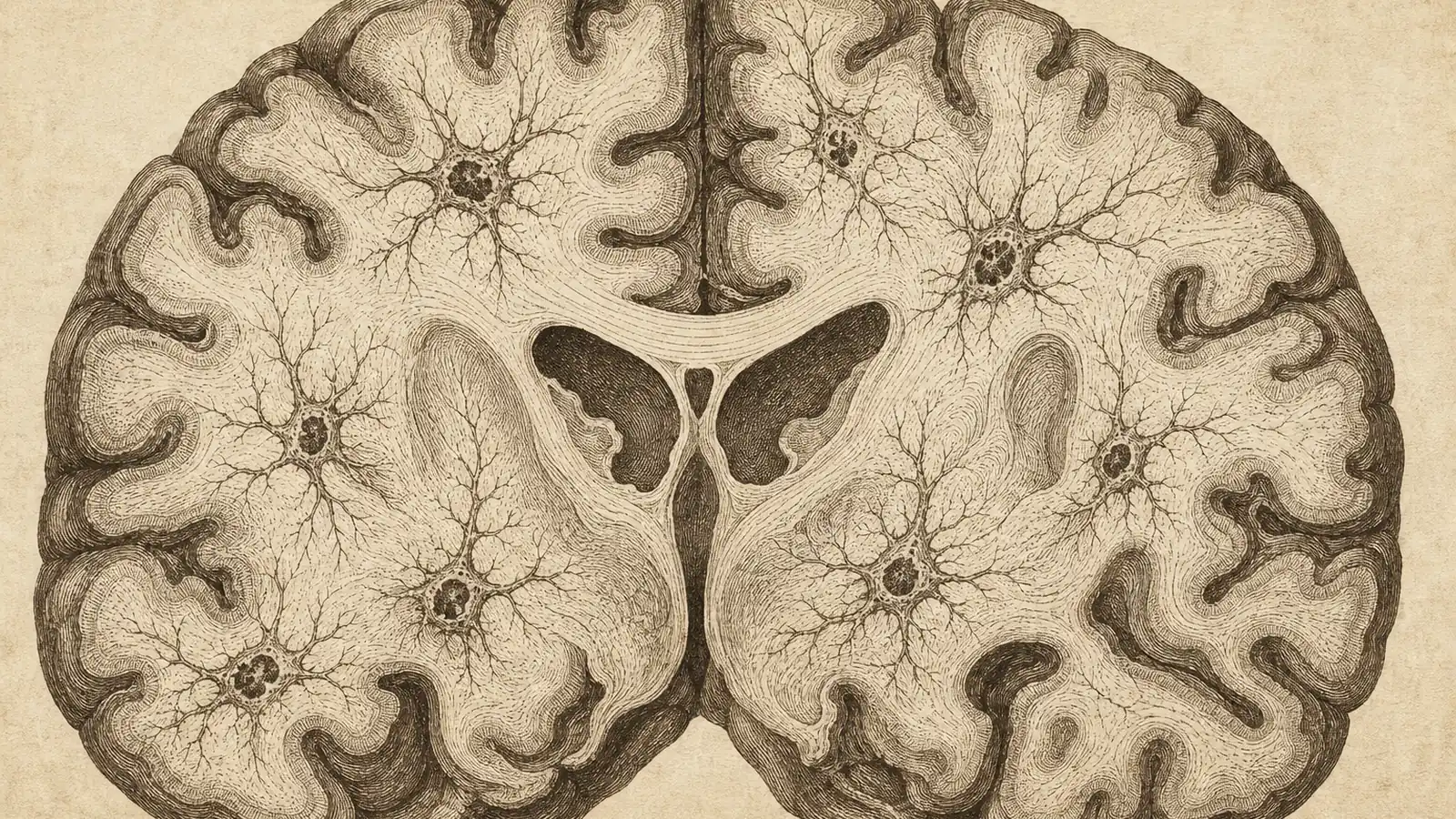
Here is the sentence I did not expect to type today: the brains of Alzheimer’s patients are carrying the same mutations that drive blood cancers, and they are sitting inside the microglia, the immune cells that were supposed to be protecting the neurons. Not the neurons themselves. The bodyguards.
That is the finding out of Christopher Walsh’s lab at Boston Children’s Hospital, published in Cell under the title Somatic cancer variants enriched in Alzheimer’s disease microglia-like cells drive inflammatory and proliferative states. Walsh, a Howard Hughes investigator, partnered with August Yue Huang and Alice Eunjung Lee to do something nobody had really done before: deep-sequence 149 known cancer-driving genes inside actual brain tissue from 190 Alzheimer’s patients, and compare it to 121 cognitively healthy controls, as the Boston Children’s writeup details. They were not chasing an Alzheimer’s hypothesis. They were asking whether somatic mutations, the kind that pile up in your body as you age, were doing anything strange in the aging brain.
They were doing something very strange.
The Alzheimer’s brains carried significantly more single-letter DNA changes than the healthy brains, and the changes were not random. They clustered in five cancer-driver genes, with three of them, TET2, ASXL1, and DNMT3A, explicitly flagged by the paper as the classic trio associated with clonal hematopoiesis. Those three names should set off an alarm bell if you have ever read a paper about aging blood. They are the dominant drivers of clonal hematopoiesis, the age-related condition where a single mutated blood stem cell starts elbowing out its neighbors and seeding a larger and larger population of itself. It is common in older adults, and it has been linked in the cardiology literature to elevated cardiovascular risk. And now Walsh’s team is saying those same mutated immune cells are showing up inside the skull.
When they checked the blood of the same patients, the identical mutations were there too. Same fingerprints, blood and brain. The team’s read, in Huang’s own words, was that the blood’s immune cells with cancer mutations are likely getting into the brain and contributing to disease. The authors propose that as the blood-brain barrier weakens with age or injury, peripheral immune cells slip across and convert into microglia-like cells inside the brain. That is a hypothesis the paper puts forward to explain the matched mutations, not a settled fact. But it is a hypothesis the matched-mutation data point at hard.
Picture what that would actually look like in tissue. An aging brain with a smolder of amyloid or tau is already tripping the local fire alarm. Microglia respond, multiply, get to work. Among them is some fraction with a TET2 mutation that gives them a proliferation advantage and a slightly thicker skin against the stress signals telling normal cells to calm down. Those cells expand faster than their siblings, dominate the inflammatory response, and keep pouring out cytokines in the wrong shape and at the wrong duration. The neurons they were supposed to be defending become bystanders in a fight that no longer has an off switch. Walsh’s framing was blunt: Alzheimer’s, he said, is “a little like cancer, driven by the same mutations that drive blood cancers like lymphoma and leukemia.” That is the model the paper is proposing. The mechanistic details I just walked through are inference from that model, not a step-by-step the paper proves.
I came in expecting to roll my eyes a little at the headline “cancer mutations cause Alzheimer’s”, because that genre of headline usually outruns its data by a country mile. It did not, this time. The sample is substantial (311 brains is a lot of postmortem tissue), the genes implicated are exactly the ones the clonal-hematopoiesis literature would predict, and finding the same mutations in blood and brain of the same patients is the kind of internal corroboration that does not happen by accident. It is the rare “surprising mechanism” paper where the surprise survives a careful second read.
It also lands into a field where the dominant story has been wobbling. For forty years Alzheimer’s research has been organized around amyloid plaques, and the drug pipeline pointed at that story has, charitably, underperformed. Lecanemab and donanemab cleared FDA approval on modest delays of cognitive decline, with brain-swelling and microhemorrhage rates that practicing clinicians still argue about in real terms. The 2006 Nature paper underpinning a specific amyloid-beta oligomer was flagged by Science in 2022 for likely image manipulation and is now being unwound. None of that disproves amyloid’s role; what Walsh’s paper does is suggest amyloid was always going to be a necessary-but-insufficient frame, because a parallel disease process was running in the immune cells the whole time, and nothing in the amyloid pipeline was looking at it.
What does this change practically? In the short term, nothing about your prescription or prognosis. In the medium term, two threads worth watching. First, screening: Lee suggested the same blood-based tests already used in oncology to detect clonal hematopoiesis could be turned around and used to flag people at elevated Alzheimer’s risk decades before symptoms, which would be a meaningful step up from waiting for cognitive decline to arrive. Second, treatment, and this is where I want everyone, including the cancer industry, to slow down. The team is openly floating the idea of repurposing existing cancer drugs against pathogenic microglia. The biology is genuinely interesting. It is also exactly the kind of opening where the companies that brought us six-figure amyloid antibodies start pricing repurposed oncology drugs against an Alzheimer’s market of tens of millions. If oncology-style screening and treatment do enter Alzheimer’s care, the pricing fight is coming with them, and the early framing of “we are repurposing a drug we already have” is the line that historically does the least amount of work to keep that price honest.
The question I would actually like answered, and that this paper does not: are the cancer-driver mutations causing the inflammation, or is the pre-existing inflammation of the aging brain selecting for the mutant cells that happen to thrive in it? Walsh’s data are consistent with both, and the difference matters a lot for what you would do about it. I will be watching what his group says next, and I would not be surprised if the answer turns out to be yes, both, reinforcing each other. That is usually how biology gets you.
Sources
- Huang, Lee, Walsh et al., “Somatic cancer variants enriched in Alzheimer’s disease microglia-like cells drive inflammatory and proliferative states,” Cell (2026), DOI 10.1016/j.cell.2026.03.040
- Boston Children’s Hospital – “In Alzheimer’s disease, cancer mutations accrue in brain’s immune cells”
- Neuroscience News – “Alzheimer’s Brains Share a Genetic Signature with Some Cancers”
- ScienceDaily – “Scientists discover a surprising cancer link to Alzheimer’s disease” (12 June 2026)
- Charles Piller, Science – “Potential fabrication in research images threatens key theory of Alzheimer’s disease” (2022)