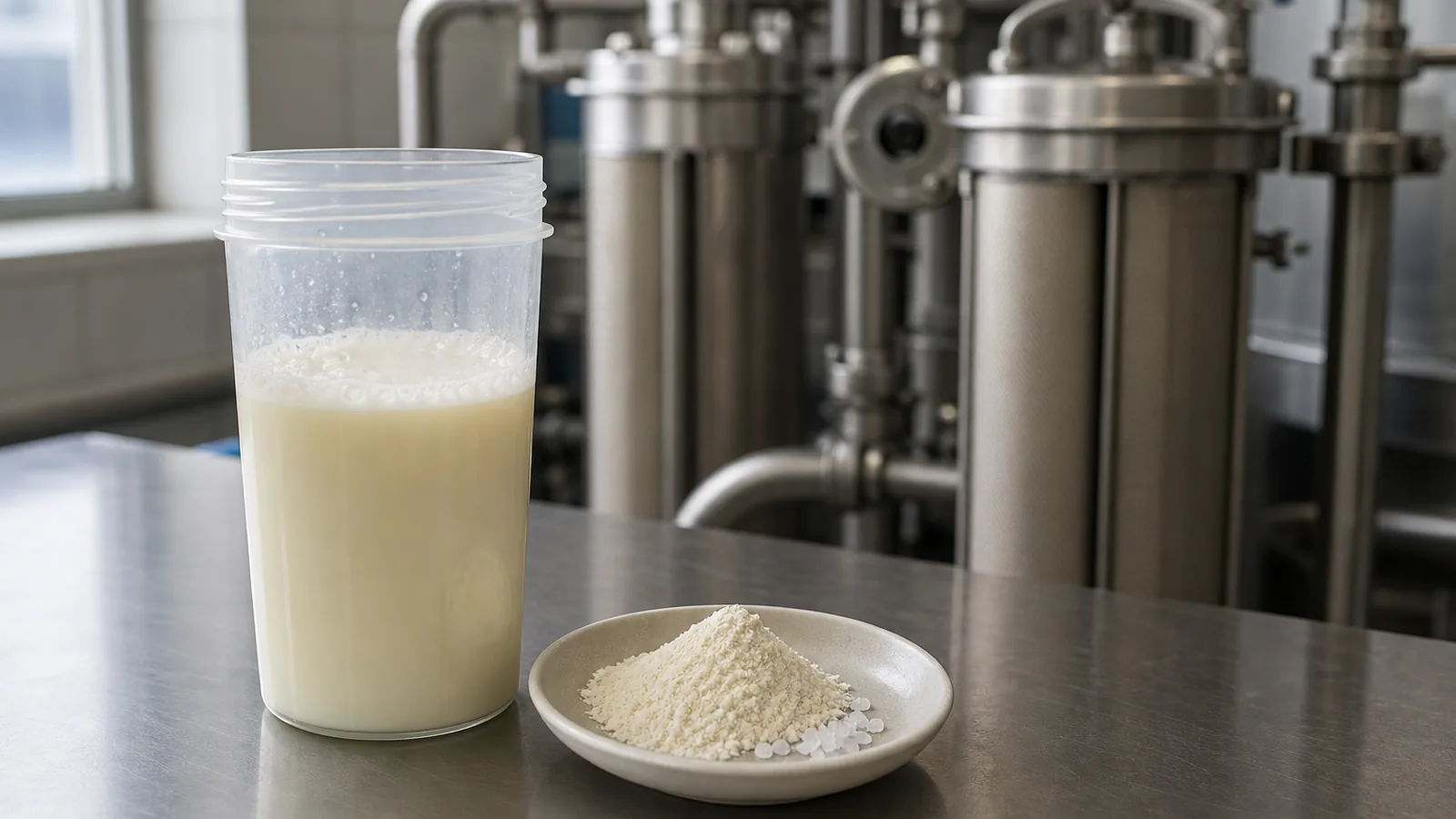
For about a decade I have been telling people, with the confidence of someone who has stirred enough sad chocolate powder into almond milk to know, that the chalky peppery aftertaste in a whey shake is just what whey protein tastes like. You learn to live with it. You add banana, drink it cold and fast, blame the protein.
You should not be blaming the protein.
A new paper out of the University of Reading, Aberystwyth, and Arla Foods Ingredients, published this year in the International Dairy Journal, ran a trained sensory panel across three versions of the same whey: a commercial reference, a sample enriched in alpha-lactalbumin (the small, sweet, tryptophan-rich whey fraction that sits closest to the protein in human breastmilk), and an alpha-lactalbumin-deficient sample. The enriched version scored much higher on slipperiness and lower on oral friction, which is the technical way of saying it actually felt like a milk in the mouth instead of a paste. The same panel also flagged it as more bitter and more peppery than the reference.
Then they ran the chemistry, and that is where the piece turns. In the samples they tested, the off-notes weren’t tracking with any peptide of the protein. They were tracking with minerals. When you push whey through a fine membrane under pressure to selectively concentrate the alpha-lactalbumin fraction, the calcium, magnesium, and phosphate salts in the buffer ride along and get concentrated too. The protein is the headliner; the salts come up the elevator with it. Pile up enough calcium and magnesium on the tongue and they ring the bitter and metallic receptors hard. Modify the filtration step to wash those minerals back out, and the bitterness goes with them. The mouthfeel improvement stays.
On one level that is a small, elegant manufacturing result. On another it is a quiet indictment of every aggressive flavor-masking strategy the supplement industry has been throwing at this problem for years. We have all sat through the parade: sucralose stacks to bury the bitter, gum thickeners to fight the chalk, “natural and artificial flavors” laundered into a vanilla that tastes like a candle. None of that was solving the underlying problem, because the underlying problem wasn’t about taste chemistry at all. It was about how ultrafiltration concentrates everything in the retentate, proteins and salts alike. The “protein flavor” a generation of customers has been told to tolerate is a process artifact, and this is the first clean demonstration I have seen that you can engineer it out at the membrane stage instead of papering over it at the flavor-house.
Now the asterisk. Arla Foods Ingredients, the industrial collaborator on this paper, sells a whole Lacprodan ALPHA line of alpha-lactalbumin concentrates, from ALPHA-10 at roughly 41 percent alpha-lactalbumin to ALPHA-50 at around 90 percent, into sports nutrition, infant formula, and “medical nutrition” markets. An Arla scientist is on the author list. The pilot-scale processing was done at AberInnovation, the commercial research campus tied to Aberystwyth. The press materials disclose no funding source. This is, functionally, supplier R&D in a university gown. That doesn’t make the chemistry wrong, sensory panels are sensory panels and minerals taste like minerals, but it does mean the reader is allowed to ask whose product line a paper most directly de-risks. The answer is on the label.
The other thing worth pulling out from behind the smoother-mouthfeel headline is what Arla is selling alpha-lactalbumin for. The marketing pitch is built on tryptophan and a claimed knock-on effect on serotonin synthesis for appetite, mood, and sleep, plus the breast-milk-mimicry argument for infant formula. The Reading paper studies none of that. It studies whether the powder feels slippery instead of pasty and whether the bitter notes can be filtered out. Those are useful questions with useful answers. But if you see a “clinically studied” alpha-lactalbumin sticker on a tub in a global whey protein market that Grand View Research pegged at roughly $9.7 billion in 2025, check what was actually clinically studied. A trained panel rating slipperiness on a scale is not a serotonin claim.
What I would do with this, if you drink the stuff: expect a generation of shakes that taste cleaner over the next couple of years, because the membrane fix is not exotic and the bigger players will copy it the moment one brand publicly differentiates on mouthfeel. And treat any new “alpha-lactalbumin enriched” sticker on a tub with the same eye you’d bring to every single-ingredient hero claim in this category. I went in expecting another small-effect manufacturing tweak. What the chemistry pulls out instead is more useful than that: the bitter chalky finish you have been blaming on whey was never whey’s fault. It was the salt riding the same elevator as the protein. Useful to know next time someone tells you that grit is the price of getting your protein in.
Sources
- International Dairy Journal – Giles et al., “The sensory and physicochemical properties of an α-lactalbumin enriched whey protein and the contribution of minerals to the sensory profile” (2026)
- University of Reading – “Your post-gym protein shake may get a taste upgrade” press release (2026)
- ScienceDaily – “The secret behind smoother, better-tasting protein shakes” (2026-06-15)
- Phys.org – “Your post-gym protein shake may get a taste upgrade” (2026)
- Arla Foods Ingredients – Lacprodan ALPHA-10 / ALPHA-50 product page (alpha-lactalbumin commercial line)
- Grand View Research – Global whey protein market overview (2025 size, 2026–2033 forecast)