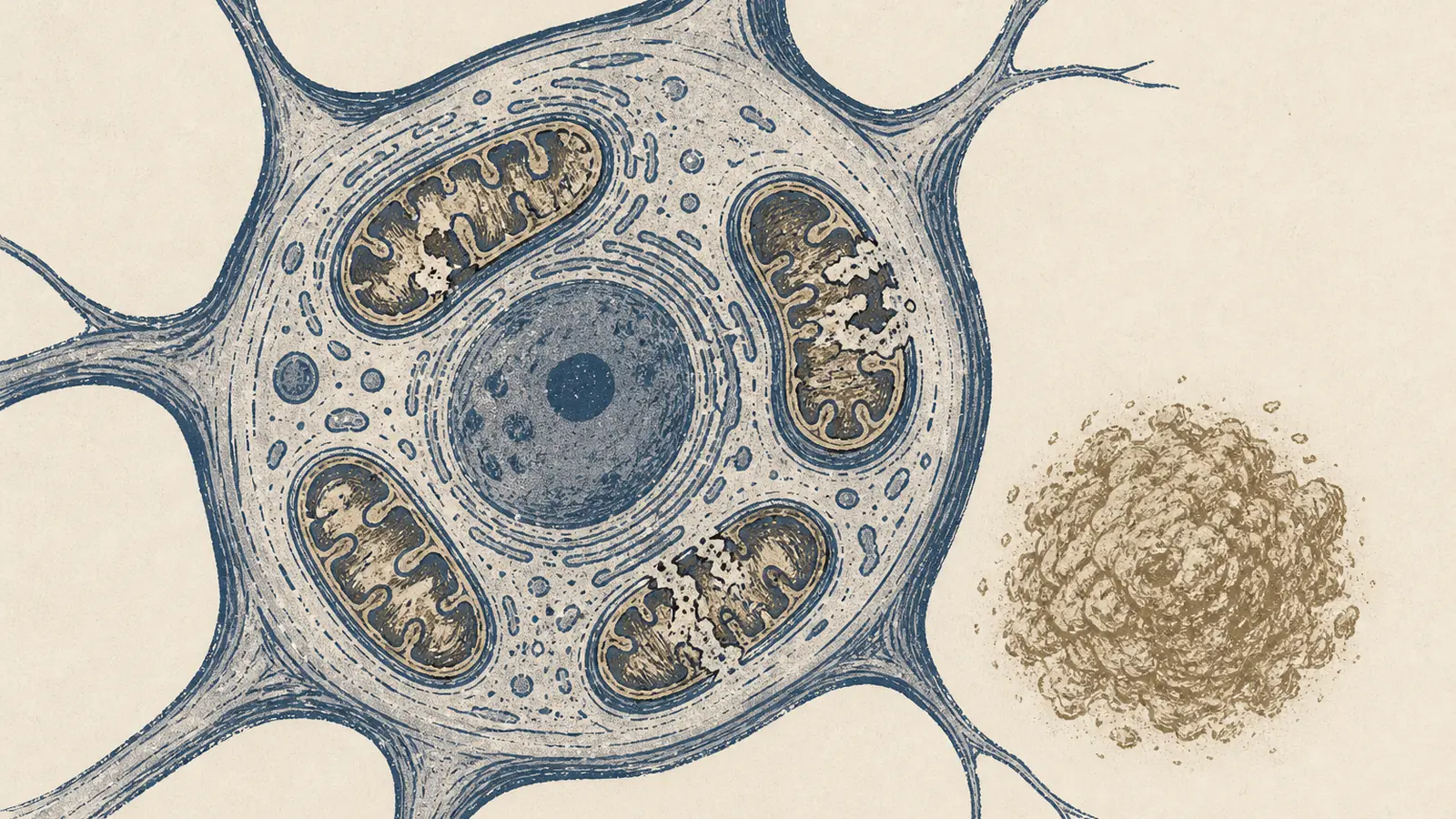
Picture a neuron sitting right next to one of those infamous Alzheimer’s plaques. By the time that plaque is big enough to light up on a brain scan, the cell beside it has probably been running on a failing power supply for years. The plaque is the smoke. A growing camp of researchers now argues the fire started somewhere else entirely, inside the microscopic engines that keep a brain cell alive, and that the field spent three decades photographing the smoke and calling it the arsonist.
That argument has a name that sounds like jargon and is really a whole worldview: defective mitophagy upstream of amyloid. It is having a moment in longevity circles and in a run of recent papers, and it is gaining ground for a brutal reason. The thing it competes against, the amyloid hypothesis that owned Alzheimer’s research for a generation, is cracking in public.
The story you were told
For most of my life the official account of Alzheimer’s was clean and confident. Sticky fragments of a protein called amyloid-beta clump into plaques between neurons, the plaques are toxic, the plaques cause the disease. Clear the plaques, cure the dementia. That is the amyloid cascade hypothesis, and it did not just win the argument. It ate the field. A 2022 investigation in Science found the U.S. National Institutes of Health was pouring roughly $1.6 billion in a single year into projects built around amyloid, about half its Alzheimer’s budget, with the large majority of drugs in development designed to hunt the protein. When that much money and that many careers point one way, the line between consensus and capture gets hard to find.
And one of the bricks holding up that wall turned out to be fake. A celebrated 2006 Nature paper named a specific amyloid assembly, Aβ*56, as a toxic memory-wrecker in rats, and it became one of the most-cited pieces of evidence for the whole theory, racking up more than 2,200 citations. In 2022 the Vanderbilt neurologist Matthew Schrag, working with that same Science investigation, flagged that the paper’s western-blot images looked digitally doctored: spliced, duplicated, touched up with an eraser tool. Nature retracted it in 2024. Every author except the lead, Sylvain Lesné, signed the retraction, and Lesné still disputes it. It is now the second most-cited retracted paper in history. You do not get to spend a generation telling everyone the case is closed and then, when a load-bearing study gets pulled for doctored images, insist the verdict holds anyway.
The drugs are the tell. The newest anti-amyloid antibodies clear plaque beautifully on a scan. What they barely touch is the patient. In its phase 3 CLARITY-AD trial, lecanemab slowed cognitive decline by 0.45 points on an 18-point dementia scale over 18 months, a gap most clinicians struggle to see at the bedside, while a meaningful share of patients developed brain swelling or bleeding. The plaques went down. The people kept sinking. Europe’s regulator did the same arithmetic: in July 2024 the EMA’s drug committee refused the medicine outright, judging that its thin benefit did not outweigh the risk, and only reversed course months later for a restricted, lower-risk subgroup. If the plaques were the disease, scrubbing them out should have worked far better than this.
What the metabolic camp actually claims
Now the alternative, and here is where the biology gets lovely. Every neuron is a power-hungry cell stuffed with mitochondria, the organelles that burn fuel into usable energy. Mitochondria wear out, and a healthy cell keeps a quality-control crew that tags the broken ones and digests them. That cleanup is mitophagy, literally “mitochondria eating.” It is one of the oldest housekeeping tricks in biology, and it slows down as we age.
The mitochondrial cascade hypothesis, first floated by Russell Swerdlow and colleagues back in 2004, flips the arrow. When mitophagy fails, broken mitochondria pile up inside the neuron and leak reactive oxygen species, the corrosive exhaust of bad combustion. That oxidative stress, the argument goes, nudges the cell’s handling of amyloid precursor protein toward churning out more of the toxic amyloid in the first place. So the energy failure is not caused by the plaques. The plaques are caused by the energy failure. Amyloid stops being the original crime and becomes a downstream alarm, the symptom of a cell that is starving. Once it gets rolling it is a vicious circle, each side feeding the other, but the metabolic camp says the first shove comes from the power plant, not the protein.
I came in expecting to roll my eyes, because “it’s actually metabolic” is the reflexive contrarian move for every disease right now. What turned me was that the upstream story explains the things amyloid never could: why brain glucose metabolism craters years before any symptoms, why mitochondria already look sick in the earliest affected neurons, why type 2 diabetes and insulin resistance track so tightly with dementia risk. It makes sense of the wreckage at the scene better than the suspect everyone arrested.
The honest part the hype skips
So do we have the answer? Not even close. The wellness internet is about to oversell this, so here is the unglamorous truth before someone sells you a capsule.
Every promising mitophagy treatment so far lives in a dish or a mouse. The enhancers people are already buying as longevity supplements, urolithin A, NAD+ boosters, and the rest, do restore mitochondrial shape and quiet oxidative stress in cultured neurons, in worms, and in transgenic Alzheimer’s mice. Encouraging. Also not a single human being with Alzheimer’s getting better. No completed trial has shown a mitophagy enhancer slows the disease in people. Zero. The same review that lays out the gorgeous mechanism says so in plain words: the human efficacy data is not there yet. The field even concedes it lacks an animal model good enough to prove that mitophagy failure comes first, which is the entire claim.
And the metabolic side has its own integrity problem, which almost nobody waving the reframe around wants to mention. One of the most prolific labs championing mitophagy enhancers has been hemorrhaging retractions. A 2022 paper titled, with no apparent irony, “Protective effects of mitophagy enhancers against amyloid beta-induced mitochondrial and synaptic toxicities” was retracted from Human Molecular Genetics in 2024 after a reader spotted duplicated beta-actin blots, the journal lost confidence in the results, and the authors disagreed with the call. It followed a 2023 correction to the same paper. A second paper from the group, on amyloid-induced mitophagy defects in a mouse model, was retracted in 2026. Duplicated blots, lost confidence, authors objecting: the exact pattern that hollowed out the amyloid camp, just aimed the other way. The lesson is not that the metabolic theory is fake. The lesson is that any field hungry enough for a win starts cutting corners, and the figures you should trust least belong to whoever most needs to be right.
So what is actually “trending”? Not a landmark trial. What is circulating is a wave of argument: a 2026 hypothesis paper making the case that failing cellular respiration is a risk factor that precedes the disease, review after review mapping how mitophagy defects and amyloid trap each other in that vicious circle, and a longevity-forum crowd ready to call the matter settled. The honest version is smaller and more interesting than the hype: the metabolic camp has built a serious case that amyloid sits downstream, and it has not yet run the experiment that would prove it in a living person.
Here is where I land. The metabolic reframe is the most exciting idea in dementia research I have read in years, and the amyloid establishment has earned every bit of the reckoning rolling toward it, doctored data and feeble drugs and all. But a mechanism that dazzles in a mouse is a hypothesis, not a prescription. I am watching the mitophagy work closely, I think the burden has shifted onto the plaque-first camp to explain why its drugs keep failing, and I would not spend a dollar on a mitophagy supplement for my own brain on the strength of a worm study. Both of those are true at the same time. That is what it looks like to take an idea seriously without letting it sell you something.
Sources
- Science – Piller, “Potential fabrication in research images threatens key theory of Alzheimer’s disease” (2022)
- Nature – Lesné et al., “A specific amyloid-β protein assembly in the brain impairs memory” (2006, RETRACTED 2024)
- NEJM – van Dyck et al., CLARITY-AD lecanemab phase 3 trial (2023)
- EMA – CHMP meeting highlights, refusal of Leqembi/lecanemab (July 2024)
- PMC – “Defective mitophagy and the etiopathogenesis of Alzheimer’s disease” review
- Human Molecular Genetics – Retraction, “Protective effects of mitophagy enhancers against amyloid beta-induced mitochondrial and synaptic toxicities” (2024)
- Human Molecular Genetics – Correction to the same mitophagy-enhancers paper (2023)
- Human Molecular Genetics – Retraction, hippocampal mutant APP / amyloid-beta defective mitophagy mouse model (2026)
- Metabolic Brain Disease – “Dysfunctional respiration as a risk factor for Alzheimer disease: a hypothesis” (2026)
- r/longevity – discussion thread, “Defective mitophagy upstream of amyloid”