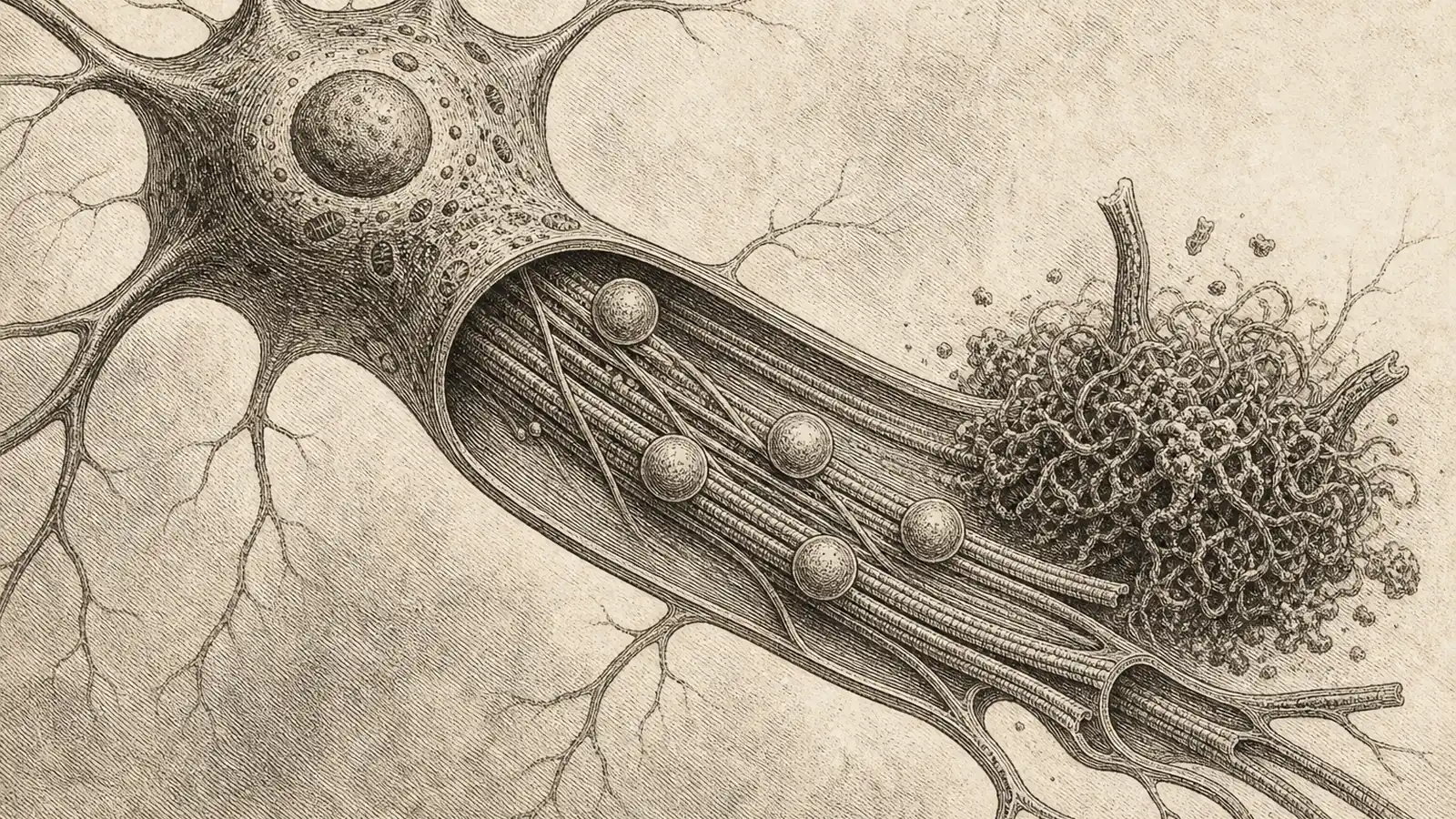
For about twenty years, the dominant bet in neurodegeneration has been a demolition job. Find the toxic protein clump, the Tau tangle in Alzheimer’s, the alpha-synuclein knot in Parkinson’s, and figure out how to break it up or stop it forming. A long line of anti-aggregate drugs, a lot of money, a long list of failed trials, and one assumption underneath all of it: the clump is the enemy.
The droplet is a workplace, not a crime scene.
So here is what stopped me when I read the new paper out of Baylor College of Medicine. The researchers did not go after the clumps at all. They left them alone and changed the conditions around them. And in the dish, that worked better.
Let me back up, because the biology here is genuinely lovely.
Tau and alpha-synuclein are not villains by nature. They are working proteins. Tau’s day job is helping build and stabilize microtubules, the internal scaffolding that gives a neuron its shape and lets it ferry cargo from one end of a long axon to the other. The trouble starts with how these proteins gather. To do their jobs they pool together inside tiny liquid blobs called condensates, droplets that form by liquid-liquid phase separation, the same physics that makes oil bead up in water. Inside those droplets the proteins are concentrated and busy, and that is where the healthy work happens. It is also where it can go wrong: if the chemistry tips the wrong way, the same crowded droplet becomes the place where the proteins lock into rigid, sticky forms that seed the aggregates that kill cells. The droplet is a workplace, not a crime scene. The question is what the proteins decide to do once they are inside it.
The field’s instinct was to blow up the droplet, or to attack the clump it can produce. The Baylor team, led by Allan Ferreon and Josephine Ferreon with first author Lathan Lucas, asked a different question: what if you leave the droplet alone and change what happens inside it?
Their answer is tubulin. Tubulin is the raw building block of microtubules, the literal subunit Tau is supposed to be assembling. When the researchers added tubulin into condensates of Tau and alpha-synuclein, the proteins stopped sliding toward toxic clumping. They changed shape, grabbed the tubulin, and started building microtubule networks instead. The very interaction that makes these proteins dangerous when they have nothing better to do gets redirected the moment you hand them their actual job. “Tubulin redirects the activity of these proteins by giving them something productive to do,” Lucas put it. Wait, why would supplying more of a building block stop a misfolding cascade? Because the misfolding was partly a problem of idle hands. That is the part I keep turning over.
And it reframes a clue that has sat in the data for years. Tubulin levels are low in the Alzheimer’s brain, and the Baylor work leans on that fact: when tubulin runs short, microtubules are less abundant, and Tau and alpha-synuclein lose the partner that keeps them busy. The standard read was that the disease chews through tubulin, that low tubulin is wreckage the illness leaves behind. The Baylor mechanism flips the arrow. If tubulin is what keeps these proteins pointed at productive work, then low tubulin might not be only damage. It might be part of the cause, upstream of the clumping rather than downstream of it. As Allan Ferreon frames it, tubulin shifts “from a passive casualty of disease to an active protector against toxic protein aggregation.” In that telling, low tubulin could be an early warning light rather than a late-stage symptom.
Now here is where the enthusiasm has to meet the history, because the gap between this result and a treatment is exactly the gap where Alzheimer’s hype usually dies, and this paper does not get to skip it.
What Baylor has is biochemistry and cell work: biophysical assays, high-resolution microscopy, and neuron-based experiments in the dish. Careful, mechanistic, beautifully controlled, and a long way from a brain. No animal model here shows that boosting tubulin slows disease. No human data. No drug. “Boosting the tubulin pool” is a direction the authors point toward, not a therapy anyone has tested in a living, tau-burdened brain.
That distinction matters more here than usual, because we have run almost exactly this play before. Propping up the microtubule scaffold to treat Alzheimer’s is not a new idea. Drugs built to stabilize microtubules looked terrific in mice. Epothilone D reduced tau pathology and cognitive deficits in aged tau-transgenic mice, went into human trials, and was quietly discontinued. Davunetide, another microtubule-stabilizing candidate, cleared safety and then failed to move the composite cognitive needle and was shelved. The mechanism made sense. The mice cooperated. The patients did not. So anyone selling you a tubulin cure off the back of a test-tube paper is skipping the exact step where this whole class of ideas has died before.
What is new and worth holding onto is the concept, not the cure. The old microtubule drugs tried to brute-force stability from the outside, stiffening everything and hoping the brain came along. This work points at something the cell already runs on its own: a built-in switch, the ratio of tubulin to its disordered partner proteins, that decides whether Tau and alpha-synuclein behave or turn toxic. That is a more precise target than “stabilize everything,” and it might even explain why the blunt instruments failed.
What I would watch is whether anyone can carry this into an animal and show that nudging tubulin up, or just tracking when it falls, lines up with what happens to a real brain. Because the most useful thing in Alzheimer’s right now is not another late swing at the tangles. It is knowing, years earlier, where the scaffolding first started to give. By the time the clumps are visible, the damage is well underway; if the tubulin runs short before any of that shows up, that is a place to look long before there is a drug to point at it. Baylor has not gotten us there. But it is the most charming case I have read in a while that the brain’s missing scaffold may be doing its harm quietly, in the empty space, while everyone was busy staring at the wreckage.
Sources
- Nature Communications – Lucas, Tsoi, Quan, Choi, J. Ferreon, A. Ferreon, “Tubulin transforms Tau and α-synuclein condensates from pathological to physiological” (2026)
- Baylor College of Medicine – “Redefining tubulin’s role in neurodegeneration: from passive casualty to active protector” (researcher quotes, 2026)
- ScienceDaily – “Tubulin prevents toxic brain protein clumps linked to Alzheimer’s and Parkinson’s” (2026)
- Tau liquid-liquid phase separation in neurodegenerative diseases – review (PMC)
- PubMed – Zhang et al., epothilone D reduces tau pathology and cognitive deficits in aged tau-transgenic mice (2012)
- Tau-targeting therapies for Alzheimer disease – review covering epothilone D and davunetide trial outcomes (PMC)
- Frontiers in Cellular Neuroscience – “Repositioning Microtubule Stabilizing Drugs for Brain Disorders,” including davunetide Phase 2 result (2018)