For most of my adult life I treated one rule about weight as settled: if you want to lose it, you have to eat less, and eating less is supposed to feel like eating less. Hunger was the toll. You paid it, or the scale didn’t move. So the number at the center of a new analysis in JAMA Network Open made me read it twice. A group of adults dropped about 357 calories a day, held it for sixteen weeks, and ate the same weight of food they always had. No calorie targets, no portion rules, no white-knuckling.
I want to walk you through what actually happened, because what drove it is stranger than the label on it, and because the lever these researchers found is not the one they most want you to grab. The funders would love you to read this as a story about going vegan. Read the mechanism and it is really about energy density, the calories packed into each bite, and that lever does not belong to any one diet.
Start with the trial underneath. Between 2017 and 2019, researchers randomized 244 overweight adults: half went on an all-you-can-eat low-fat vegan diet built from fruit, vegetables, grains, and legumes, and half were told to change nothing. Sixteen weeks later the vegan group had lost 6.4 kg, about 14 pounds, against 0.5 kg in the do-nothing group, a between-group difference of 5.9 kg. Fat mass fell 4.1 kg. Insulin sensitivity climbed. None of that is new. What is new is that the team went back into the food diaries this year to ask why, and the answer reframes the whole thing.
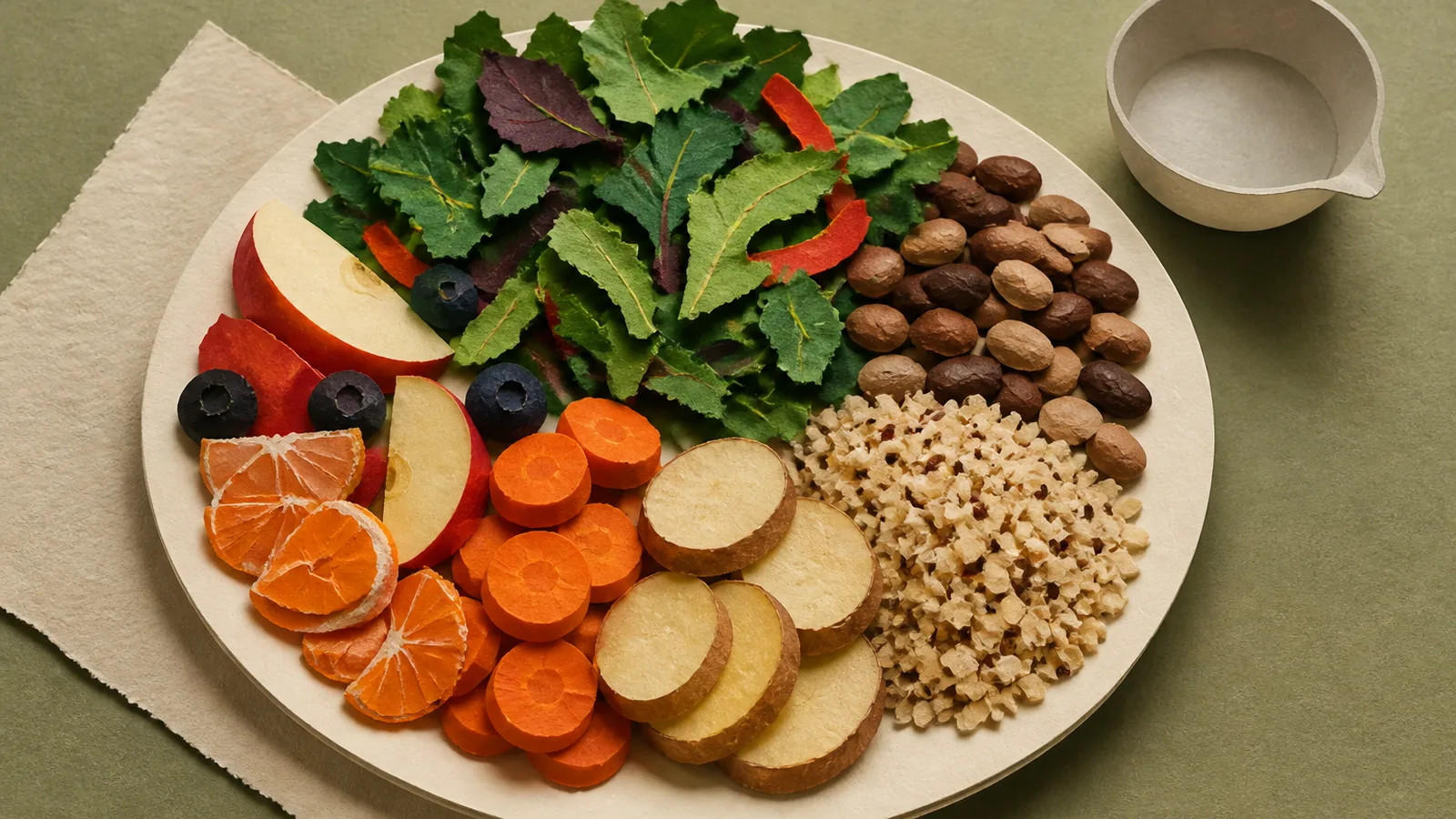
Think of your stomach less as a calorie counter and more as a scale. What it mostly registers is how much mass and volume have arrived, not how many calories rode in with them. The vegan group’s food diaries showed their energy density, the calories in each gram, dropped by about 30 percent: trade oil and dense animal products for a plate where most of the bulk is water and fiber, and the total weight of food barely moves while the calorie count falls out the back. Same plate, same fullness, roughly a third fewer calories per bite.
But why would water and fiber move the needle that hard? That is the question I kept circling. Fiber pulls two levers at once: it adds bulk with few usable calories, and it holds water, so a cup of beans or a bowl of vegetables lands in your stomach heavier and slower than the same calories in cheese or oil. It drags out how fast the stomach empties, which stretches fullness further. You are not overriding your appetite. You are handing it the same volume it always wanted and letting the calories come up short. Once I saw it laid out that way it stopped looking like a diet trick and started looking like basic physics.
Now, who paid for it, because it should change how you read the label even if it doesn’t touch the biology. The study was funded by the Physicians Committee for Responsible Medicine, a nonprofit whose whole reason for existing is promoting plant-based eating. Its longtime president, Neal Barnard, is one of the authors and earns royalties from books about, yes, plant-based diets. A second author disclosed consulting fees from the same group. None of that makes the data fake. It does mean you are reading a mechanism study written by the mechanism’s biggest fans, and they picked the framing.
Look at that framing closely and it gets thinner. The comparison arm was not a sensible rival diet. It was nothing. So the trial does not show vegan beats a fair alternative; it shows a structured whole-food diet plus a research team checking in on you beats making no changes at all. Even the 357-calorie figure is a comparison: the vegan group cut about 491 calories a day, the control group cut 134 just from being watched, and the gap is what got advertised. The food logs are self-reported, the softest data in nutrition science. And this is a fresh press cycle pressed out of a six-year-old dataset. There is a signal here, but it is wearing a lot of makeup.
The thing that keeps pulling at me cuts against the word PCRM most wants you to keep. The lever is not “vegan.” It is energy density. Calories per gram. And low energy density is not the private property of a plant-based plate. A pot of vegetable soup, a bowl built on beans and greens and whole grains, a lean protein next to a mountain of produce: all of them run low on calories per bite. You can pull that lever without signing anyone’s manifesto. Earlier work from the same group found the low-fat vegan pattern beat a Mediterranean diet on weight and cholesterol, and a 2024 analysis found it cost less at the register, both PCRM-funded, both worth exactly that grain of salt. The through-line is the physics, not the ideology stapled to it.
I keep setting this against the drugs so many people are now on. A weekly shot of tirzepatide works from the top down: it reaches into the appetite circuitry in the brain and turns the hunger signal down, so you eat less and don’t mind. Energy density works from the bottom up. It leaves your appetite alone and changes what a full stomach costs you in calories. Fourteen pounds in sixteen weeks is not what a GLP-1 delivers, and I won’t pretend it is. But it is free, it repeats across the group, and nobody has to titrate you onto it.
So here is what I do with it. I am not going vegan on the say-so of the group that most wants me to, and I would read their next headline with the funding line open in another tab. But I have started building meals around the thing the data actually points at: more water and fiber per bite, the same amount of food, fewer calories tagging along. I fill the plate. I don’t count. And I will trust the mechanism long before I trust the label somebody wrapped around it.
Sources
- JAMA Network Open – Kahleova et al., dietary energy density secondary analysis of a low-fat vegan trial (2026)
- JAMA Network Open – Kahleova et al., original low-fat vegan diet RCT on body weight and insulin sensitivity (2020)
- Physicians Committee for Responsible Medicine – news release on the energy-density finding
- ScienceDaily – “Low-fat vegan diet helps people lose weight without eating less” (2026)
- Journal of the American Nutrition Association – Mediterranean vs low-fat vegan crossover trial (PCRM-funded, 2021)
- JAMA Network Open – food costs of a low-fat vegan vs Mediterranean diet (2024)
- Journal of General Internal Medicine – evidence summary on tirzepatide for weight loss (2025)