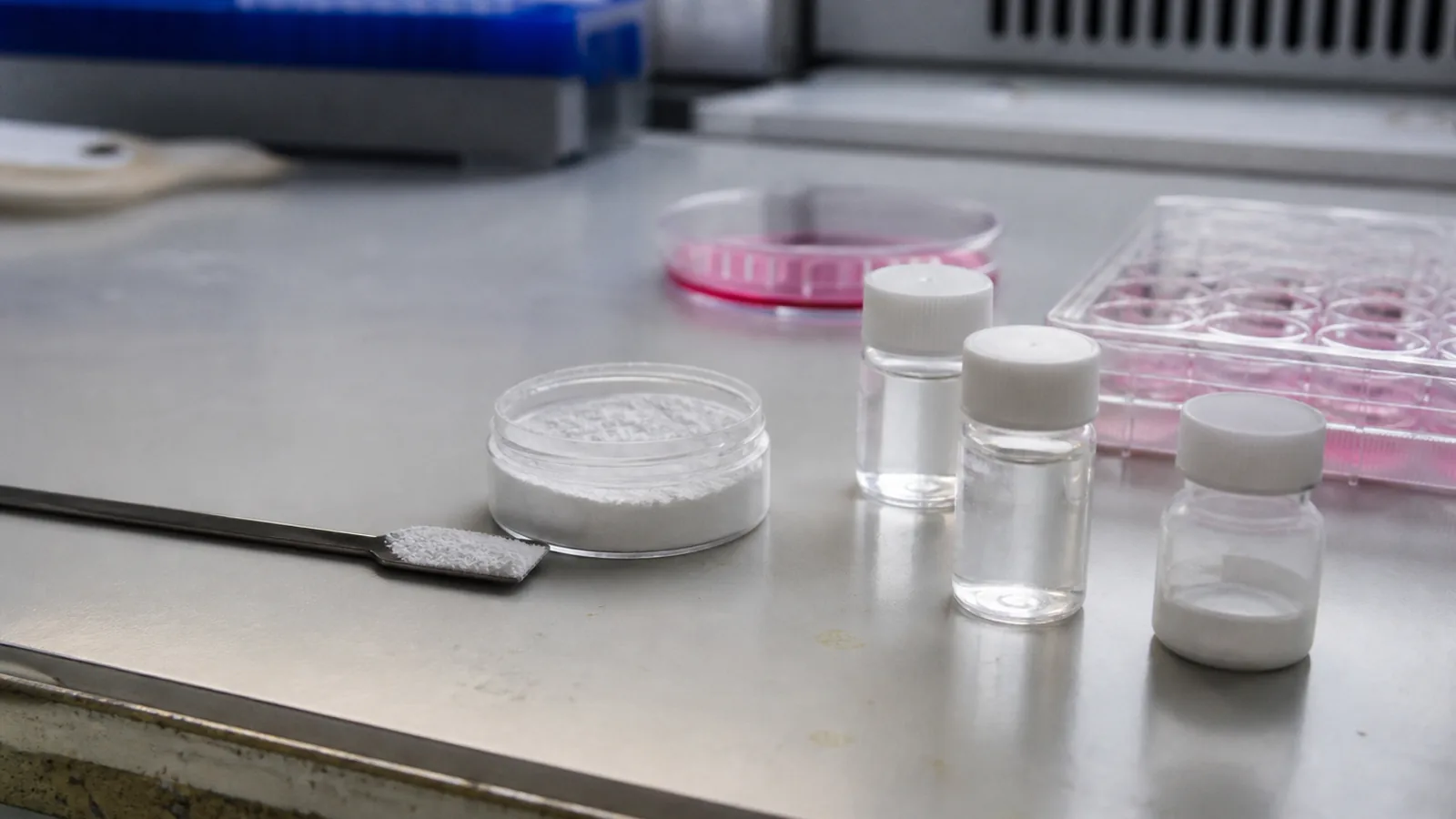
Lili Yang has spent years at UCLA on one elegant idea: that the immune system already knows how to kill cancer, and the scientist’s job is to feed it. This month her lab argued that part of the feeding might come from the cheapest tub of powder in any gym bag. By the time the finding reached the public it had shed every qualifier. “Creatine doesn’t just build muscle,” ScienceDaily announced. “It may also help fight cancer.” Five years earlier, a different lab had fed creatine to a different set of mice and watched their tumors spread faster.
Here is what the paper in iScience actually did. Yang’s team, with co-first authors Elliot Kang and James Elsten-Brown, looked at dendritic cells, the immune system’s scouts, the cells that spot a tumor and hand the target to the killer T cells that do the shooting. Dendritic cells inside tumors, they found, turn up a protein called the creatine transporter and pull creatine in to run their machinery. Knock that transporter out in a mouse and the cells go sluggish and stop rallying the T cells. Supplement creatine instead, and daily injections into mice with melanoma slowed tumor growth. In a lab dish, creatine sharpened up human dendritic cells too.
It is a clean piece of mechanism, and it belongs to a real question. It is also, start to finish, a study in mice and in cells on a bench. The researchers said so themselves, in the part of the UCLA announcement the headlines walked past: the work “was conducted in cells and mice, not patients, and no dietary or medical recommendations should be drawn from it.” No patient took this creatine. No human tumor got smaller. The injections went into mice, the transporter got knocked out in mice, and the human contribution was cells in a plate.
The distance between what a study does and what a headline says it does is the whole job of covering cancer science, and creatine is an unusually sharp test of it, because the record on this molecule does not point in one direction.
Five years before UCLA’s melanoma mice, a team at the Chinese Academy of Sciences’ Institute of Biophysics ran a different set of mice through a different question and got an answer nobody prints on a supplement label. In Cell Metabolism in 2021, they reported that creatine building up in cancer cells switched on a signaling axis, MPS1 and then Smad2/3, that drives the genetic program tumors use to spread. In their colorectal and breast cancer models, creatine barely touched the size of the primary tumor. It enhanced metastasis to the liver and the lung. Their conclusion was a caution, not a press release: be careful with dietary creatine, especially in cancer patients.
So the same molecule, in mouse experiments five years apart, energized the immune cells that fight a tumor and greased the pathway a tumor uses to escape. Nobody has resolved that. It is why a 2021 review in Trends in Cell Biology carried the flat title “The two sides of creatine in cancer.” Creatine sits at a metabolic crossroads that both the immune system and the tumor can use, and which side wins inside a living human being is exactly the thing none of these studies can answer, because none of them was run in one.
We do have human data on creatine and cancer, and it is the least breathless part of the story, which is probably why it never makes the feed. The mouse studies get the headlines; the human studies get filed. Gather up the trials that actually gave creatine to people with cancer, and the picture is not a supercharged immune system. It is a shrug. As the Oncology Nursing Society laid out this year, a trial of 263 patients with incurable disease saw only 2 people in the creatine arm reach the weight-gain endpoint. A trial in 31 colorectal cancer patients found it did nothing for muscle mass, function, or quality of life. A trial pairing creatine with resistance training in 55 prostate cancer patients found it added no benefit over the training alone. The mice grew smaller tumors. The patients got nothing.
None of this makes Yang’s work wrong. The mechanism is worth chasing, and the honest reading of it is the modest one her co-author offered: creatine might one day be tested as an add-on for patients already on immunotherapy, or as a way to build better dendritic-cell vaccines in the lab. Those are hypotheses. The way you find out is a clinical trial, with a control arm, an endpoint, and a follow-up window long enough to catch the thing the 2021 study warned about. What you do not do is skip that apparatus and let “may also help fight cancer” travel from a mouse cage to a comment section where someone with a fresh diagnosis is deciding whether to start scooping powder into a shaker bottle.
The people who did the work know the difference. The UCLA release ends by telling cancer patients to ask their doctors before touching a supplement. That caution sat at the bottom of a story whose headline promised the supplement fights the disease. The same institution sold both in the same week, out of the same building: the promise up top, the warning in the fine print. Only the promise traveled.
Sources
- ScienceDaily – “Creatine doesn’t just build muscle. It may also help fight cancer” (2026)
- UCLA Health – “Creatine may supercharge immune cells that are key to fighting cancer” (press release, 2026)
- iScience – Kang, Elsten-Brown, Yang et al., “Creatine uptake promotes dendritic cell activation and enhances antitumor immunity” (2026)
- Cell Metabolism – Zhang et al., “Creatine promotes cancer metastasis through activation of Smad2/3” (2021)
- Oncology Nursing Society – “What the Evidence Says About Creatine in Patients With Cancer” (2026)
- Trends in Cell Biology – “The two sides of creatine in cancer” (2021)