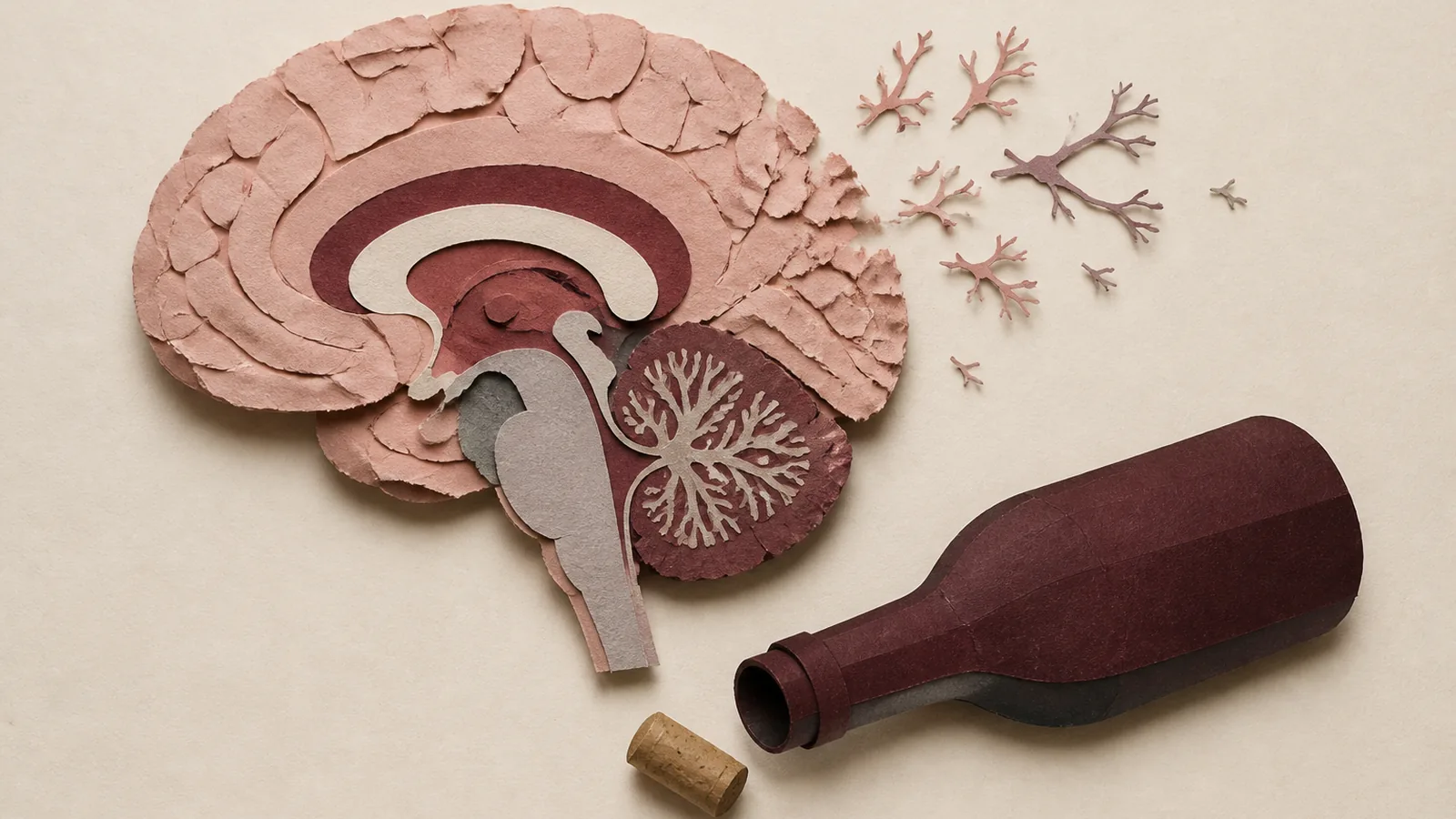
I used to think the brain made consciousness the way the liver makes bile: an organ doing its job, messy but explicable, a matter of enough of the right cells firing in the right order. So it genuinely stopped me to read that the scientist who spent his career hunting consciousness inside the brain has started to doubt the brain is where it comes from.
Christof Koch is not a mystic. For decades he was the closest thing American neuroscience had to a professional consciousness hunter: chief scientist and president at the Allen Institute for Brain Science, Francis Crick’s collaborator for the last sixteen years of Crick’s life, the man who helped turn “find the neural correlates of consciousness” into a real research program. In April 2026, at the 15th “Behind and Beyond the Brain” symposium in Portugal, an event bankrolled by the BIAL Foundation, the research arm of a Portuguese drug company, he stood up and argued that materialism, the reigning scientific worldview, has failed to explain the one thing it most needs to. Everything, materialism promises, reduces to matter, energy, and physical law. And yet, Koch said, no amount of matter in motion tells you why seeing the color red feels like anything at all.
That gap has a name. Philosophers call it the hard problem of consciousness, and it is stubborn in a very specific way. A brain scan shows you which neurons fire when someone sees red. It cannot tell you why there is a redness on the inside, why the lights are on for you and presumably not for your laptop, why it is like something to be you. I find the honest version of this bracing: after a century of the most sophisticated neuroscience ever done, that question has no answer that satisfies even the people asking it.
Koch knows the shortfall more intimately than his critics, because he wagered real money on it and lost. In 1998 he bet the philosopher David Chalmers a case of fine wine that within 25 years researchers would pin down a clear neural signature of consciousness. The deadline was 2023. When it arrived, a set of rigorous head-to-head tests had pitted his favored theory against a leading rival and split the difference: some data favored one, some the other, no clear winner. “It’s clear that things are not clear,” Chalmers said. Koch grimaced, conceded, walked off stage, and came back with the wine while the room laughed. It is one thing for a field to quietly stall. It is another for its most public champion to settle the debt in front of everyone.
- 1998Koch bets Chalmers a case of wine
- 2023deadline arrives, Koch concedes and pays up
- 2025a deep-brain structure tied to consciousness
What he wants to reopen now is the material most neuroscientists file under “anecdote” and hurry past: near-death experiences, mystical states, and the one that keeps pulling at me, terminal lucidity. These are the unexpected returns of a clear, lucid mind in the last days or hours before death, sometimes in people whose dementia had seemed to erase them. Wait, why would a failing brain produce its cleanest signal on the way out? If consciousness were simply what a healthy cortex secretes, then as the tissue goes the lights should dim and stay dim. Instead, in these cases, they flare, once, brightly, right at the end.
I want to be straight about who is talking, because Koch is not a neutral witness. His preferred alternative is Integrated Information Theory, which says consciousness is what any sufficiently interconnected system has, from a human brain down to strikingly simple stuff. It is a flavor of panpsychism, consciousness woven into the fabric of reality rather than assembled by neurons, and it is contested to the point of bloodsport. In 2023, the same year he lost the bet, 124 scientists and philosophers signed an open letter branding IIT “pseudoscience”, unfalsifiable and overreaching. Koch fired back and defended it. So the man telling you materialism came up empty is also selling the disputed replacement, and he knows exactly how disputed it is. Read him precisely: he is not saying the brain is irrelevant. He is floating the possibility that the brain tunes consciousness rather than generates it, the way a radio does not invent the music it pulls out of the air.
None of this means the neuroscience is fake, and I would push back hard on anyone who reads it that way. Real correlate-hunting continues and finds real things: a 2025 study pointed to a deep-brain structure that helps control whether consciousness is switched on at all. But mapping when the lights come on is not the same as explaining why there is any light, and it is that second question that has not moved in a generation. The confident version of the materialist story, the one that treats the mind as basically solved and waiting on better scanners, was sure enough of itself to bet wine on a calendar date. On its most famous test it came up empty, and its critics conceded only that the question is hard. Taking terminal lucidity seriously is not woo. Refusing to look at it because it embarrasses the paradigm is the actual failure of nerve.
I am not trading my biology degree for idealism, and I do not think Koch is either. But I have stopped saying “the brain creates consciousness” as if it were a finding instead of a hope, because the man who spent 25 years betting it was a finding lost that bet and paid up. So two things change for me. I will keep the terminal-lucidity reports in the data column, not the anecdote column. And I will treat anyone who assures me the mind is a solved problem the way I would treat a gambler who still has not made good on his last sure thing.
Sources
- ScienceDaily / BIAL Foundation – Christof Koch, “What if the brain does not create consciousness?” (July 2026)
- Scientific American – A 25-Year-Old Bet About Consciousness Has Finally Been Settled
- Big Think – Scientist loses 25-year consciousness bet to a philosopher
- Nature – Consciousness theory slammed as ‘pseudoscience,’ sparking uproar (2023)
- PLOS Biology – Does brain activity cause consciousness? A thought experiment (2022)
- Nature – How a deep-brain structure controls consciousness (2025)