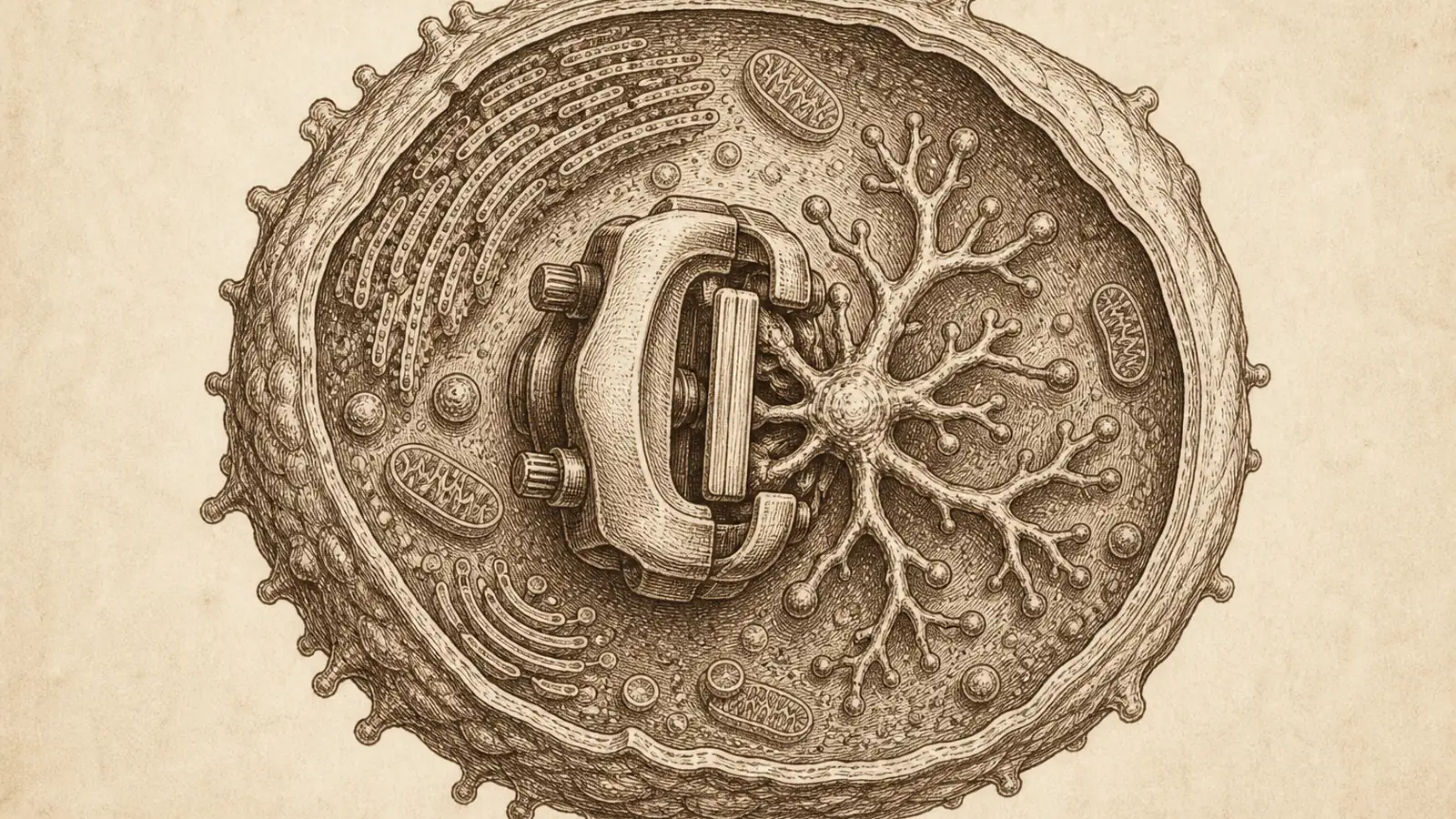
For years I thought inflammation only knew how to switch on. You catch a bug, the alarm blares, the tissue swells, and eventually the whole thing quiets back down. I never once asked what did the quieting. The alarms get all the press. It turns out a small kinase called MST4 has been riding the brake inside your cells the entire time, leaning on the exact protein that lets inflammation spiral out of control. Researchers mapped how it works back in 2015. Eleven years on, the drugs that dominate autoimmune care still don’t work anything like it.
- 2015MST4 brake on TRAF6 mapped
- 2023same kinase found in other immune pathways
- 2026author correction posted, science stands
The protein MST4 leans on is TRAF6, one of the busiest relay points in your innate immune system. When a receptor on a cell detects a bacterial signature or an inflammatory cytokine, TRAF6 is the adaptor that carries the message inward and lights up NF-κB, the transcription factor that switches on the inflammatory program. A lot of disease routes through TRAF6 precisely because so many signals converge on it. And your body already built something to keep it from running away.
So how do you restrain a protein that busy without shutting the whole system off? Here’s where the biology got me. MST4 doesn’t destroy TRAF6, and it doesn’t sit upstream jamming the receptor. It drops two tiny phosphate tags onto TRAF6’s tail, at two threonine residues the 2015 Nature Immunology paper pins down as Thr463 and Thr486. That’s it. Wait, why would two little chemical tags near the tail be enough to quiet a protein this central? Because TRAF6 can’t work alone. To fire, it has to grab copies of itself, cluster into a chain, and tag that chain with a mark that props the whole assembly open. The phosphates MST4 adds get in the way of the clustering. The adaptor is still there, still intact, but it can’t hold hands with itself anymore, so the signal never amplifies. The brake works by keeping TRAF6 from ganging up.
Then the team, working out of the Chinese Academy of Sciences in Shanghai with collaborators at Peking and ShanghaiTech, ran the experiment that turns a mechanism into something that matters. They knocked MST4 down in mice and pushed them into septic shock; those animals inflamed harder and died faster than their normal littermates, exactly what you’d see if you had cut the brake line. Then the clean confirmation: when they also genetically halved the animals’ TRAF6, the damage eased back off. Take away the brake and you get catastrophe. Take away half of what the brake was pressing on, and the catastrophe softens. That’s how you show one protein is really acting through another, and not sneaking in some side door.
And MST4 doesn’t only ride this one brake. By 2023, the same kinase had surfaced dialing down type I interferon signaling and steering macrophage behavior in immune thrombocytopenia, an autoimmune bleeding disorder. TRAF6, for its part, keeps showing up as the node other labs are trying to restrain, including work using the enzyme USP25 to tamp down TRAF6-driven inflammation in diabetic kidney disease. What comes into focus is an endogenous system built for proportion: enough inflammation to fight the threat, not so much you cook your own tissue.
Which brings me to the thing I can’t get past. We’ve had this precise, self-limiting brake described for over a decade, and the blockbusters that run autoimmune care still don’t work like it at all. The TNF blockers, IL inhibitors, and JAK drugs are effective, but they work by broadly muffling inflammation from the outside, which is exactly why their labels carry serious-infection warnings. MST4 does something more surgical: it doesn’t silence the system, it just stops one adaptor from over-amplifying. And yet TRAF6 itself stays essentially undrugged, with no approved therapy hitting it directly. Nature Immunology posted an author correction to the 2015 paper on August 7, 2026, which is what pulled it back across my desk; the notice reads as housekeeping, not a retraction, so the story here isn’t a scandal. It’s neglected biology.
I’m not holding my breath for an MST4 pill. Kinases like this are genuinely hard to turn into safe, specific drugs, and a decade of quiet on the TRAF6 front tells you as much. But it’s changed how I’ll read the next round of anti-inflammatory pitches. When a company sells me another broad immune-dampener, I’m going to ask why they’re still swinging sledgehammers when the body showed us in 2015 exactly where the finish-line brake is and how gently it presses. I’d put my money on the labs chasing that scalpel, not the ones reselling the hammer.
Sources
- Nature Immunology – Jiao et al., “The kinase MST4 limits inflammatory responses through direct phosphorylation of the adaptor TRAF6” (2015)
- Nature Immunology – Author Correction to Jiao et al. (2026)
- Cellular & Molecular Immunology – “MST4 kinase regulates immune thrombocytopenia by phosphorylating STAT1-mediated M1 polarization of macrophages” (2023)
- Cell Communication and Signaling – “MST4 negatively regulates type I interferons production via targeting MAVS-mediated pathway” (2022)
- International Immunopharmacology – “USP25 ameliorates diabetic nephropathy by inhibiting TRAF6-mediated inflammatory responses” (2023)
- PubMed – record for Jiao et al. (2015), PMID 25642822