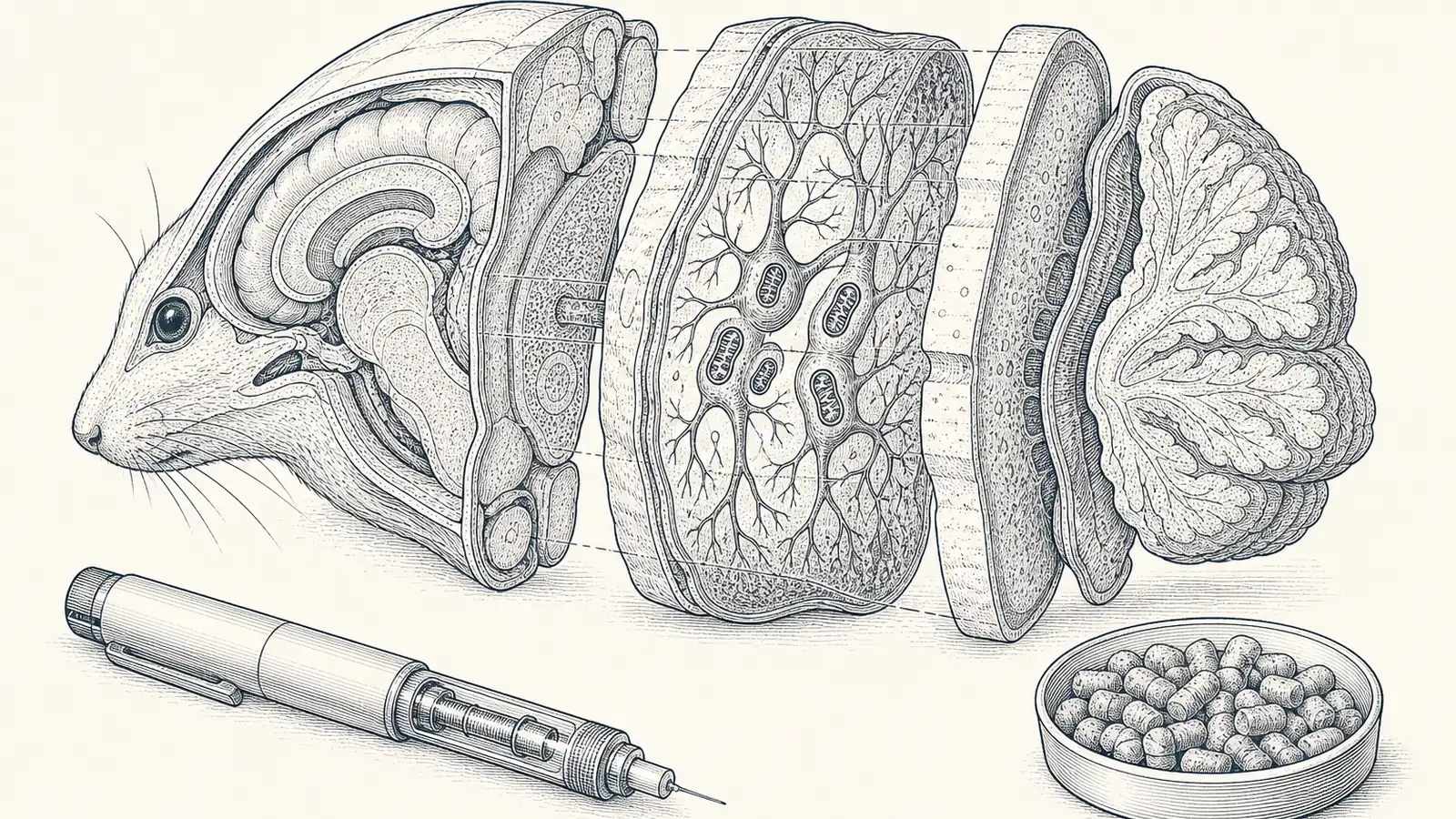
For years I filed the late-night reach for the fatty thing under willpower, a small nightly failure of character somewhere between the fridge and the couch. A mouse study out of Osaka has me rethinking that, because it suggests the pull toward fat is run partly by the health of the tiny power plants inside one specific cluster of brain cells, and that those power plants may run differently in a female brain than a male one. In the female mice, the wiring failed harder. And the expensive drug aimed at this exact pathway worked weakest on them.
That is the claim coming out of Osaka Metropolitan University, where a team led by Professor Shigenobu Matsumura reported in The FASEB Journal that a mitochondrial protein called OPA1, sitting inside the brain’s appetite-braking neurons, helps decide how much fat an animal eats and how much weight it gains. The work is in mice, and a knockout mouse is not a woman. So this is not a cure story. It is a warning about averages, sex, and a drug pathway that is already on the market at a staggering price.
Here is the neuron that matters. Deep in the hypothalamus there is a population of cells carrying the melanocortin-4 receptor, or MC4R, and they are part of the brain’s satiety circuitry, the system that is supposed to send the “enough” signal. OPA1 is a fusion protein: its job is to keep the mitochondria inside those neurons knitted into healthy, interconnected networks. Mitochondria are the cell’s furnaces, and a neuron running a well-tended furnace has the energy to do its job. When the researchers deleted OPA1 specifically from the MC4R neurons, that satiety brake started to slip. The mice ate more, gained weight as they aged, and slid into obesity.
Now the part that made me stop and read it twice. The team gave the mice free access to soybean oil as a pure fat source, and in normal male mice, drinking the oil actually pushed OPA1 levels up. The male brain, handed a river of fat, reinforced its own off-switch. In females, that same oil did nothing to OPA1. And when OPA1 was missing, the females were hit harder than the males: they took in more fat and piled on more weight.
Wait, why would the identical molecule quietly reinforce the male brain and leave the female brain untouched? I don’t think anyone can fully answer that yet, and the study does not pretend to. But it points at something the obesity field has been sloppy about for a long time, which is that the circuitry feeding appetite is not unisex, and the mitochondria inside these neurons may be one of the places that sex difference actually lives.
Then comes the finding that turns this from an interesting mouse paper into a story worth telling. The researchers tested setmelanotide, an MC4R agonist, a drug designed to press exactly that satiety pathway. In control mice and in OPA1-deficient males, it suppressed appetite as advertised. In the OPA1-deficient females, the appetite suppression was significantly weaker. The drug meant to rescue a failing appetite circuit did the least in the animals whose circuit was already broken, and those animals were female.
This is where I stop being just curious and start being skeptical, because setmelanotide is not a thought experiment. It is a real, FDA-approved drug sold as Imcivree by Rhythm Pharmaceuticals, targeting this very pathway in people. Its label was expanded in March 2026 to cover acquired hypothalamic obesity, on the strength of an 18.4 percent placebo-adjusted BMI reduction in its Phase 3 TRANSCEND trial. The list price runs to roughly $441,000 per adult, per year. At that number, “does it work as well in women as in men” is not an academic footnote. It is a question the people billing for the answer ought to be able to settle with their own data.
So here is the question I keep circling. That pivotal trial enrolled 142 patients and reported one pooled figure, the 18.4 percent average. Was it ever powered to catch a sex difference like the one these mice just flagged? And if Rhythm has the results broken out by sex on this pathway, where are they? An average is a generous place to hide. When a company reports one benefit for everyone, the people the drug helps least can dissolve quietly into the mean, and nobody has to account for them by name.
I want to be careful about what a mouse can carry. This is preclinical, the animals were genetically engineered to lack a protein most people make just fine, and none of it proves the same split runs in humans. But that is exactly why the human breakdown matters. Matsumura’s own read is that the sex differences “may help inform the development of obesity treatments that take them into account, as well as future personalized medicine approaches.” Out of scientist and into plain speech: we built appetite drugs as if one brain fits all, and the biology underneath is telling us it never did.
What I take from it is smaller and more practical than a headline cure. The next time I see a shiny weight-loss number, I am going to ask who it worked for and who it didn’t, and if the answer skips over sex entirely, I am going to treat that silence as part of the finding, not a rounding error.
Sources
- ScienceDaily – “A surprising brain discovery could help explain why we overeat fatty foods” (2026)
- The FASEB Journal – Matsumura et al., OPA1 in MC4R neurons and dietary fat intake (2026)
- PubMed – record for Matsumura et al., FASEB J 2026
- MedicalXpress – “Impaired brain protein drives fat cravings and obesity in mice” (2026)
- Rhythm Pharmaceuticals / GlobeNewswire – FDA approval of Imcivree (setmelanotide) for acquired hypothalamic obesity, with the 18.4 percent Phase 3 result (March 2026)
- CADTH pharmacoeconomic review – setmelanotide annual treatment cost