For most of my life I filed relapse under willpower. Someone quit, someone slipped, and somewhere in the back of my head sat a quiet, unkind little verdict: they wanted it less than they said they did. I never liked thinking it. I just could not find a better story to put in its place. A group of neuroscientists at Vanderbilt just handed me one, and it starts with a result I keep turning over: in mice that had quit alcohol, a deep brain region lit up more than 2 times as much as normal, and it did so before they got a single drop back. The signal came first. The behavior followed.
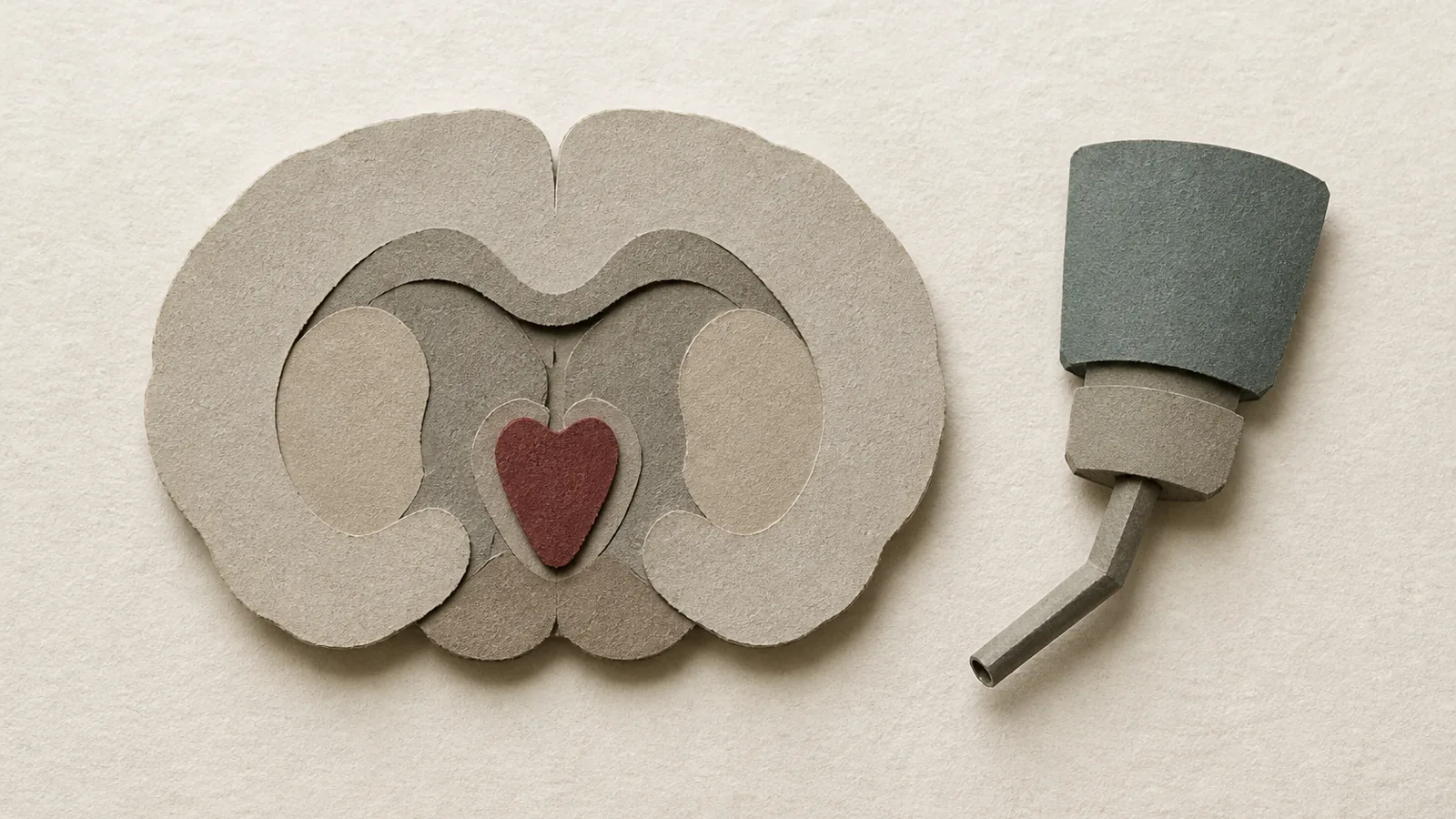
The region is the bed nucleus of the stria terminalis, the BNST, a small knot of neurons deep near the center of the brain that keeps showing up whenever scientists go looking for the machinery of anxiety, dread, and craving. In a study published in Molecular Psychiatry, Marie Doyle, Danny Winder and colleagues gave mice long-term voluntary access to alcohol, forced them into abstinence, then watched what the abstinence itself did to the circuit.
The design is clever. The team laced the alcohol with quinine, the same bitter compound that makes tonic water pucker your mouth, and kept turning the bitterness up. Most mice, sensibly, back off. A subset does not. They keep drinking the increasingly foul stuff, which is the rodent version of the thing that scares everyone about addiction: continuing despite the cost. Scientists call it aversion-resistant intake. After a stretch of forced abstinence, those aversion-resistant mice drank even more of the bitter alcohol than mice that had never been made to quit, as the researchers describe it. And in exactly those mice, the BNST ran at more than double its normal activity before the alcohol was anywhere in reach. Abstinence did not calm the system down. It wound it tighter.
So why would going without alcohol make the brain crave it more? That is the question I could not stop chasing. The intuitive model says quitting lets things settle: the fog clears, the cravings fade. The mouse data point the other way. The stretch of not-drinking is itself an event the brain adapts to, and in a vulnerable subset the adaptation shoves the BNST into a higher gear, the circuit that hums with anxiety and threat humming louder on its own, before a bottle enters the picture. That reframes the shaky, white-knuckle weeks of early sobriety not as the absence of a problem but the presence of a new one, laid down in tissue. It lines up with human work showing that relapse in alcohol dependence comes with disrupted, reorganized brain networks, not a simple failure of resolve.
I want to be careful with how far this travels, because a clean rodent result is the easiest thing in the world to oversell. This is mice. It is a subset of mice. It is activity in one small region, and the authors are refreshingly plain that they do not yet know the exact role the BNST plays or what drives the spike. “Relapse” is itself a slippery word that researchers cannot even agree how to define, which should make anyone wary of a single rodent signal carrying the whole concept. The leap worth watching is the one from “a brain region lights up in mice” to screening actual people and hunting for treatment targets. A parallel human effort, led by Jennifer Blackford, is already imaging the BNST in people during early abstinence, and if it holds up the team floats using it as a screening tool in clinical trials. Maybe. That is also the exact moment a preliminary biomarker turns into a product: a scan you get billed for, a target somebody builds a drug around. I would hold the enthusiasm until the human data are in.
What I do trust about this study is not that federal money is some purity badge. It is that nobody had a drug to sell at the end of it. The work ran through the NIH’s alcohol and diabetes institutes, out of a university metabolic phenotyping center, with no pharmaceutical sponsor disclosed in the sources. That is basic biology, the unglamorous kind that maps how a body actually works before anyone builds a product on top of it. The risk was never in the mechanism paper. It shows up in the step after, when a quiet research signal becomes a billable scan and a screening line item, and the incentive quietly flips from understanding the circuit to selling access to it.
The mouse result points somewhere specific, and it is unsettling one way and oddly steadying another. If a brain can tilt itself back toward drinking during the very weeks we praise as recovery, then the person who slips a month into sobriety is not staging a referendum on how badly they wanted it. The stretch outsiders read as “doing well” may be exactly when the circuit is rearming. That is an inference from mice to people, not a proven human finding, and I am holding it as one. But it has already shifted something small in me. When someone I love slips, I am done reading it as a character verdict. I will read it as a body that adapted while it was being praised, and I will save my skepticism for the day somebody tries to turn that small knot of neurons into a screening bill.
Sources
- Molecular Psychiatry – Doyle, Winder et al., “Alcohol abstinence precipitates alcohol seeking and aversion-resistant intake in association with increased BNST activity” (2026)
- The Conversation – Doyle & Winder, “Quitting alcohol changes the brain and can increase the risk of compulsive drinking” (authors’ explainer)
- ScienceDaily – “Quitting alcohol may prime the brain for relapse”
- SciTechDaily – funding and study summary
- Journal of Studies on Alcohol and Drugs – “Variety in Alcohol Use Disorder Relapse Definitions” (2022)
- European Archives of Psychiatry and Clinical Neuroscience – “Relapse in alcohol dependence is characterized by disrupted modular brain network organization” (2026)