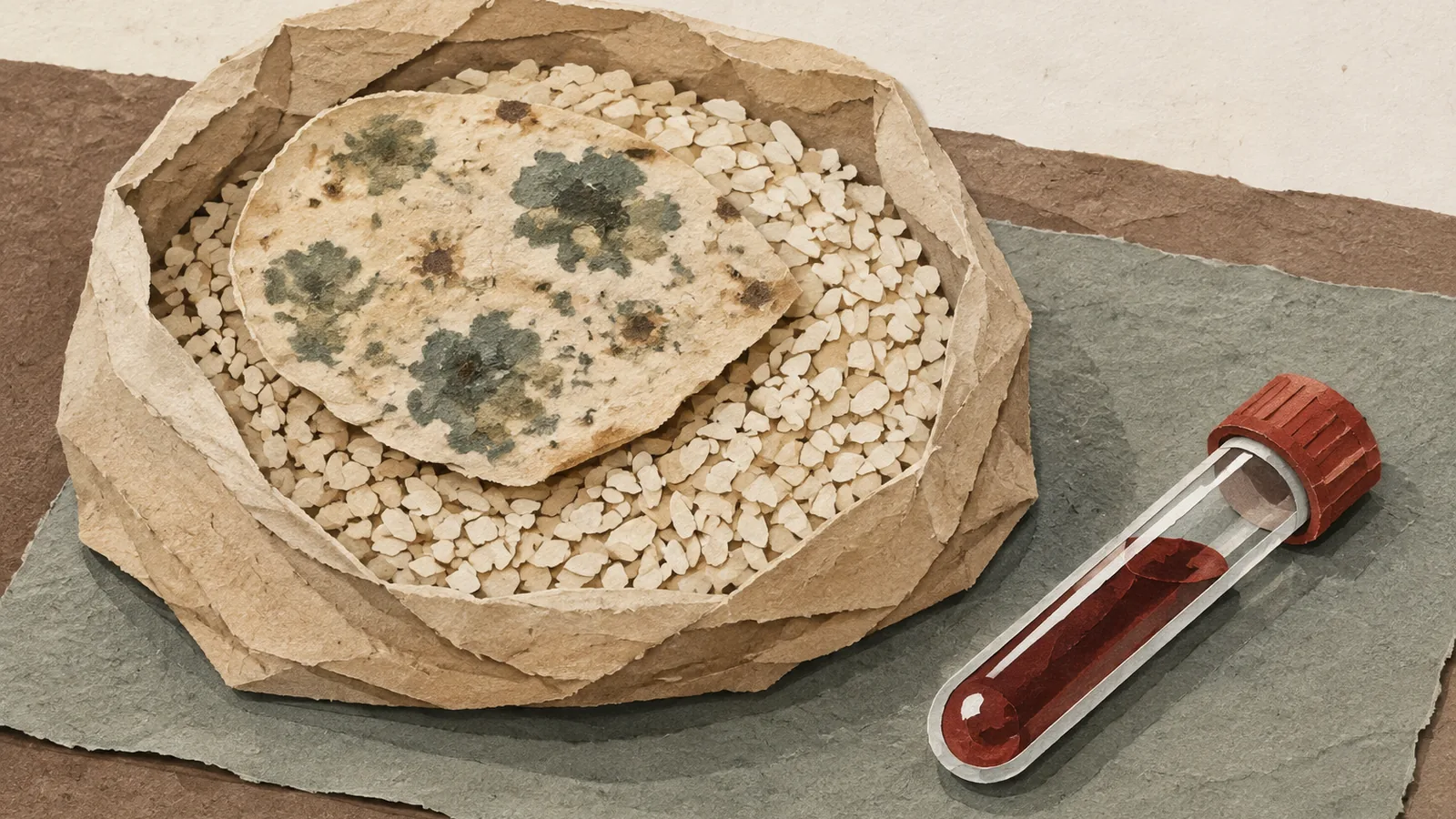
I used to think mold on food was a throw-it-out problem. You see the fuzz on the bread, you pitch the loaf, you move on. Then a team of German and Bangladeshi researchers thawed out blood drawn from 719 women and young children in a rural district of Bangladesh, ran it through a mass spectrometer, and not one sample came back clean. Ochratoxin A, a kidney toxin the European Food Safety Authority treats as a genotoxic carcinogen, was present and quantifiable in every mother and every child, and in up to 99 percent of the youngest kids the exposure crossed the line toxicologists use to flag a cancer risk. Mold, it turns out, does not stay on the bread. It gets into the blood.
Ochratoxin A showed up in 100 percent of the plasma samples. Citrinin, another kidney toxin, in 91 percent. Enniatin B, an “emerging” mold toxin nobody regulates yet, in 92 percent. Every single participant carried at least two of these compounds at once, and 84 percent carried three or more. The most common signature, in 79 percent of the group, was the same grim trio circulating together: ochratoxin A, citrinin, and enniatin B. The findings come from a blood biomonitoring study published in Environmental Health, using samples collected in late 2019 from the FAARM maternal-nutrition cohort in Habiganj.
Here is what made me put my coffee down. The children were not carrying less than their mothers. They were carrying more risk. For ochratoxin A the researchers calculated a margin of exposure, roughly how much headroom sits between a person’s dose and the level where a carcinogen gets worrying, and anything below 10,000 is where toxicologists start to worry. Among the women, 37 to 80 percent fell below that line depending on the clearance model. Among the children, 91 to 99 percent did. Citrinin ran the same direction: the average one-year-old’s estimated daily intake, 201 nanograms per kilo, edged above the 200 that marks the tolerable limit for the whole day. Think about the arithmetic in a small body. An 8-kilogram infant eating rice and lentils from the same pot as her 49-kilogram mother takes in roughly the same contaminated food, spread across a fraction of the body mass. The dose per kilo runs the opposite way from what you would hope, and it lands hardest in the first thousand days everyone talks about protecting.
Then the strange part, the reason I kept reading. One of the ochratoxin forms they measured is called 2’R-ochratoxin A. In European biomonitoring it has a reputation as a coffee marker: it forms when contaminated beans get roasted, and it had never turned up in people who don’t drink coffee, and never in children. So why was it in more than 97 percent of these samples, including breastfed infants who have obviously never touched a cup of coffee? Wait, if not coffee, then what is cooking this molecule? The researchers think the answer is that word, cooking. Their explanation is that 2’R-OTA is a heat-forged version of ordinary ochratoxin, made when the toxin is held above 100 degrees Celsius long enough for part of the molecule to flip its geometry. In rural Bangladeshi kitchens, staples and spices get boiled, roasted, fried, and reheated for a long time, and the household stove may be quietly rewriting one toxin into another that no regulator has a threshold for. That is a blind spot hiding inside a rice pot.
The one that chilled me most was aflatoxin. The team measured AFB1-lysine, an adduct that forms when aflatoxin B1, one of the most potent liver carcinogens known, binds to blood protein and lingers as a fingerprint of chronic exposure. It was detectable in 22.6 percent of the mothers and 3.8 percent of the children, and as far as the authors can tell this is the first time anyone has measured this long-term aflatoxin marker in blood in Bangladesh at all. Here the burden sits with the mothers: nearly a quarter of these young women carry a documented signal of ongoing exposure to a compound that even at low chronic doses raises liver-cancer risk. The Bangladesh authors point to a rural Nepal cohort where AFB1-lysine detection ran as high as 75 to 94 percent and aflatoxin exposure tracked with stunted growth in kids. A separate Bangladeshi study has already tied chronic aflatoxin exposure to cognitive and language development in young children. The signal here is quieter than Nepal’s, but it is sitting in the mothers, and it is not nothing.
Here is where the official yardstick fails these families. Food-safety rules regulate mycotoxins one at a time: a limit for aflatoxin here, a tolerable intake for citrinin there. But nobody in this study was exposed to one toxin. They were exposed to cocktails, and ochratoxin A and citrinin are both hard on the kidney, with experimental evidence that together they hit it harder than either alone. Enniatin B and the coffee-less 2’R-OTA have no reference values at all. The authors’ own conclusion is that regulating one mycotoxin at a time may substantially underestimate real-world risks. When the measuring stick counts one poison at a time and people are drinking from a mixed cup, the stick is the problem.
Who paid for this shapes how much I trust it. The work was funded by the German federal research ministry, not by a food company or an agrochemical firm, the authors declare no competing interests, and there is no product waiting at the end of it. The fix the science points to is not a pill: drier storage, better post-harvest handling, less mold-friendly processing, more diverse diets. A survey of this very population found families had little sense of what conditions breed the mold in the first place. The honest limits are folded into the paper too, since the intake numbers rest on toxicokinetic assumptions and there was no food diary running alongside the blood draws, so the researchers can point at the diet without naming the dish. The question I am left with is the one they cannot answer yet: what does a childhood spent marinating in three or four of these compounds at once do to a kidney, or a liver, or a developing brain, across thirty years?
I can’t do anything about a stove in Habiganj. But this study did change my own kitchen, and I’ll be specific, because vague inspiration is useless here. I stopped cutting around mold. A fuzzy patch on bread or a soft spot in a bag of nuts means the whole thing goes now, because the toxin does not stay politely inside the part you can see. I keep grains, nuts, and dried spices cold and genuinely dry instead of in a warm cabinet, since warmth and damp are exactly what these molds want. Those are small privileges of a full pantry, and they don’t touch the harder problem this paper documents. But I would rather act on the biology than keep believing the comfortable thing I believed a week ago.
Sources
- Environmental Health – Kyei et al., chronic exposure to aflatoxin B1, ochratoxin A, and citrinin in women and children: blood biomonitoring from rural Bangladesh (2026)
- Maternal & Child Nutrition – Andrews-Trevino et al., multiple mycotoxins, enteric dysfunction, and child growth: the AflaCohort Study, Banke, Nepal (2022)
- Toxins – chronic aflatoxin exposure and cognitive and language development in young children of Bangladesh (2022)
- Mycotoxin Research – biomonitoring of ochratoxin A, 2’R-ochratoxin A, and citrinin in human blood serum from Switzerland (2022)