For years I have been the person at the table quietly defending the sugar-free version. Diabetic? Reach for the sorbitol gum. Watching your weight? The “no sugar added” bar is the smaller sin. Sugar alcohols were supposed to be the clever workaround: sweet on the tongue, more or less invisible to the body, a way to have the taste without paying the metabolic bill. So a finding out of Gary Patti’s lab at Washington University rattled a habit of mine. The body can take that “inert” sweetener and, one chemical step later, turn it into a molecule that behaves like fructose, the sugar I was trying to dodge. And whether that conversion matters at all turns out to hang on which bacteria are living in your gut.
If you have the right bacteria, turns out, it doesn't matter. However, if you don't have the right bacteria, that's when it becomes problematic.
The study ran in Science Signaling under a title that says the quiet part out loud: “Intestine-derived sorbitol drives steatotic liver disease in the absence of gut bacteria.” Patti, a professor of chemistry, genetics and medicine at WashU, has spent his career chasing what fructose does inside the liver. His team traced sorbitol through the bodies of zebrafish and watched where it ended up. The short version, in his own words: sorbitol is “one transformation away from fructose,” and that one transformation is enough to make it induce similar effects.
And it isn’t only the sorbitol you chew. Your own intestine makes the stuff. After you eat, some of the glucose you absorb gets converted into sorbitol right there in the gut lining, by an enzyme that mostly kicks in when glucose is abundant. So even someone who has never touched a sugar-free product is producing sorbitol internally, at what Patti called “significant levels.” The question was never really whether sorbitol is in you. It is. The question is what your body does with it next.
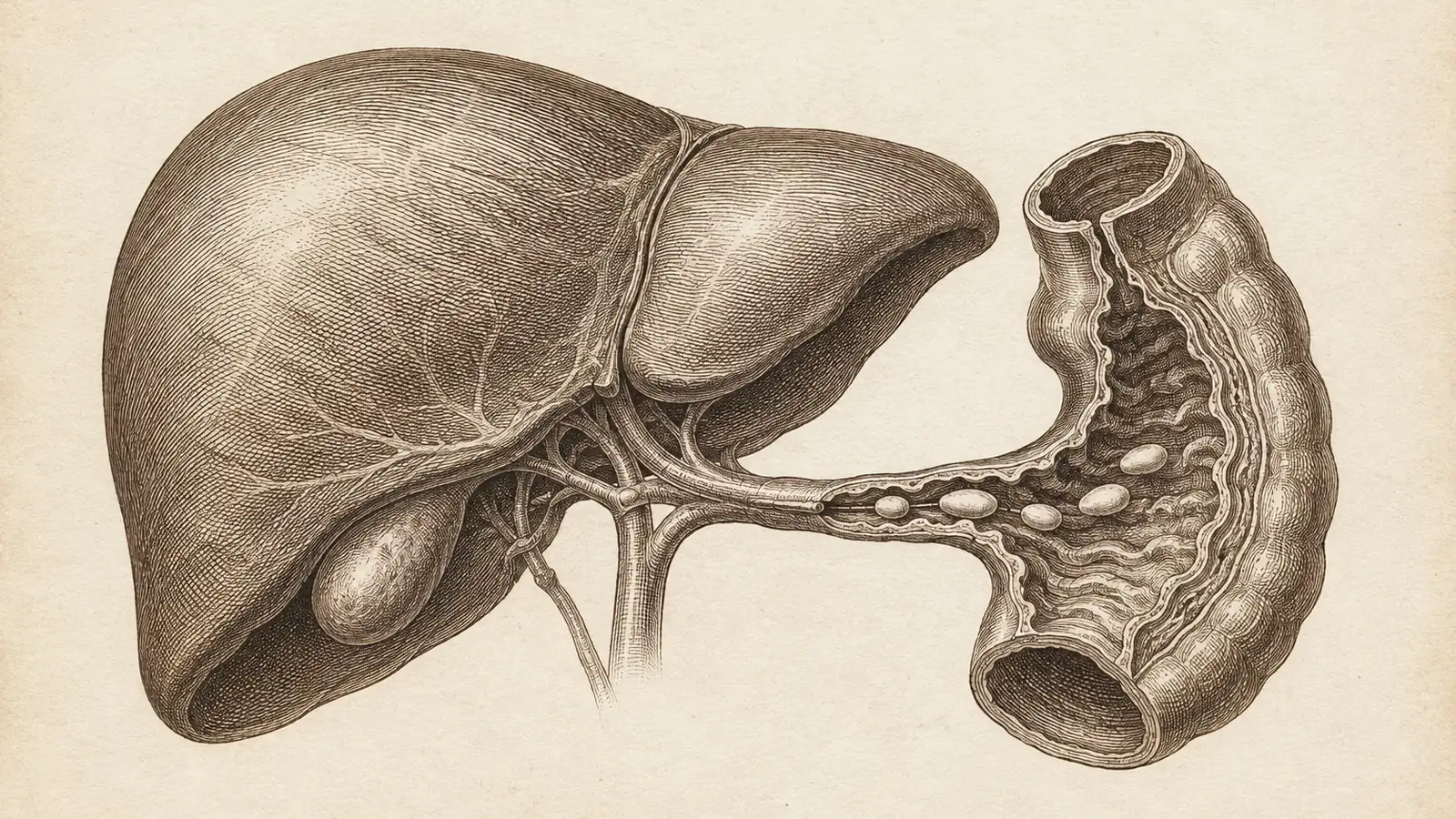
And that depends on your gut bacteria, which is where the biology gets strange enough that I had to reread it. Normally a crew of microbes, including strains of Aeromonas, simply eat the sorbitol and break it down into what the researchers call a harmless bacterial byproduct before it can go anywhere. The bacteria clear it, and far less reaches the liver. But when the team stripped the gut microbiome out of adult zebrafish and kept them on an ordinary diet, the sorbitol had nowhere to go. It slipped past the intestine, traveled to the liver, and there the machinery converted it into fructose-1-phosphate, the same fructose-metabolism intermediate the sugar itself produces, and the liver packed the overflow away as fat. Fat in the liver. Steatotic liver disease, in animals eating a standard diet, with no sugar bomb in sight.
Wait, why would emptying out the gut flora be enough to flip a harmless sweetener into a liver problem? Because the “harmless” part was never a property of sorbitol. It was a service the bacteria were quietly performing the whole time. Patti put it plainly: “If you have the right bacteria, turns out, it doesn’t matter. However, if you don’t have the right bacteria, that’s when it becomes problematic.” That reframes it. The safety of a sugar alcohol may not sit in the molecule at all. It may sit in your microbiome. Which raises the human question the zebrafish cannot answer: what about someone who just finished a hard course of antibiotics, or lives with the kind of gut disruption that is quietly common now? The study does not measure that. It makes it the question worth asking.
Sugar alcohols earned their halo from an appealing pitch: they do not spike blood sugar the way sucrose does, so they got folded into diabetic foods, keto bars, sugar-free candy, gum, and diet desserts as the responsible choice. Sorbitol has been a generally-recognized-as-safe additive in the U.S. for decades, treated as metabolically inert, a passenger that goes in and comes out unchanged. Patti’s data pushes back on that assumption. The compound is not a passenger. It is a substrate, one enzymatic move from a sugar we already know the liver mishandles. That the marketing never mentioned this is not a conspiracy. It is what happens when “does not raise blood glucose” gets quietly translated into “does nothing,” and nobody checks the second claim for thirty years.
The boundaries here matter, so let me be plain about them. This was zebrafish, not people, at concentrated exposures, and the dramatic liver damage showed up specifically when the gut bacteria were removed. It does not mean an occasional stick of gum is torching anyone’s liver, and Patti’s team says as much. There is no human trial here putting a number on how much sorbitol, in how depleted a gut, tips a person toward fatty liver. What there is: a clean mechanism and a useful warning that the risk is not uniform. It rides on the state of your microbiome. And the work came out of NIH-funded academic labs (grants R35ES028365 and P30DK056341), with no sweetener company underwriting it and no conflicts of interest disclosed, which is worth saying out loud in a field where the “it’s totally safe” studies so often carry an industry logo.
So what do I actually do with this? I am not going to panic over a peach, and neither should you. At the modest levels in whole fruit, the bacteria clear sorbitol fine, which is exactly the point the study makes. But I am done treating “sugar-free” as automatically the smarter choice, and I will not reach for a sorbitol-loaded bar or a fistful of sugar-free candy the way I used to, especially in the stretch right after antibiotics when I know my gut crew is thin. The sweetener was never the free lunch it was sold as. My bacteria were paying for it, and I would rather not find out what happens when they stop.
Sources
- Science Signaling – Patti et al., “Intestine-derived sorbitol drives steatotic liver disease in the absence of gut bacteria” (2025)
- WashU (The Source) – “Alternative sweetener sorbitol linked to liver disease” (2025)
- ScienceDaily – “Scientists discover a hidden problem with this popular sugar substitute” (2026)
- SciTechDaily – “Popular Sugar-Free Sweetener Linked to Liver Disease, Study Warns”