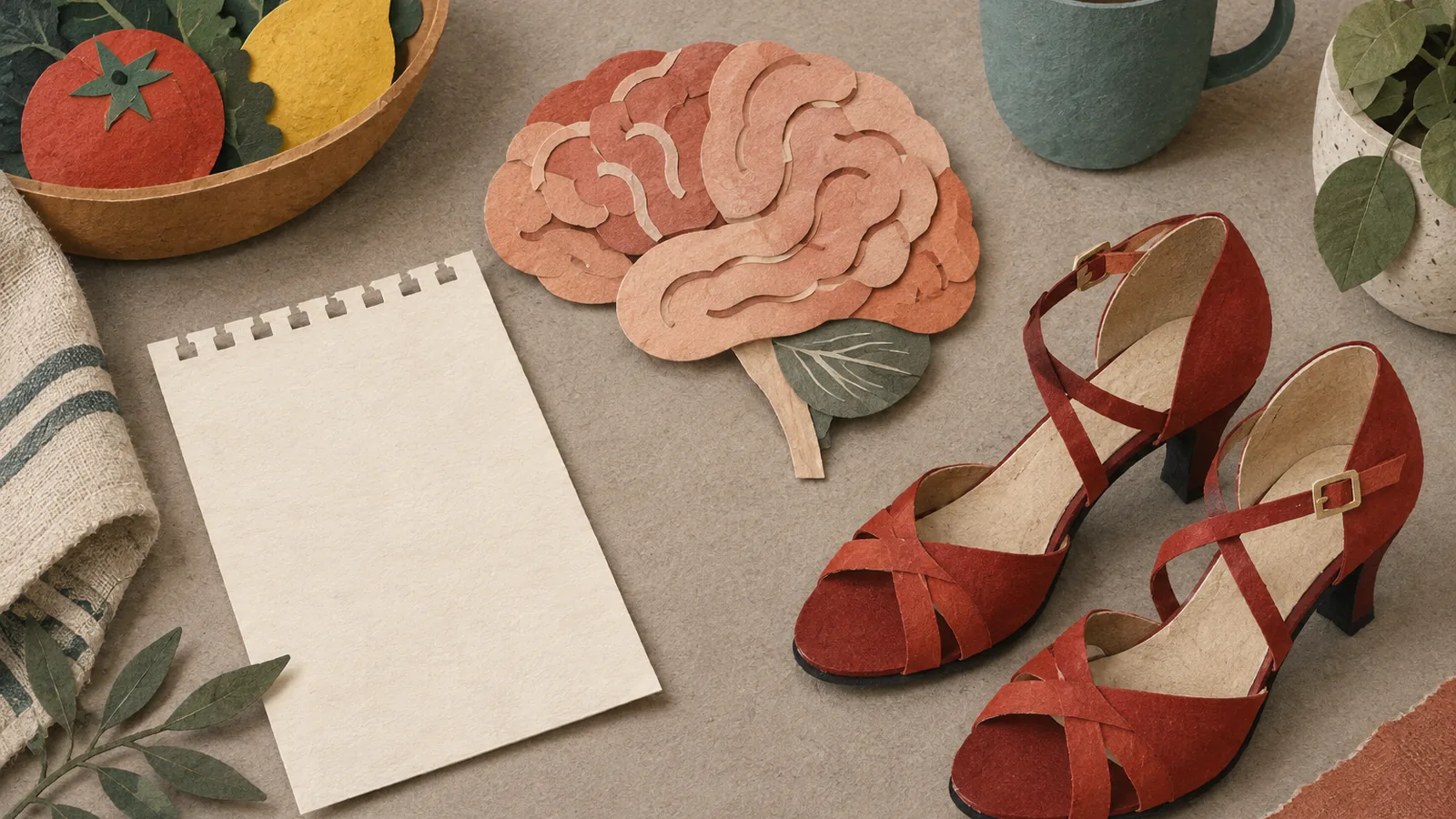
For years I filed the question of how to keep my own brain under things you don’t get to choose. You inherit your risk, you wait, and maybe a drug arrives before you need it. So I did not expect to spend this week half-convinced that a salsa class, a grocery list, and someone who actually checks in on you can do more for memory than a doctor’s standing advice.
That’s the finding from LatAm-FINGERS, a single-blind randomized trial published in The Lancet and presented again this month. Across 12 sites in 11 Latin American countries, from Argentina to Mexico to the Dominican Republic, researchers enrolled 1,065 older adults at elevated risk of dementia and split them in two. One group got a structured, coached program with 38 group sessions over two years. The other got periodic health advice and 4 meetings in the same window. The thing that separated the two arms wasn’t a molecule. It was showing up, together, 38 times.
Two years later, the coached group had improved on a composite measure of global cognition by 55 percent more than the advice group. The biggest gains landed in memory, the day-to-day kind that tends to slip early, with more on top in executive function and processing speed. The trial was funded by the Alzheimer’s Association and led by Lucia Crivelli at Fleni, a neurological institute in Buenos Aires.
So what did coached actually buy? Supervised exercise, some of it salsa and tango and workouts in the local park, because the team built the program around the culture people already lived in instead of translating an American manual into Spanish. A MIND diet rebuilt around regional foods: avocado, quinoa, açaí, chia, pumpkin seeds. Computerized cognitive training. Blood-pressure and cardiovascular checks. And those 38 group meetings, for accountability and for company.
Here is where I got curious, because dementia is sold to us as an amyloid story, a sticky protein gumming up the machinery. So why would dancing and lentils and a weekly standing date move memory at all? Wait, why does that even work? The honest answer is that the brain doesn’t age in a sealed box. It ages on top of your blood vessels, your blood sugar, your sleep, your inflammation, and how hard your mind and your relationships are actually being worked. Exercise pushes more blood through the tiny vessels that feed neurons. The MIND diet leans on the foods that keep those same vessels and your metabolism from drifting. Cognitive challenge builds the spare capacity neurologists call reserve. And social contact, the piece everyone treats as a nice-to-have, is closer to a load-bearing wall, since isolation is itself a documented dementia risk. The program didn’t pull one lever. It leaned on all of them at once, which is why shrinking brain aging down to a single protein was always going to disappoint.
And this isn’t one lucky trial to file under too-good-to-be-true. It’s the third leg of a stool. The original FINGER trial in Finland showed the multidomain approach worked back in 2015. Then U.S. POINTER, a 2,111-person American trial published in JAMA in 2025, reached the same place: a structured lifestyle program protected thinking against normal age-related decline. LatAm-FINGERS carried it into populations that clinical research usually skips, across a dozen cultures and income levels. Getting the same result across that much human variety is the opposite of a fluke.
Now hold that next to what the industry is selling. The two anti-amyloid drugs the FDA approved, lecanemab and donanemab, buy a modest slowing of decline and run roughly $26,500 and $32,000 a year before you add the brain scans they require.
They also carry a harm the coached arm simply doesn’t. It’s called ARIA, brain swelling or bleeding, and it turned up in 17.3 percent of lecanemab patients and in up to 30.5 percent of donanemab patients, with three ARIA-linked deaths in the donanemab trials. Billions of research dollars and a decade of promises went into scraping plaque off neurons with an infusion that can bleed the organ it’s meant to save. A program of movement, food, cognitive games, and dozens of standing dates nudged memory the right way with a downside risk of roughly nothing. Ask who profits from teaching us that dementia is a molecule you medicate instead of a life you build, and the patient isn’t the answer.
I want to be straight about what this trial is. It wasn’t lifestyle against nothing. It was intensive, supported change against light-touch advice, and both groups improved; the coached one just improved far more. That distinction makes the result more useful, not less, because it tells you the dose: the checking-in is doing work. The 55 percent is a relative gain on cognitive scores over two years, and better scores at 24 months are not the same as a diagnosis prevented at 84. That longer trial takes decades nobody has finished yet.
But even the cautious read hands you something the infusion never will. The thing that worked costs almost nothing, needs no specialist and no prior-authorization fight, and molds to whatever food and music your actual life already contains. So here’s what changed for me, concretely. I’m not waiting for the plaque drug, and I’ve stopped treating my morning walk and my Sunday cooking as hobbies I’ll get to eventually. I’d start the version of this my own week can hold now, and the piece I used to skip first, the standing date with other people, is the piece I’d guard on the calendar before anything else.
Sources
- The Lancet – LatAm-FINGERS: multidomain lifestyle intervention RCT (2026)
- ScienceDaily – LatAm-FINGERS lifestyle program improved cognition 55% more than basic advice
- JAMA – U.S. POINTER structured lifestyle intervention randomized clinical trial (2025)
- Alzheimer’s Association – U.S. POINTER study results
- Nature – Controversial new Alzheimer’s drugs: benefit, ARIA rates, and cost (2025)