Reading “a simple amino acid that fights memory loss” gave me déjà vu, and I had earned it. ScienceDaily ran this research on September 18 as a story about restoring a brain protein, then again on October 12 with the amino acid, D-serine, moved up into the headline. Both pieces rest on a paper that Lige Leng, Jie Zhang and colleagues at Xiamen University published in PLOS Biology in March 2023. In that paper the two treatments did very different things. Restoring the protein, menin, in one small patch of the brain gave old mice thicker skin, more bone and better learning, while D-serine improved the learning and left their skin and bone as old as it found them.
the remission of aging phenotype by D-serine is limited to cognitive improvement
The molecule now carrying the headline is the half of the study that did less. I expected to be irritated by a 2023 paper showing up as news twice in 2026. Instead I came away more taken with the biology than either headline suggested, and a lot less taken with the supplement.
A thermostat that keeps time
The hypothalamus is an almond-sized region at the base of the brain that runs hunger, body temperature, hormones and daily rhythms. Leng’s team zoomed in on one patch of it, the ventromedial hypothalamus, and on the neurons there that carry a marker called SF-1. In those neurons, menin levels fall as mice age.
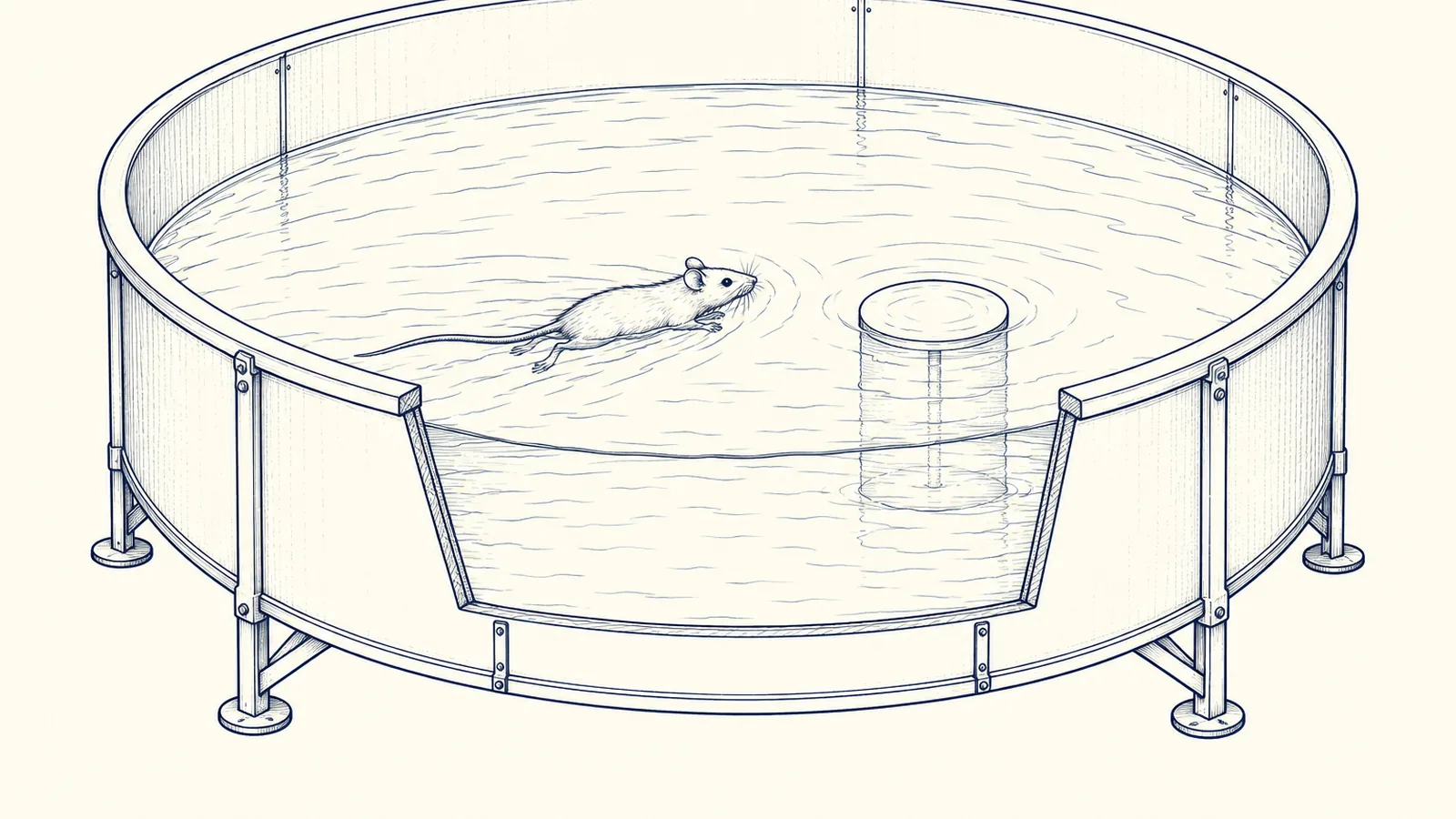
To find out whether that drop matters, the researchers deleted menin from those neurons, and the mice aged early on several fronts at once. They had more inflammation in the hypothalamus, thinner skin and less bone, and they got worse at finding the hidden platform in a water maze. They also died sooner, though that survival comparison rested on 14 control mice and 16 knockouts.
When the team ran the experiment in reverse, my starting skepticism took a hit. They injected a virus carrying the menin gene into that same patch of hypothalamus in 20-month-old mice, which is properly elderly for a mouse. Thirty days later the treated animals had thicker skin, more bone, less stiffening of the collagen in their tail tendons, lower inflammation, better learning scores and better balance on a rotating rod. The authors also report that menin extended lifespan in a comparison of 19 mice per group, though they never say by how much, and they acknowledge that they “did not use a statistical method to predetermine the proper sample size.”
Even with those caveats, it’s a strange and lovely picture: a dial in one small cluster of neurons seems to set the pace of aging in skin, bone and tendon all over the body.
Wait, why would the hypothalamus care about a maze?
Spatial memory lives in the hippocampus, a different structure entirely. So why would a menin shortage in the hypothalamus make a mouse forget where the platform is?
It comes down to chemistry. Menin sits on the starting switch, the promoter, of a gene called phgdh. That gene makes PHGDH, the enzyme that runs the first, rate-setting step in the pathway cells use to build serine. When menin drops, PHGDH drops with it, and the brain runs short of D-serine, a mirror-image form of the amino acid that helps switch on NMDA receptors, the glutamate receptors that learning leans on. The team measured the D-serine shortfall in both the hypothalamus and the hippocampus. They propose that SF-1 neurons release D-serine along a circuit linking the two regions, and in their discussion they put it more cautiously, saying D-serine “may be a neuronal transmitter that is secreted by SF1 neurons.” The paper shows the shortage at both ends but doesn’t directly show the release. Still, I can’t stop turning the idea over: a hunger-and-hormone center could be supplying an ingredient that memory depends on somewhere else in the brain.
That’s where the amino acid comes in. The researchers put D-serine in the drinking water at 600 milligrams per liter, roughly 100 mg per kilogram of body weight a day, for three weeks. The 22-month-old mice that got it did better on the learning and memory tests.
The October headline leaves out what the authors wrote next. In their discussion, they say that “the remission of aging phenotype by D-serine is limited to cognitive improvement.” Skin, bone and the rest of the body’s aging didn’t budge. The authors suggest three weeks may have been too short, or that menin runs other pathways D-serine can’t reach. Either way, D-serine plugs one leak that menin loss causes without touching the loss itself. The whole-body effects came from restoring menin, which meant injecting a gene into the brain.
For human evidence, the paper has one comparison of blood D-serine between five people aged 22 to 26 and five aged 83 to 94. The older group had less. With five people per group, that’s a hint at most.
The human trial was a single glass of orange juice
To be fair to ScienceDaily, the body of the October story is more careful than its headline. It says D-serine “should be considered an experimental approach rather than a proven treatment for brain aging,” and it quotes Leng calling it “a potentially promising therapeutic for cognitive decline.” But headlines travel further than body text, and this one promises an amino acid that fights memory loss. D-serine is already sold as a dietary supplement, so the headline points straight at something you can buy.
Both stories rely on the same human evidence. In a 2016 trial, Brazilian researchers gave 50 healthy older adults, average age 73, a single 30 mg/kg dose of D-serine dissolved in orange juice, and plain orange juice as the placebo on a separate visit. The trial was randomized, double-blind and crossover, which is a respectable design. D-serine reduced errors on one spatial maze-learning test (p = 0.03) and did nothing measurable for working memory, mental flexibility, visual attention or mood. The authors called for long-term studies.
- 2016single-dose D-serine trial in older adults
- 2023menin paper published in PLOS Biology
- 2025FDA approves the menin blocker revumenib for leukemia
- 2026ScienceDaily runs the menin study twice
The direction of the effect isn’t settled either. In a 2023 study by Japanese researchers, male mice bred to develop Alzheimer’s-type amyloid got D-serine in their drinking water from 9 to 12 months of age, and the supplement “exacerbated neuronal loss in the hippocampal CA1,” a region central to memory. So why would the same molecule sharpen one old mouse and hurt another? The authors’ proposed answer runs through the same receptor. D-serine is a required co-activator of NMDA receptors, and excessive NMDA stimulation kills neurons. It’s one mouse model at one dose, but I keep coming back to it, because the people most drawn to a “fights memory loss” headline are often the ones who suspect their brains are already in trouble.
On safety, a 2021 cross-species review found that doses above 500 mg/kg commonly damage rat kidneys, an effect not reported in mice, dogs, rabbits or the other species it covered. In people, D-serine itself has been given at up to 120 mg/kg a day for four weeks. One person developed protein in the urine, which cleared within a few days of stopping. That’s reassuring for a month, and it tells you nothing about a 70-year-old taking D-serine every day for years.
One more fact makes me wary of anyone spinning this into “boost your menin.” Cancer medicine is busy switching menin off. In October 2025 the FDA approved revumenib, a drug that blocks menin’s grip on a partner protein called MLL1, for relapsed or refractory acute myeloid leukemia with an NPM1 mutation, because in those cancers the menin complex keeps cancer-promoting genes running. The same protein protects against aging in one patch of mouse hypothalamus and drives disease in some leukemias. What worked in the Xiamen mice was a virus aimed at a single cluster of neurons, which is about as far from a capsule as delivery gets.
The authors also admit that “the upstream regulators for Menin are unclear,” so nobody yet knows what makes it fall with age. That leaves the study without a human treatment. Restoring menin takes an injection into the brain, and D-serine has been tested for cognition in healthy older people only as a single drink. The research is careful work, funded by China’s National Natural Science Foundation, its National Key R&D Program and Fujian and Xiamen grants, and the authors declared no competing interests. The repackaging is the problem: a paper about how the hypothalamus may coordinate aging became a story about an amino acid you could order tonight.
I’m not buying D-serine. I’ll reconsider when someone gives older adults more than one glass of orange juice of it and checks on them a year later.
Sources
- Leng et al., Hypothalamic Menin regulates systemic aging and cognitive decline, PLOS Biology (2023)
- Avellar et al., The effect of D-serine administration on cognition and mood in older adults, Oncotarget (2016)
- Regional contributions of D-serine to Alzheimer’s disease pathology in male AppNL-G-F/NL-G-F mice, Frontiers in Aging Neuroscience (2023)
- Meftah, Hasegawa and Kantrowitz, D-Serine: A Cross Species Review of Safety, Frontiers in Psychiatry (2021)
- AACR, Revumenib approved to treat certain cases of acute myeloid leukemia (2025)
- ScienceDaily, Scientists find hidden driver of aging and a simple amino acid that fights memory loss in mice (October 2026)
- ScienceDaily, Scientists restore a brain protein and reverse signs of aging in mice (September 2026)