For years I filed dreaming under rest. The body goes still, the eyes flick behind closed lids, and the brain, I figured, was running a screensaver until morning. Then I read what a team at Tohoku University watched inside a sleeping mouse, and my foggy mornings stopped looking so innocent.
About 50 seconds before REM sleep begins, blood volume in the mouse’s cortex starts to surge, a wave that starts at the back of the cortex and rolls forward over roughly 15 seconds. Fuel gets rushed to the scene before the dreaming stage even arrives. Then REM kicks in, and the neurons’ immediately usable energy, their ATP, drops sharply. More delivery showing up, less energy on hand. The supply line and the fuel gauge move in opposite directions at the exact moment the brain lights up in the stage most associated with dreaming.
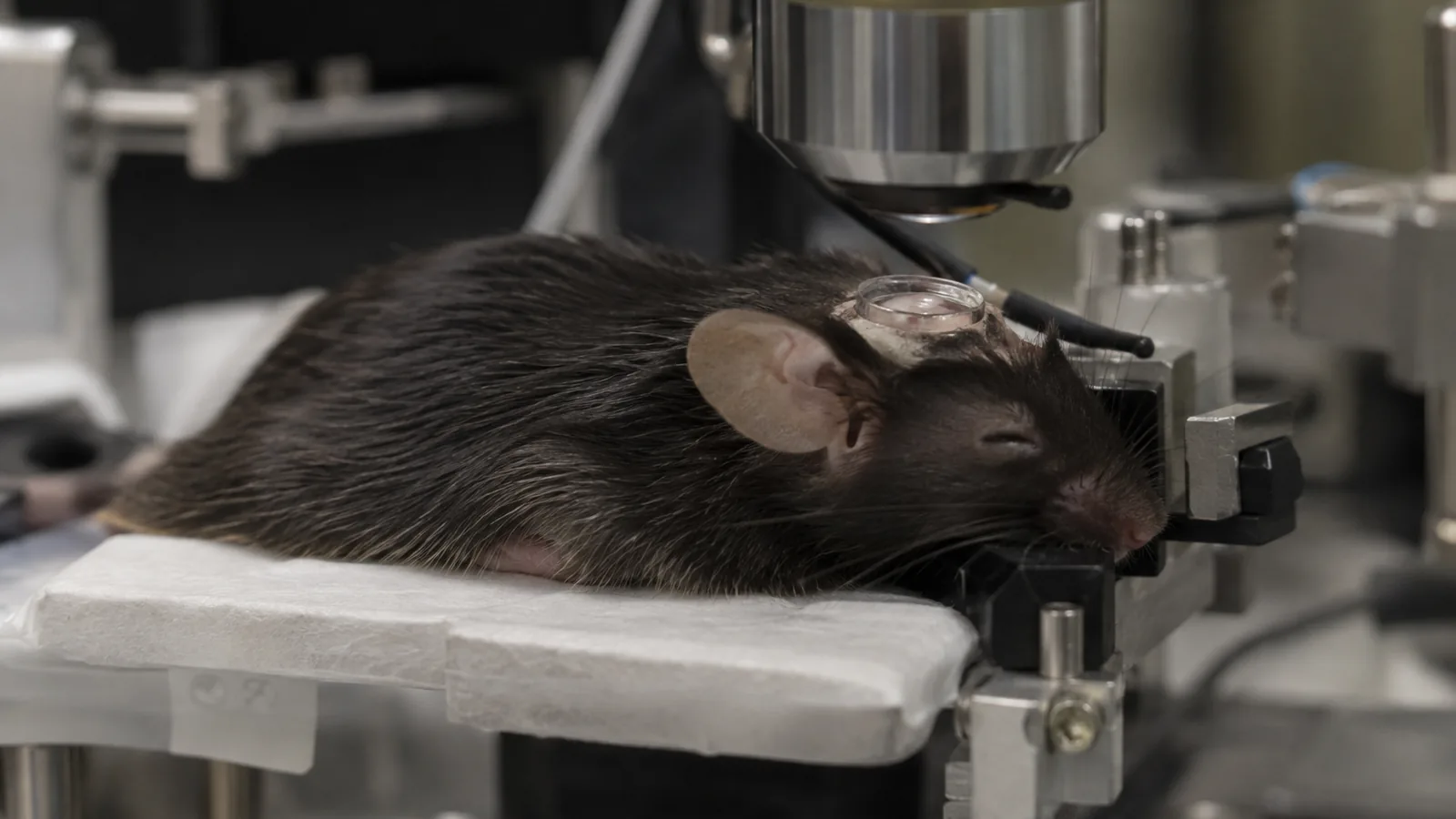
The study, published in Communications Biology on July 27, 2026 by Yusuke Takahashi, Yoko Ikoma, and Ko Matsui, pulled this off with a clever trick. They kept the skulls of live mice optically clear with a UV-curable resin, then used wide-field fluorescence imaging to watch three things at once through that transparent window: blood volume standing in for fuel delivery, neuronal ATP for the energy in the neurons’ pockets, and pyruvate inside astrocytes for the raw material being handed over. The mice carried fluorescent sensors that brighten and dim with those molecules, so the team read relative shifts in a living brain’s metabolism as they happened instead of inferring them after the fact.
And the astrocytes are where I got stuck, in the best way. Astrocytes are the brain’s support cells, and one of their jobs is to take in glucose and pass fuel to neurons. During REM their pyruvate went up right alongside the extra blood. So the pantry was fuller, the delivery truck had arrived, and the neurons still ran low. Wait, why would more raw fuel show up and less usable energy come out the other end? Supply, transfer, production, and consumption are four separate steps, and they do not have to move together. You can pour more flour into a kitchen and still finish fewer loaves if the ovens are already running flat out. The researchers read it much the same way: the ingredients were not the limit, the neurons were simply burning through what they made faster than it could be topped up.
So what are the neurons spending it on? The team floats a few possibilities. One is memory: some evidence links REM with abstracting and reorganizing memories rather than just replaying them, work that treats dreaming as the brain reshaping what it learned, and rewiring synapses is metabolically expensive. Another is the sheer traffic of REM, the hippocampus and cortex talking hard, whole circuits flipping state. A third points back at the astrocytes, hinting that the fuel handoff from support cell to neuron itself shifts during dreaming. Matsui’s own framing in the Tohoku announcement, asking whether you have ever felt exhausted after a vivid dream, might be less poetry than it sounds. The dreaming brain may be doing hard, hungry work while you lie there perfectly still.
Now the skeptic in me needs a turn, because the headlines are already outrunning the data. This is 15 male mice, with just three of them across nine trials carrying the extra experiment that confirmed the blood-flow timing, so the effect holds in this dataset but the dataset is small and all-male. The imaging captures relative changes, not absolute ATP, which means nobody has measured how much energy a dream actually costs in any real unit. The researchers also did not track oxygen or lactate directly, the two things you would want before calling the metabolic ledger closed. And it is a mouse cortex. The jump from ATP dipping in a mouse during REM to “this is why your dreams leave you wrecked” is a long one, and the press cycle cleared it in a single hop.
The money is worth a plain look too. Most of it came from Japan’s public science agency, the JSPS, which is what you want to see behind curiosity-driven basic work. Some came from foundations tied to pharma names, Takeda and Daiichi Sankyo among them. There is no drug and no product anywhere in this study, and the paper does not spell out author conflicts one way or the other, so I am not going to invent a scandal the evidence does not show. Still, you deserve to see who paid for the picture you are being shown.
What I keep circling is that REM has been a metabolic riddle for decades, the stage where the brain looks awake on every readout while the body lies paralyzed. This work does not solve it, but it reframes the question in a way I find useful. Energy in the brain is not one pool sloshing around evenly. It is routed, staged, and spent on demand, and REM is the moment when the routing gets strange enough to catch on camera.
So where do I land, knowing this is still mice under a microscope and not a prescription for me? I have quietly stopped reading a groggy morning after a big dream night as a sign that something went wrong. If a brain spends those hours burning fuel to file the day away, I would rather not picture mine as broken for doing it. I am not about to set an alarm to clip my own REM on the strength of 15 mice, and I would tell a friend chasing an optimized sleep score the same thing: let the expensive work finish.
Sources
- Communications Biology: Takahashi, Ikoma & Matsui, “Energy paradox in REM sleep: balancing supply and consumption in brain metabolism” (2026)
- Tohoku University: “Dreams Drain Energy: The REM Sleep Paradox” (press release)
- ScienceDaily: “REM sleep paradox: Dreaming may drain the brain’s energy even as fuel supply rises”
- PsyPost: “Scientists uncover an energy paradox in the brain during REM sleep” (mouse count, method, stated limitations)
- Brain Sciences: “The Persistent Paradox of Rapid Eye Movement Sleep (REMS)” (2024)
- The Journal of Neuroscience: “Dreaming outside the Box: Evidence for Memory Abstraction in REM Sleep” (2023)