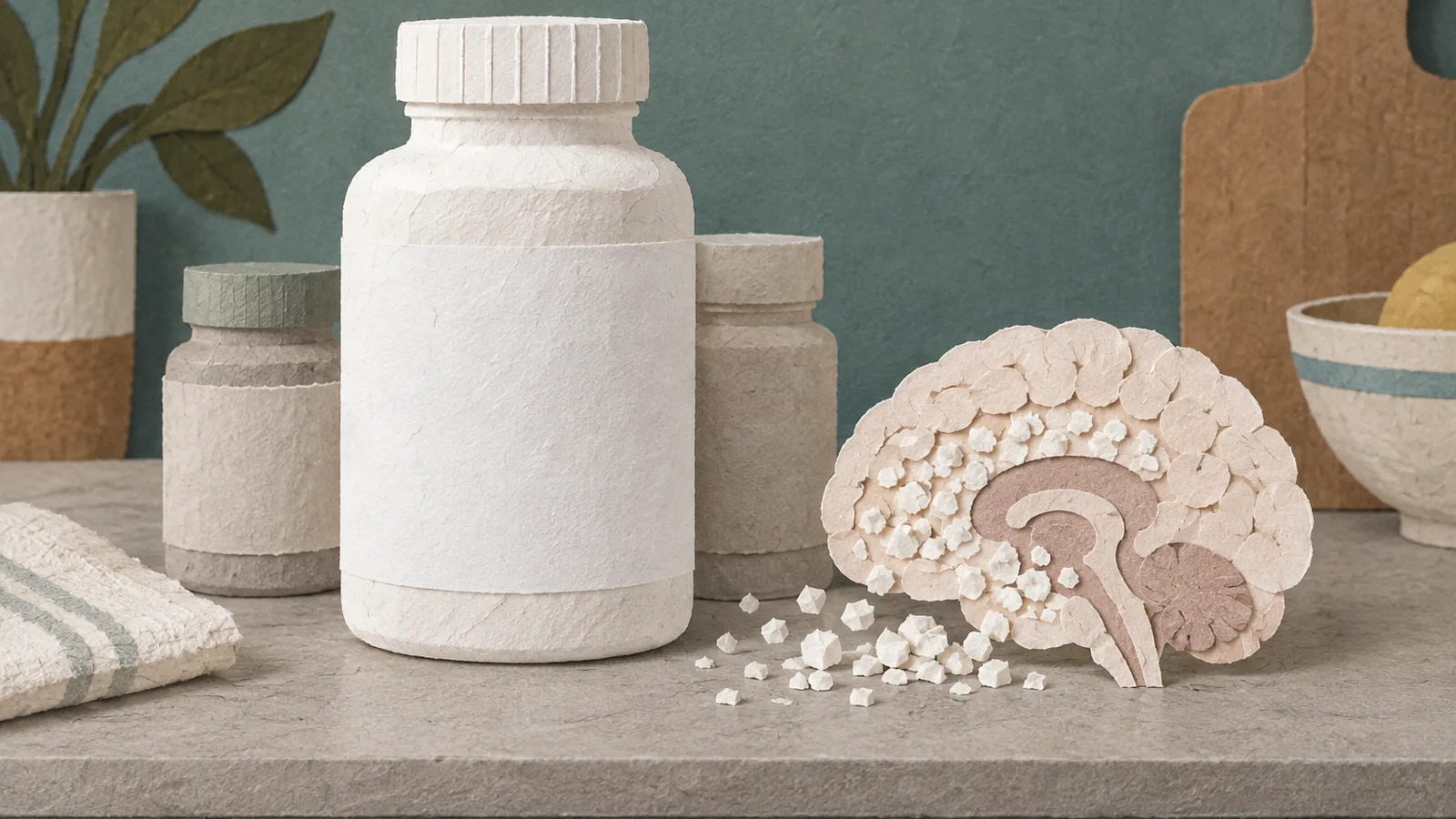
There is a white plastic bottle of glucosamine in my father’s kitchen, wedged between the fish oil and a multivitamin, and for years the worst thing I figured it could do was nothing. That was the deal I thought I understood with joint supplements: maybe your knees loosen up a little, maybe they don’t, and either way it is expensive sugar. Then a University of Florida team went looking, and the worst case turned out to be worse than nothing.
Published in Nature Metabolism, the analysis used artificial intelligence to comb deidentified UF Health records from 2012 to 2024. Among 2,750 patients with mild cognitive impairment, the ones taking glucosamine were 25 percent more likely to tip over into dementia. Among 1,896 with an established dementia diagnosis, it tracked with a 25 percent higher mortality risk. About 8 percent of patients in each group reported taking it. And the chemistry it feeds is the one an entire wing of Alzheimer’s drug research spent years trying to crank up on purpose, certain it would protect the brain.
| Measure | Share |
|---|---|
| of patients reported glucosamine | 8 percent |
Your first instinct should be the one I had: this is exactly the kind of correlation that lies to your face. People who reach for glucosamine skew older, stiffer, heavier, less able to get up and move, and any of that can drag cognition down on its own. A records study cannot fully separate the pill from the person taking it, and the authors say so. So why did this one not get filed under noise? Because the same team did not stop at the spreadsheet. They went into brain tissue and mice.
Glucosamine does not just sit in your joints. Swallow it and a good share pours into the hexosamine pathway, a little cellular assembly line that builds a molecule called UDP-GlcNAc. That molecule is the raw material for a sugar tag, O-GlcNAc, that your cells clip onto thousands of proteins to flip their behavior on and off. Tau is one of those proteins, and O-GlcNAc competes for the same landing sites on tau that phosphate wants, which matters because it is phosphate-loaded tau that clumps into the tangles of Alzheimer’s. More sugar tag, less toxic tau. On paper it reads like a defense.
So the field chased it. Feed the brain more O-GlcNAc and you should starve the tangles, the thinking went, and in tau-and-amyloid mice a drug that did exactly that blocked cognitive decline and shrank plaques. Pharma noticed. Eli Lilly, Merck, Biogen and others built OGA inhibitors, drugs whose entire job is to raise O-GlcNAc, and pushed them toward the clinic.
Then why would glucosamine, which nudges that same dial the same direction, line up with people getting worse faster? I kept turning that over, because it should not work that way. The Florida team’s answer flips the drug thesis on its head: in the Alzheimer’s brain, they argue, the tagging machine is not sluggish and underfed. It is already jammed in overdrive. “The Alzheimer’s brain is adding too many of these sugar structures, and this seems to contribute to the disease,” said Matt Gentry, who chairs UF’s biochemistry department. Pour more fuel into an already-flooded engine and you do not help it run.
And the humans had already told us something. Lilly’s OGA inhibitor, ceperognastat, made it all the way to a Phase 2 trial in 327 people with early Alzheimer’s. Patients on the higher dose declined faster than the ones on placebo, across almost every cognitive measure, with more serious side effects. Lilly cut the drug from its pipeline. The one time the protective thesis got a real test inside human brains, raising this pathway did not save them. It tracked with the opposite. Two independent human signals, a failed drug and a records study of a supplement, now point the same unwelcome way.
There is also a public-trust problem sitting under the biology. Because glucosamine is a supplement, nobody had to prove it was safe, or that it even worked, before putting it on the shelf next to the vitamins. And it may not do much: the big NIH-funded GAIT trial found glucosamine no better than placebo for knee arthritis pain overall. So we have a pill of thin benefit, sold without a safety bar, quietly working the exact biology that pharma has poured a fortune and years of trials into moving, with none of the post-market safety surveillance a real drug carries. “Natural” never meant “inert.” This is what the gap between those two words can look like.
So here is what I am doing with it, which is not pretending one health system’s records and a rack of mouse brains settle the question for everyone. They don’t. But my father has memory complaints and a bottle of glucosamine on the counter, and until somebody runs the trial that would actually test this in people like him, that bottle is going to the back of the cabinet. His knees, honestly, were never getting much out of it anyway.
Sources
- Nature Metabolism: glucosamine and dementia progression (2026)
- UF Health: joint supplement linked to accelerating dementia
- ScienceDaily: glucosamine linked to faster Alzheimer’s progression
- Synaptic toxicity of OGA inhibitors and the failure of ceperognastat
- Eli Lilly cuts ceperognastat from its pipeline
- The emerging link between O-GlcNAc and Alzheimer disease
- OGA inhibition prevents cognitive decline and plaques in tau/APP mice
- NEJM: glucosamine and chondroitin for knee osteoarthritis (GAIT)