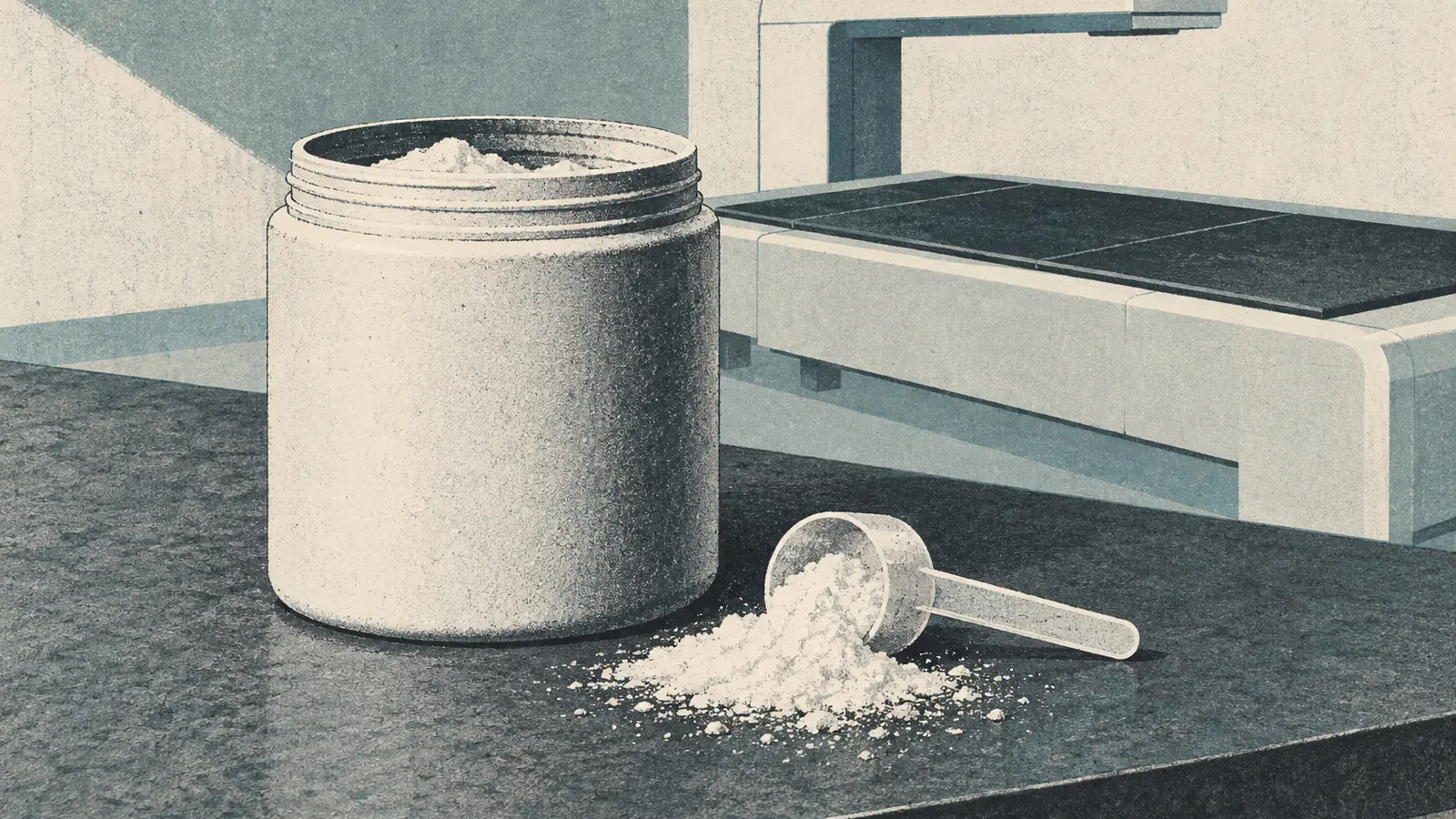
I keep a tub of creatine on the kitchen counter, next to the coffee. It is one of the few supplements I have ever trusted, which is why a headline this month made me set the scoop down and go find the actual paper.
The headline said creatine builds muscle without exercise. It came out of a 12-week trial at Texas A&M, where 64 healthy adults between the ages of 45 and 65 took either 10 grams of creatine a day or a placebo. The group that took creatine and followed no structured exercise program still gained about 2.4 pounds of lean tissue by the end, measured by a DXA scanner, according to the university. To a lot of people over 45 who dread the gym, that reads like permission to skip it.
I wanted it to be true. I am in that age bracket, I lift when I can, and the idea of holding onto muscle without a program is appealing to me. So I did what I do with every result that flatters a supplement I already like: I asked how they measured it.
DXA is an X-ray scan that sorts your body into three buckets, bone, fat, and lean mass. It cannot tell muscle protein apart from water. Anything that is not bone or fat gets filed under lean, and water lands there too. Creatine’s whole job inside a muscle cell is to drag water in alongside it. It is an osmolyte, so more creatine in the cell means more fluid in the cell. Give someone creatine, scan them, and the lean-mass number climbs partly because the muscle is holding more water, not because new protein has been laid down.
This is not a fringe objection. In a 2023 study of collegiate dancers, creatine raised both total body water and DXA lean mass, and the authors wrote that the lean-mass gain was “likely attributed to increases in TBW due to the inclusion of body fluids in the LM measurements for DXA”. In other words, the scanner saw water and recorded muscle.
Which brings me to who ran the Texas A&M trial. It was led by Richard Kreider, who directs the exercise and sport nutrition lab there and helped found the International Society of Sports Nutrition. The paper appeared in that same society’s journal, and its disclosures note that Kreider has worked with the supplement industry and received creatine from manufacturers for his research. None of that is hidden, and none of it makes the raw data false. It does mean the person most invested in creatine’s reputation designed the study, chose the measurement that favors it, and published the result in a venue he is bound to.
There is a part of the trial I find more convincing than the muscle number. The creatine groups also got stronger, and strength is harder to counterfeit with water weight. The likely reason is energy rather than bulk: creatine helps regenerate ATP, the fuel a cell spends on every contraction, so a well-stocked muscle can do a little more work before it quits. That mechanism is plausible and heavily studied, though this trial shows the pattern, not the proof.
One more detail the headlines skipped. Participants were not randomly sorted into the exercise and no-exercise arms. They chose which program to join, and only the creatine-versus-placebo assignment was randomized. People who opt out of a workout tend to differ from people who opt in, in ways a study cannot fully account for, which makes it hard to credit the creatine alone.
So the tub stays on my counter. I take creatine for the strength and the steadiness it seems to lend my training, and that evidence is solid enough for me. What I will not do is grade its worth by a DXA lean-mass reading, or let a number that counts water as muscle argue me out of the gym. If I want muscle, I still have to earn it. Creatine just helps me show up for the work.