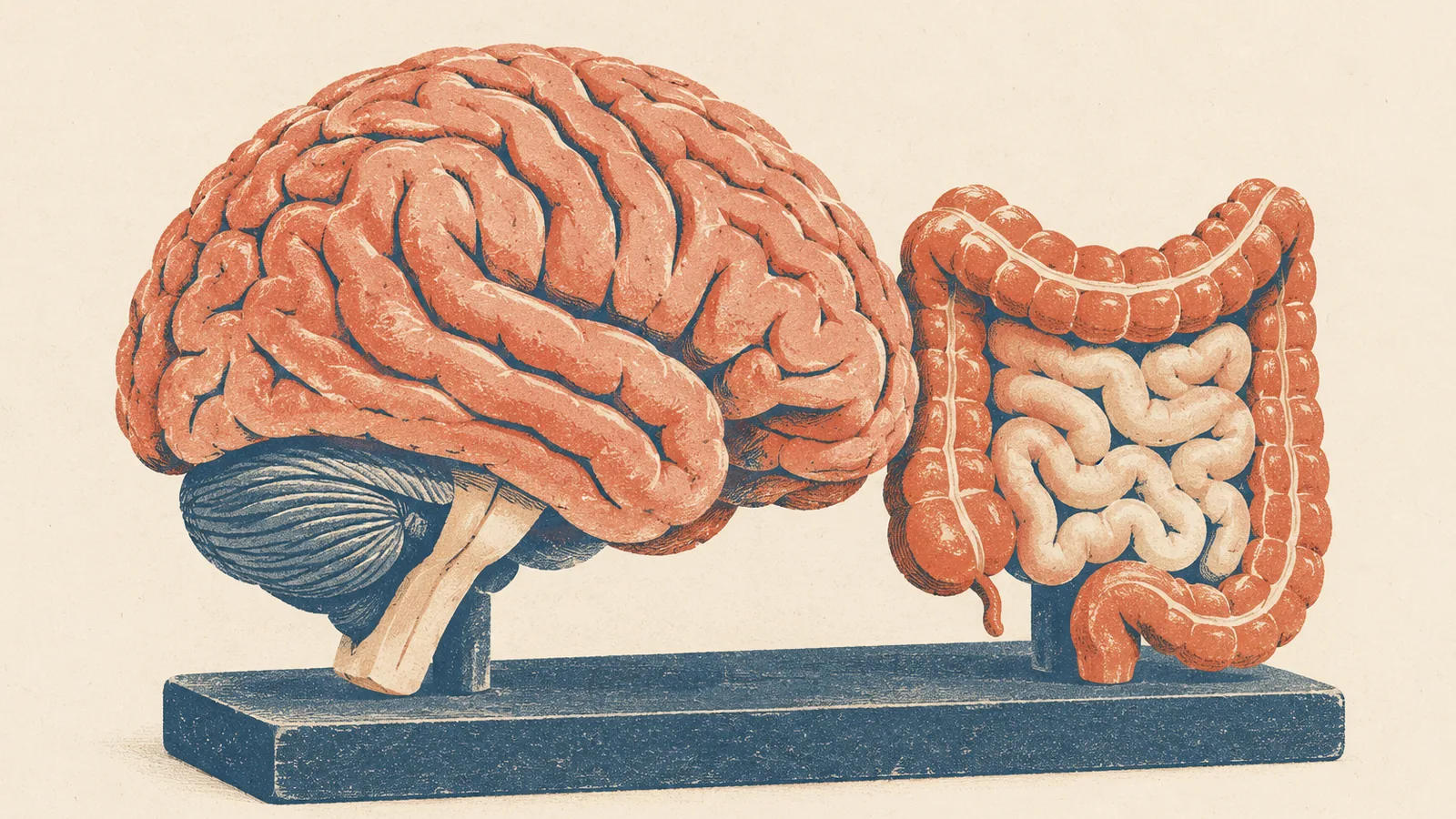
I had imidazole propionate filed under diabetes, and I’d left it there. That’s where I first ran into it, and where most researchers did too: a compound certain gut bacteria churn out, found at stubbornly high levels in people with type 2 diabetes, where it gums up insulin signaling. So I did a double take when the same molecule showed up in an Alzheimer’s study, tracking with the brain-protein warning signs and with faster memory decline in people whose memory had been fine when the study began.
The 2026 paper, from a UW-Madison team led by Barbara Bendlin and Federico Rey and published in Nature Communications, measured ImP (their shorthand) in the blood of 1,196 cognitively unimpaired adults from the Wisconsin Registry for Alzheimer’s Prevention and the Wisconsin Alzheimer’s Disease Research Center. People with the most ImP were much more likely to show markers of abnormal proteins and struggling neurons, the biology that comes years before a diagnosis. When the team followed the same people through repeated cognitive testing, the ones with the highest levels declined fastest.
I’d assumed, lazily, that anything with that kind of reach must come from somewhere exotic. It comes from dinner. Gut bacteria make ImP while they burn histidine for energy, an amino acid you need and get from food, especially protein-rich food. “You need histidine, and it’s all over the place,” Bendlin said. The microbes doing the work are bit players, too. “ImP-producing bacteria are present in a large fraction of people, but they’re not very abundant in most people,” Rey said. A minor tenant in the gut, with a footprint that may run all the way to the brain.
So how does a by-product of digestion get anywhere near a neuron? The brain is supposed to be walled off. According to the paper’s abstract, ImP weakened that wall in their experiments, damaging the endothelial barrier that lines the brain’s blood vessels. Mice given ImP over a long stretch developed worse Alzheimer’s-like pathology, with more of the beta-amyloid and tau clumps that define the disease. In isolated neurons, ImP pushed tau into its hyperphosphorylated, clump-prone form, and that effect disappeared when the researchers blocked a single enzyme, GSK-3β. That’s when the question that had been nagging me changed from “is this a coincidence?” to “wait, they found the switch?” They found a lever and pulled it.
Then came the genetics. A genome-wide analysis turned up a stretch of chromosome 12 linked both to blood ImP and to Alzheimer’s risk. The variation, carried by about 43 percent of the people in the study, went with substantially higher ImP, and the researchers suspect it changes how well the kidneys clear the molecule. Rey noted that the same variation had already surfaced in large genetic studies of Alzheimer’s risk. If something you inherit raises a molecule and also tracks with the disease, the molecule starts to look less like a bystander and more like a participant. That is the authors’ case for causation, and it’s a good one. It’s still a case, though, not proof: in people, everything here is correlation, the causal work was done in mice and in dishes of neurons, and nobody has lowered ImP in a human being and watched what happens to their memory.
| Measure | Share |
|---|---|
| of study participants | 43 percent |
What keeps me from shrugging this off is the molecule’s track record. Back in 2018, Fredrik Bäckhed’s group in Gothenburg reported in Cell that ImP runs higher in people with type 2 diabetes, interferes with insulin signaling, and worsens glucose tolerance when given to mice. In 2025, a team at Madrid’s CNIC showed in Nature that ImP tracked with the extent of atherosclerosis in two independent human cohorts. In mice, ImP alone was enough to cause artery disease without changing their lipid profile, and blocking the receptor it acts through stopped the damage. Bäckhed is an author on all three papers. One gut-made compound now runs through three of the conditions that most define how Americans age badly. I don’t think “metabolic health” and “brain health” were ever separate accounts.
- 2018tied to type 2 diabetes
- 2025drives artery disease in mice
- 2026tracks with Alzheimer's biomarkers and decline
Which is why the first instinct on display made me raise an eyebrow. Bendlin’s stated hope is a drug: “If we can find an inhibitor that can help decrease the levels of ImP in the blood,” she said, likening it to how statins lower cholesterol. I understand the appeal. But think about what’s being proposed: a molecule your own gut makes from ordinary food, with levels set by your microbes, your kidneys and your genes, gets answered with a lifelong pill on the statin model. And remember that in those mice, ImP clogged arteries with cholesterol unchanged, an awkward detail to set beside a statin comparison. The level isn’t fixed. It depends on which bugs are doing the histidine chemistry and how well your body clears what they make. Bendlin said the quieter, less patentable part out loud too: “Generally improving your diet would probably help.”
My own conclusion follows. I’m not cutting protein, because you can’t dodge histidine and shouldn’t try. I’m not going to wait for an ImP blocker that may never reach a pharmacy. My call, and it’s mine, not something this study tested, is to change the ecosystem instead: more fiber and fermented foods, on the bet that a different microbial crowd does different chemistry with the same histidine, plus closer attention to the two things this molecule keeps showing up around, my blood sugar and my kidney function. If my gut is writing notes to my future brain, I’m changing what it eats now instead of waiting thirty years for a pill to intercept the message.
Sources
- Vemuganti et al., Nature Communications (2026): “Gut bacterial metabolite imidazole propionate potentiates Alzheimer’s disease pathology”
- ScienceDaily, Oct 3, 2026: “Your gut may be making a molecule that raises Alzheimer’s risk”
- UW School of Medicine and Public Health: “Gut compound identified as next target for reducing Alzheimer’s risk”
- Technology Networks: “Gut Bacterial Compound Linked to Alzheimer’s Risk”
- Koh et al., Cell (2018): “Microbially Produced Imidazole Propionate Impairs Insulin Signaling through mTORC1”
- Mastrangelo et al., Nature (2025): “Imidazole propionate is a driver and therapeutic target in atherosclerosis”