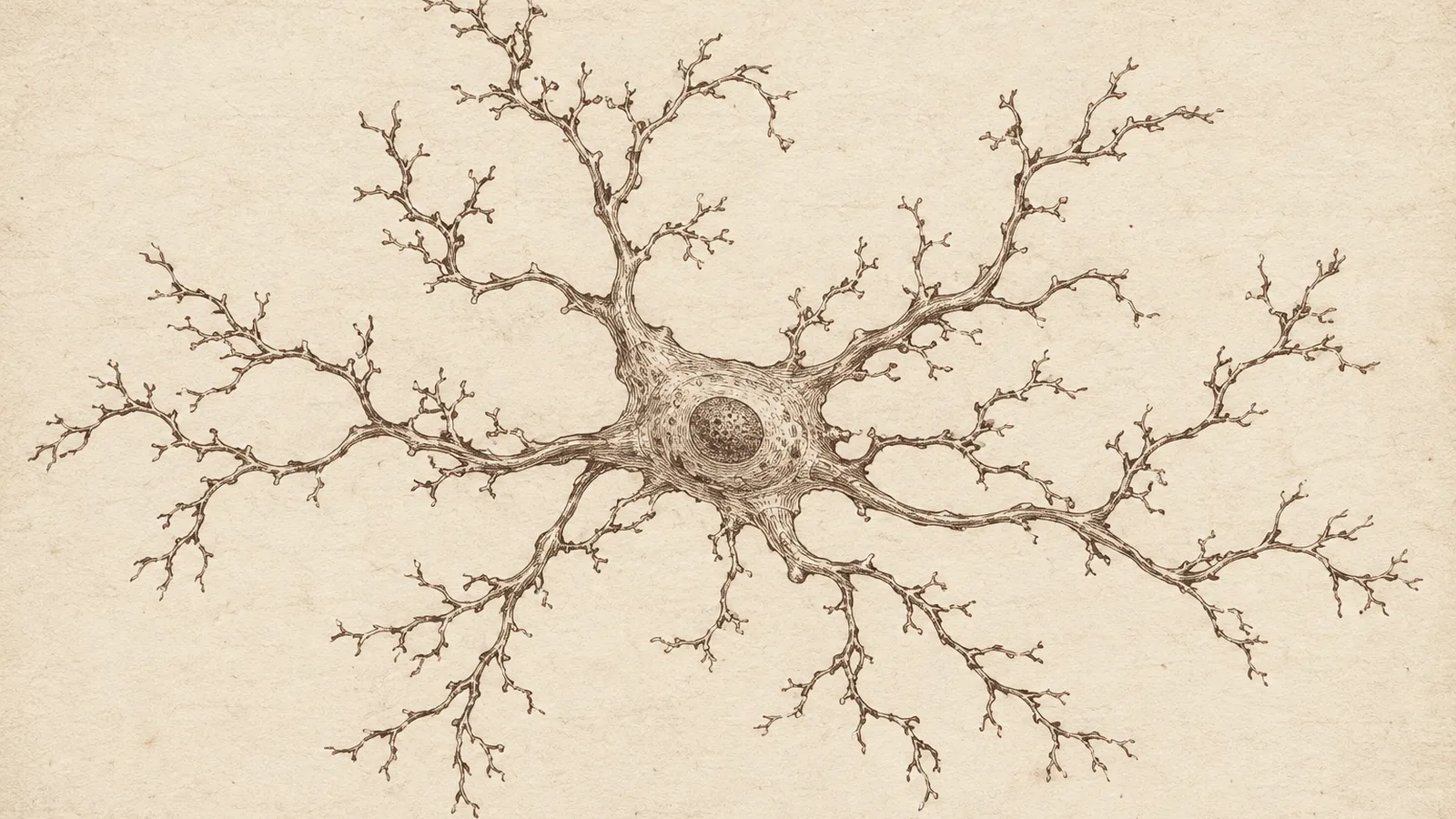
Professor Nicholas Barnes and his team at the University of Birmingham went after a problem most brain researchers quietly work around. Human microglia, the brain’s resident immune cells, make terrible lab subjects, because once they leave the skull, as Barnes put it, they “rapidly lose their defining characteristics.” So the team grew microglia-like cells from monocytes taken from ordinary blood samples, which Barnes calls a “powerful, scalable and virtually unlimited platform” for studying the brain’s immune system, and then checked their findings against slices of living human brain removed during neurosurgery.
The dish said yes. The patients, so far, have said no.
The result, published in Brain under the title “P2X7 receptor-mediated IL-1β release by human brain tissue,” is tidy. Provoke the tissue and it releases IL-1β, one of the inflammatory cytokines at the center of the brain’s alarm system, and a receptor called P2X7 drives that release. Block the receptor with a specific antagonist and the inflammatory response drops significantly. For anyone tired of mouse brains standing in for human ones, a human-tissue method that reproduces the result in surgical tissue is a useful piece of work.
By the time it reached the public it had grown. The ScienceDaily writeup ran under the headline “Drug target could block brain inflammation linked to Alzheimer’s and Parkinson’s,” with traumatic brain injury added further down. Barnes called the finding “a major step toward repurposing existing therapeutics” and said the next stage “is the development of clinical trials” in neurodegenerative disease and brain injury. In this study, nobody gave anything to a patient or to an animal. The coverage also never names the antagonist that quieted the tissue or says how many surgical patients supplied it, and that leaves a reader taking a lot on trust from a press release that has already picked out the diseases.
“Existing therapeutics” is an interesting phrase for this receptor, because the existing therapeutics have a track record. AstraZeneca took its P2X7 blocker, AZD9056, into rheumatoid arthritis, and the first look was the kind of result a business-development team frames on the wall: in a 75-patient phase IIa study, 65 percent of patients on the top dose reached the standard ACR20 improvement mark, against 27 percent on placebo. Then the company ran the bigger trial. In the phase IIb study, 383 patients were treated for six months across four doses, with placebo and an open-label etanercept arm alongside, and AZD9056 at every dose had “no clinically or statistically significant effect” relative to placebo. The authors, AstraZeneca’s own people among them, concluded that the receptor “does not appear to be a therapeutically useful target in RA.”
| Group | Value (percent) |
|---|---|
| AstraZeneca drug, top dose | 65 |
| Placebo | 27 |
Pfizer’s attempt was shorter and blunter. Its antagonist, CE-224,535, went to 100 rheumatoid arthritis patients already on methotrexate, and after 12 weeks 34.0 percent of those on the drug had reached ACR20 compared with 36.2 percent on placebo. The sugar pill came out slightly ahead. AZD9056 was also tried in Crohn’s disease, and a phase IIa trial judged it ineffective. Johnson & Johnson’s JNJ-54175446, a brain-penetrant blocker, was tested in major depression, where, according to a 2025 review of the field, its effect on mood “remains inconclusive.” The same review sums up the record: several P2X7 antagonists “have been tested, and all have failed to prove efficacy in clinical trials.”
The dish said yes. The patients, so far, have said no.
The review’s explanation for the gap applies directly to this week’s paper. The gene behind the receptor, P2RX7, carries “the highest degree of genetic variation” in its receptor family, and many of those variants show population-specific frequencies that, the authors write, complicate “uniform therapeutic efficacy.” On top of that come “species-specific differences in pharmacology and binding sites,” which is why a compound that looks commanding in a rodent can lose its grip in a person. A human-tissue platform does deal with the species problem, and that’s to its credit. It doesn’t touch the variation problem. The receptor’s response can change from one person to the next, so tissue from an unreported number of neurosurgical patients can’t say much about the next thousand. The trade coverage concedes the rest of the unanswered list: whether these compounds are selective enough, whether they cross the blood-brain barrier at useful concentrations, and whether turning down this alarm spares the protective inflammation the brain also needs.
To be fair to the Birmingham group, none of those failed trials was in a brain disease, and the brain is the one territory where P2X7 blockade hasn’t had its day in the clinic. But a target that has already gone through two large drugmakers without beating placebo needs more than a cytokine drop in a slice of surgical tissue to justify the word “repurposing.” Barnes has built a better instrument for asking whether these drugs can work in people. The last time anyone asked properly, it was AstraZeneca, with 383 patients, and the answer is still on file in the Annals of the Rheumatic Diseases.
Sources
- Cowley et al., Brain (2026)
- Keystone et al., Annals of the Rheumatic Diseases (2012)
- Stock et al., Journal of Rheumatology (2012)
- Cheah et al., International Journal of Molecular Sciences (2025)
- Drug Target Review, University of Birmingham study coverage with Barnes quotes
- ScienceDaily, “Drug target could block brain inflammation linked to Alzheimer’s and Parkinson’s”