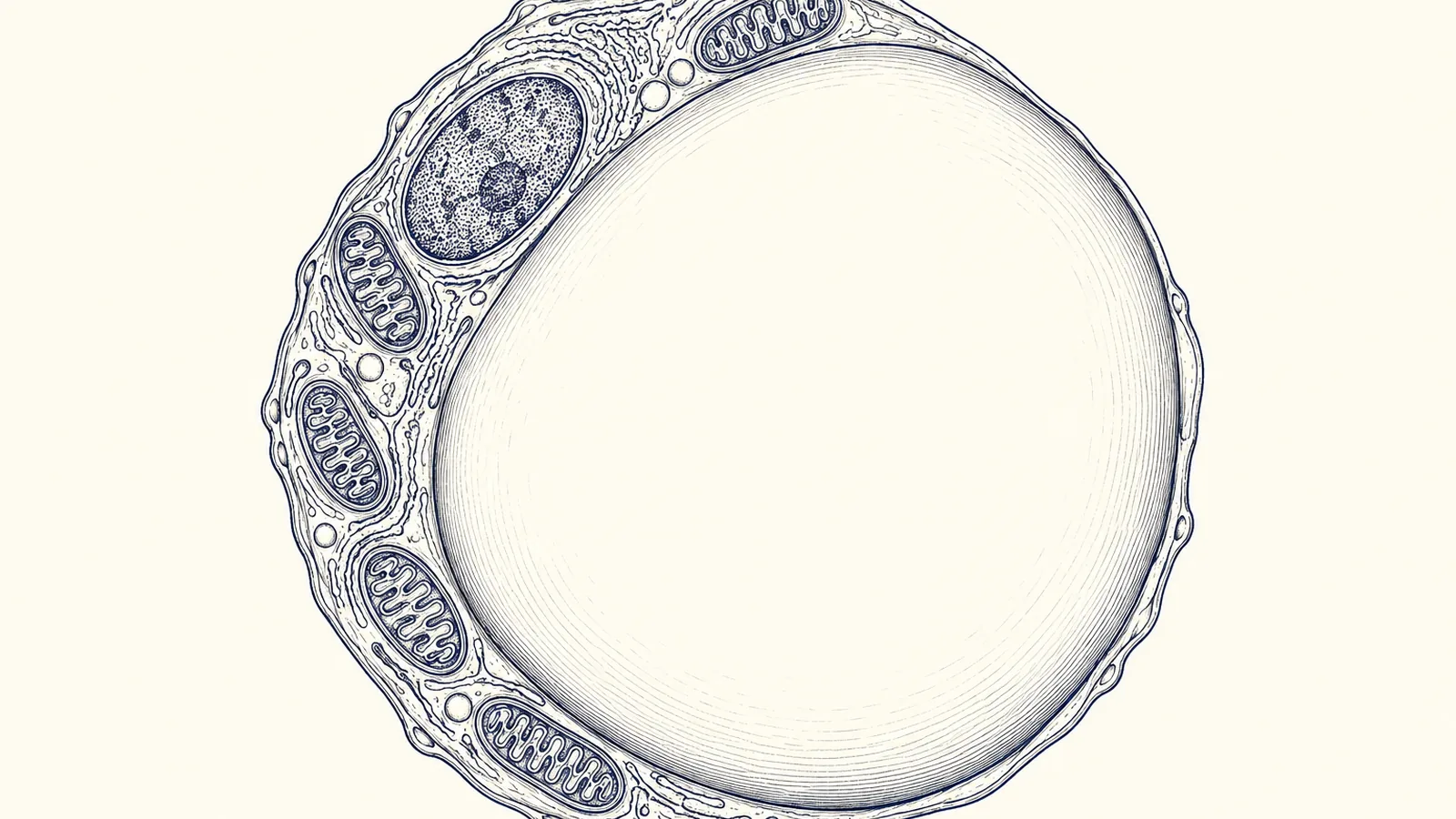
I clicked on a headline about a “hidden switch that burns fat and blocks new fat cells” expecting another vague, supplement-adjacent promise. What I found was a cleaner experiment than that: delete one mitochondrial protein, and precursor cells that would normally mature into fat cells mostly don’t. Then I checked whose cells they were. The fuel-burning measurements came from HeLa, a cervical cancer line, and the fat-cell work used a line derived from mice. The most persuasive animal study behind ScienceDaily’s October 24 write-up was paid for by a company that is already pushing its own obesity drug through trials.
The protein is MTCH2, which Atan Gross’s lab at the Weizmann Institute of Science has nicknamed “Mitch.” It sits on the outer membrane of your mitochondria, the small furnaces inside nearly every cell. “We showed that Mitch determines the fate of fat in human cells,” Gross said when ScienceDaily first ran the story on July 2. The paper behind that line went online in The EMBO Journal on January 3, 2025, and ScienceDaily has now presented it as a discovery twice in four months.
Too busy burning to build
Lead author Sabita Chourasia and colleagues deleted MTCH2 and sampled more than 100 metabolic substances every few hours. Without Mitch the cells ran hot, with their demand for ATP (the cell’s energy currency) climbing and their mitochondria working harder. “We discovered that deleting Mitch led to a major drop in fats in membranes,” Gross said. In the differentiation experiment, about 80 to 90 percent of normal precursor cells matured into fat cells within six days, compared with only about 5 to 10 percent of cells lacking MTCH2, which also built far fewer of the lipid droplets where fat gets stored.
I’d always filed fat under surplus, the stuff that piles up when there’s energy to spare. So why would a cell burning more fuel fail to become a fat cell? Because storing fat and becoming a fat cell are different jobs. A precursor turning into a mature fat cell has to build new membranes and a whole lipid-droplet storage system, and that construction costs energy. The authors describe MTCH2 loss as creating a catabolic, oxidative environment that can’t support the anabolic work of differentiation. The cell is too busy burning to build.
Now the cells. The metabolic measurements were made in HeLa, and the differentiation experiment used NIH3T3-L1 preadipocytes, a mouse-derived line. Even ScienceDaily’s October write-up concedes that the results don’t show blocking the protein would prevent fat cell formation in people.
The doorman at the furnace
The stronger evidence is in a Nature Communications paper published October 3, 2025, from Christian Wolfrum’s group at ETH Zurich with Gross and Chourasia as coauthors. This team switched MTCH2 off only in the fat cells of adult mice, using tamoxifen at seven to nine weeks of age. On ordinary chow the knockouts burned more energy than controls while eating and moving the same amount, and their respiratory exchange ratio dropped, a sign their bodies had shifted toward burning fat. On a high-fat diet they gained less weight on similar food. After 13 weeks on that diet they carried less fat mass with about the same lean mass, and after 12 weeks they cleared a glucose challenge better. Plasma cholesterol fell while triglycerides didn’t budge. The extra burning didn’t need UCP1, the classic heat-making protein of brown fat, either: in brown fat cells grown in a dish, respiration stayed high when UCP1 was knocked down too.
The mechanism is wonderfully physical. Long-chain fatty acids can’t just drift into a mitochondrion; they have to get past CPT1, part of the import machinery, which works like a doorman at the furnace. After you eat, a molecule called malonyl-CoA tells the doorman to shut the door so fat heads to storage instead. Without MTCH2, CPT1 went partly deaf to that signal and fatty acids kept pouring in to be burned, even though the amounts of CPT1 and malonyl-CoA themselves never changed. The team found MTCH2 sitting right beside CPT1 in fat cells and coming out attached to it in a separate cell line. The paper calls this a direct physical interaction, though those assays show closeness and association rather than proof of direct binding.
I understand the appeal. Today’s blockbuster obesity drugs mostly work by making people eat less, and these mice ate the same and burned more, which puts the lever on the other side of the equation. The Zurich team also took human fat cells into the dish, running its screen and knockdown work in hMADS cells, stem cells taken from a 4-month-old boy’s fat tissue and grown into fat cells. That’s closer to a person than HeLa. It’s still a lab line from an infant donor, not fat from an adult with obesity.
Then there’s the muscle puzzle. In 2016 the Gross lab reported in Cell Reports that mice lacking MTCH2 in muscle also resisted diet-induced obesity, with higher energy expenditure, more endurance and better heart function, but their bodies showed a preference for carbohydrate. Strip the same protein from fat and the cells lean on fat. Why would one protein push muscle toward sugar and fat tissue toward fat? The Zurich authors say the reason is unclear, and they put their disagreement with an earlier study, which deleted MTCH2 from early development, down to timing. The switch does different things depending on which tissue loses it and when, so nobody can yet predict what blocking it throughout a human body would do.
Who paid for the mice
The disclosures in the Nature Communications paper are short. The study was supported and funded by Boehringer Ingelheim, and four of its authors are full-time employees of Boehringer Ingelheim Pharma GmbH & Co. KG. Public money came in too, from EU Horizon 2020 and Slovak and Spanish grants, and the paper lays all of it out, which is to its credit.
Boehringer is already in the obesity race. Its once-weekly drug survodutide produced mean weight loss of up to 16.6 percent across its two doses, against 3.2 percent on placebo, at 76 weeks in the SYNCHRONIZE-1 trial. When a company with a horse in that race pays to characterize a brand-new obesity target, I read it as target-hunting. The paper doesn’t describe a drug program. It does hand the company a mechanism, a mouse model and a reason to keep looking.
The animal numbers are small. The high-fat-diet comparison used 17 control mice and 13 knockouts, 30 animals in all, and the energy-expenditure measurements behind the “burns more” claim used 5 and 6. Every mouse was male. Roughly half the people who would ever be offered an MTCH2 blocker are women, and these data tell us nothing about them.
The human evidence leans the same way, and all of it is correlation. Genome-wide association studies have tied MTCH2 variants to obesity and diabetes risk. In the Nature Communications cohorts, people with obesity carried more MTCH2 in both the fat under the skin and the fat around the organs, with levels tracking body fat and leptin. Among 60 young adults, more MTCH2 in fat under the skin went with lower relative oxygen consumption, and in 30 of them with a smaller calorie burn after a meal. That fits a protein acting as a brake, but it can’t tell you whether more Mitch builds more fat or more fat raises Mitch.
A drug would also have to work around Mitch’s other job. A 2026 Nature Structural & Molecular Biology paper led from the University of Cologne found that MTCH2 helps the proteins BAX and BAK assemble into the pores a damaged cell uses to kill itself, and cells without it were slower to put that machinery together. Healthy fat tissue matters too, because it stores excess energy, helps keep blood sugar steady and makes hormones; ScienceDaily’s own write-up warns that disrupting it could push fat into organs where it does harm. No human trial has shown that blocking MTCH2 produces safe, lasting weight loss.
The experiment that would change my mind is easy to name: delete MTCH2 in adult female mice and in fat cells from adult human donors with obesity, and check that the extra burn holds without loosening the cell’s self-destruct safeguards. Until someone runs it, I’m filing Mitch under beautiful biology, not under weight loss.
Sources
- Nature Communications: Wu et al., “MTCH2 modulates CPT1 activity to regulate lipid metabolism of adipocytes” (2025)
- The EMBO Journal: Chourasia et al., “MTCH2 controls energy demand and expenditure to fuel anabolism during adipogenesis” (2025)
- ScienceDaily: “Scientists discover a hidden switch that burns fat and blocks new fat cells” (October 24, 2026)
- ScienceDaily: “Scientists discover a protein switch that burns fat and blocks new fat cells” (July 2, 2026)
- Cell Reports: Buzaglo-Azriel et al., “Loss of Muscle MTCH2 Increases Whole-Body Energy Utilization and Protects from Diet-Induced Obesity” (2016)
- Nature Structural & Molecular Biology: “MTCH2 promotes BAX and BAK self-assembly and apoptotic pore growth” (2026)
- Consultant360: SYNCHRONIZE-1, survodutide weight loss versus placebo (2026)