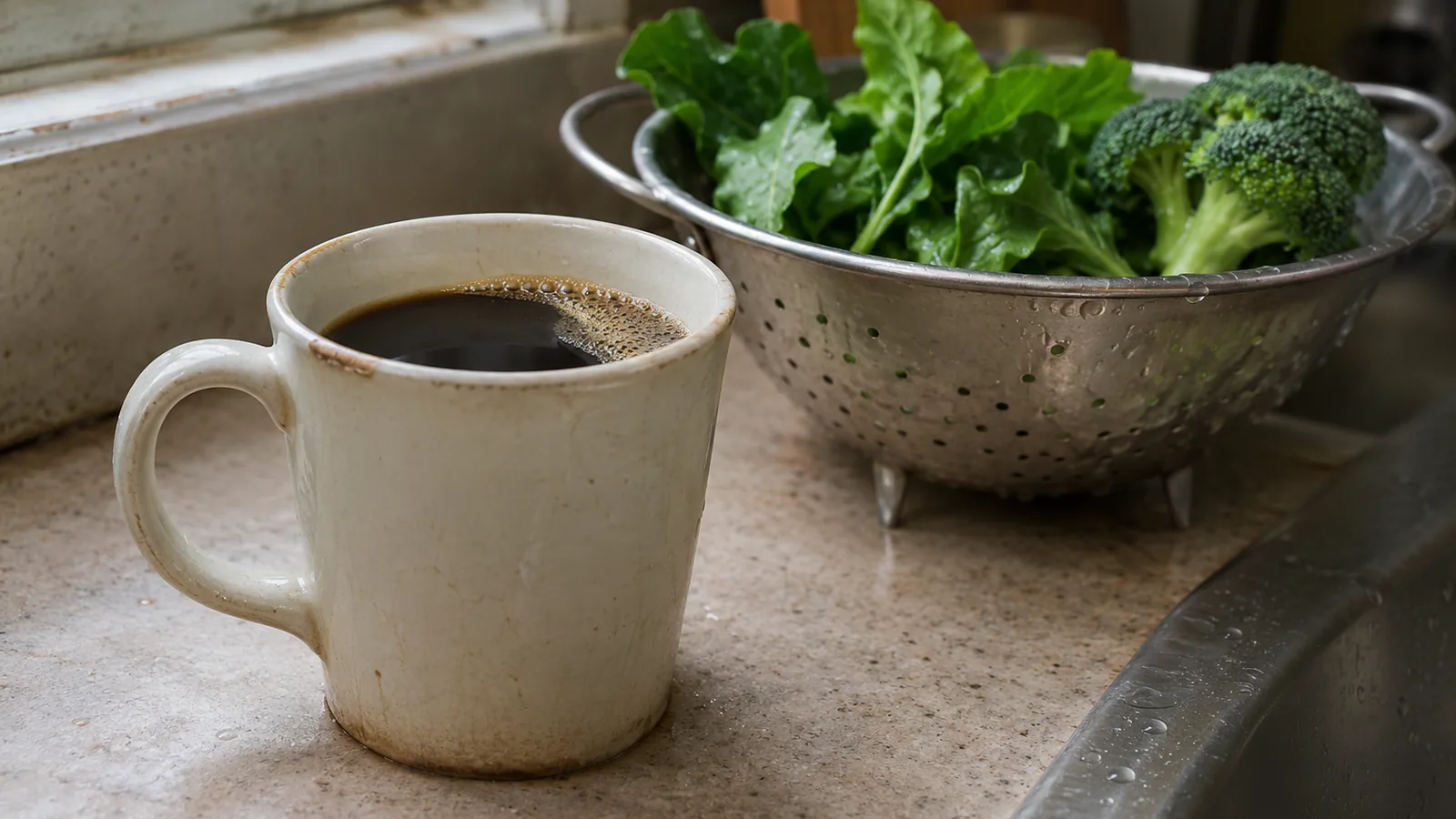
Why would bacteria that belong in your mouth turn up as markers of disease in your colon? I didn’t expect to be asking that after opening a study about coffee, vegetables and exercise, but that’s where it took me.
Across 6,803 Japanese adults, coffee lined up with vegetables, fermented foods and physical activity behind one set of butyrate-making gut microbes. Smoking, refined carbohydrates and long hours in a chair lined up behind a different set, and 26.3% of that second set were bacteria classified as oral-derived. On the healthy side the share was zero. That’s the finding of Nagata et al., Nature Medicine (2026), published November 5 by Naoyoshi Nagata and colleagues, among them Peer Bork’s group at the European Molecular Biology Laboratory.
| Measure | Share |
|---|---|
| of disease-side mediators | 26.3% |
The data come from Japan’s 4D project (Disease, Drug, Diet and Daily Life), which sequenced stool from adults aged 16 to 95 and tracked 28 lifestyle factors against general health and 15 chronic diseases, from inflammatory bowel disease and type 2 diabetes to hypertension and depression. The team ran mediation analyses, statistical tests of whether a habit’s association with a disease is partly accounted for by specific microbes. I like the sharpness of that question, and I want to be clear about its limits: a mediator here is a microbe that sits on the path in the numbers, not one proven to sit on the path in the body.
Two sides, one gut
The health side runs on butyrate makers: Faecalibacterium prausnitzii, Anaerostipes hadrus, Fusicatenibacter saccharivorans. Butyrate is a short-chain fatty acid that the cells lining your colon burn for fuel, and the team measured it instead of inferring it. In 1,713 participants with fecal data, the health-side microbes rose with short-chain fatty acids, butyrate above all, and in 1,740 people with blood work they ran opposite to inflammatory markers such as TNF-α, IL-8 and IFN-γ, according to News-Medical’s summary of the paper. Vegetables, fruit and mushrooms tracked with microbial pathways that break down plant polysaccharides, and physical activity tracked with the same butyrate makers.
The tempting reading is a chain: eat the plants, feed the butyrate makers, calm the gut wall. It’s a reasonable hypothesis, and it’s the one I reached for first, but these are correlations taken at a single point in time, and a sick gut can reshape its microbes as easily as the reverse. The authors tested for reverse mediation and dropped the links that showed it. They still say experiments are needed to establish causality.
What are mouth bacteria doing in a stool sample?
This is where the biology got strange. Of the 175 disease-side mediators, 26.3% were oral-derived and 14.3% were pathobionts, microbes that usually live quietly until conditions let them cause trouble. Among the 187 health-side mediators, both counts were zero. Refined carbohydrates, which in this cohort meant rice, bread, noodles and soda, tracked with several Streptococcus species along with Klebsiella pneumoniae, Escherichia coli and Morganella morganii, per Nagata et al., Nature Medicine (2026).
Wait, why would that happen? You swallow saliva all day, and most of what rides along is supposed to die in stomach acid or lose out to the dense community already living downstream. One explanation is that the resident community thins enough to let oral microbes hang on. That’s an explanation, not a result: stool sequencing detects DNA, it doesn’t prove those microbes are alive and settled in the colon, and this design can’t say which came first. A split that lopsided is what I’d want the next study to chase.
Sitting, defined as 9.5 hours or more a day, got its own disease-side mediators, E. coli and Ruminococcus gnavus, and one species, Gemella morbillorum, a microbe better known from the mouth, was associated with sedentary behavior and nothing else. Alcohol pulled both ways, though its disease-side mediation won out for irritable bowel syndrome, abnormal blood lipids, hypertension, high uric acid and depression.
The starter cultures didn’t carry it
Fermented foods landed on the health side, and the starter cultures themselves (Bacillus subtilis from natto, Latilactobacillus sakei from pickles, Streptococcus thermophilus from yogurt) did show up in the guts of people who ate them. They just weren’t significant mediators. Yogurt’s starter cultures correlated with 49.2% of gut species, but those species were only weakly tied to butyrate and positively tied to inflammatory cytokines, the paper reports.
What did track with benefit was resident microbes working on the food. People eating natto and miso carried more equol-producing Adlercreutzia species, which turn soy isoflavones into equol, and the authors float a postbiotic explanation: compounds made during fermentation, not the live organisms. Failing to detect mediation doesn’t prove the starter strains do nothing. It does mean this study offers no support for a probiotic label’s pitch that the live cultures are doing the good. Dairy came out mixed, too: milk and yogurt tracked with Bifidobacterium species and lactose-handling genes, yet for IBD, type 2 diabetes and depression the disease-side mediation was more prominent.
Coffee’s favorite microbe
Coffee lined up with the butyrate makers as well, and its standout was Lawsonibacter asaccharolyticus. In the Japanese data it showed the strongest positive association with any lifestyle factor in the analysis, it emerged as a potential mediator between coffee and lower odds of IBD, and among daily drinkers it correlated with 64.5% of the bacterial species analyzed. Broad correlation doesn’t tell you what a microbe does, but this one clearly doesn’t live alone.
The same bacterium headlined Manghi et al., Nature Microbiology (2024), which drew on 22,867 people in US and UK cohorts and found 4- to 8-fold more of it in heavy coffee drinkers than in non-drinkers. The association held for decaf as well as caffeinated coffee. In a separate lab experiment, as News-Medical reported, adding coffee to culture media boosted the bacterium’s growth 3.5-fold regardless of caffeine content. Caffeine looks like the wrong suspect. The likelier candidates are coffee’s polyphenols such as chlorogenic acid, which gut microbes break down into compounds including quinic acid, a metabolite that in 438 plasma samples tracked with both coffee intake and the bacterium.
across US and UK cohorts
- Lower bound
- 4
- Upper bound
- 8
Tobacco money, dairy money and a Glico employee on the byline
The study was partially supported by Japan’s medical research agency AMED, alongside the Smoking Research Foundation, a Danone research grant, the Japan Dairy Association (J-Milk), the Takeda Science Foundation and Ezaki Glico. The corresponding author disclosed a grant from Ezaki Glico, and one coauthor is a Glico employee.
The Smoking Research Foundation was created when Japan Tobacco was established and is funded by it, according to Shiga et al., Tobacco Prevention & Cessation (2024), whose authors argue such grants help the company keep influence over the medical community. Glico sells yogurt built around its Bifidobacterium BifiX strain, and its own corporate history touts the strain’s capability to produce short-chain fatty acids, the same chemistry this paper puts at the center of the healthy side.
The authors state the funders had no role in design, analysis or writing. Smoking landed on the disease side anyway, dairy came out mixed and yogurt’s own starter cultures tracked with inflammatory signals, none of which reads like a sponsor’s brochure. That still isn’t clearance. Funding bias rarely shows up as a flipped headline; it shows up in which questions get asked and which analyses get run, and no results table can rule that out. With a tobacco-funded foundation and three dairy and probiotic interests on the list, I’d want anything touching their products replicated by a group without those ties before it goes anywhere near a carton.
The rest of the fine print is short. Diet was self-reported for the preceding month, IBS came from a questionnaire rather than a diagnosis, and everyone was Japanese. A follow-up arm of 402 people with 804 samples over a median of about two years couldn’t show whether the microbial shifts shaped later disease. The team also built a stool-based score, MADE, which held up in 11 of 13 outside cohorts totaling 3,095 people and beat age, sex, BMI and lifestyle alone for 9 of 16 outcomes, though it struggled with IBS. The authors say its clinical usefulness isn’t established. If a research score validated in 13 cohorts can’t claim clinical use yet, the consumer gut reports sold online shouldn’t get to claim it either.
I’d keep drinking the coffee, decaf included, I’d get up from the chair long before the nine-and-a-half-hour mark, and I wouldn’t spend a cent on a gut-testing kit because of this paper.
Sources
- Nagata et al., Nature Medicine (2026)
- News-Medical, Coffee, vegetables and exercise share a surprising connection in your gut (2026)
- Manghi et al., Nature Microbiology (2024)
- News-Medical, Scientists uncover coffee’s surprising effect on gut microbiota (2024)
- Shiga et al., Tobacco Prevention & Cessation (2024)
- Ezaki Glico, History of Glico yogurt and the BifiX strain